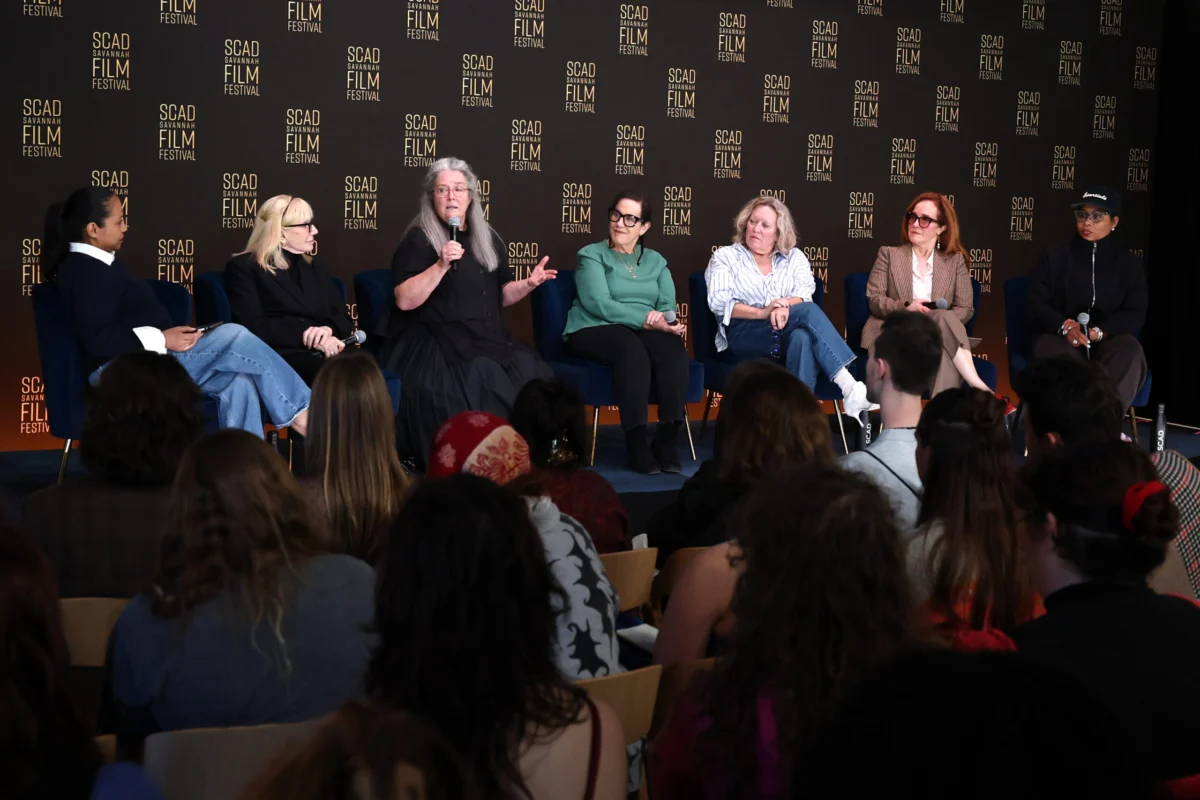
The glamorous world of cinematic costume design is frequently misunderstood as little more than a high-budget shopping spree, a misconception that top industry professionals are actively working to dispel. At the recent Costume Design Roundtable during the SCAD Savannah Film Festival, moderated by Variety’s Senior Artisans Editor Jazz Tangcay, an elite panel of veteran costume designers gathered to discuss the grueling research, psychological depth, and political navigation required to dress characters for the screen. Featuring industry titans such as Molly Rogers, Ellen Mirojnick, Arianne Phillips, Linda Muir, Amy Roth, and Marci Rodgers, the panel offered a rare, behind-the-scenes look at how fabric and fit translate into narrative storytelling.
The annual SCAD Savannah Film Festival, hosted by the Savannah College of Art and Design, has long served as a premier Oscar-season bellwether, drawing distinguished craftspeople, directors, and actors to celebrate the art of visual storytelling. This year’s artisan panels provided a vital platform for below-the-line talent—costume designers, cinematographers, and production designers—whose contributions often dictate the cultural impact and historical accuracy of major motion pictures. As the boundaries between contemporary fashion, luxury brand product placement, and cinematic art continue to blur, the insights shared at the roundtable underscore an ongoing industry-wide conversation about authenticity, creative control, and the hidden labor of world-building.
Deconstructing the Myth of Contemporary Shopping
Contrary to public imagination, designing contemporary wardrobes for film is often more daunting than outfitting historical epics. While period pieces rely on historical archives and specialized craftspeople, contemporary design demands that artists capture the hyper-specific nuances of modern culture while elevating characters to mythic or narrative proportions.
Molly Rogers, who earned her stripes as an assistant costume designer on the cultural touchstone “The Devil Wears Prada” and later stepped up as the costume designer for its anticipated sequel, pulled no punches regarding industry greenhorns. Recounting aspiring designers who approach her with a passion solely for retail therapy, Rogers stated bluntly, “When someone comes up to me and says, ‘I really want to learn and work with you. I love to shop.’ That’s an automatic exit.”
This sentiment was echoed by Ellen Mirojnick, whose illustrious career spans decades of defining cinematic style through iconic films like “Wall Street,” “Basic Instinct,” and “Fatal Attraction.” Reflecting on her early work, Mirojnick noted the sociological importance of dressing modern characters. “In the beginning of my career, I did a lot of contemporary costume, and I loved it. I loved being able to document what New York was like at that period, because yes, it was for film, but it also documented the history of what we were like, even if it was an elevated contemporary character,” she explained, adding that contemporary design remains simultaneously difficult and beautiful to execute.
Marci Rodgers shared similar foundational lessons from her early days working on Spike Lee’s groundbreaking “She’s Gotta Have It.” Relocating from Chicago, Rodgers recognized that New York’s indigenous street style required deep observation. She recalled sitting with Spike Lee during background casting sessions simply to study how locals walked into the room dressed. When developing the wardrobe for the artistic and free-spirited protagonist Nola Darling, Rodgers discovered that the character’s favorite artist was Prince. Rather than relying on high-end luxury retailers like Saks Fifth Avenue to outfit her, Rodgers gravitated toward thrift stores, utilizing subtle, sporadic touches of purple—Nola’s signature hue—to honor her artistic inspirations authentically.
Rodgers applied this community-centric philosophy to later projects like the comedy “Barbershop,” set in Chicago, where reflecting authentic neighborhood fashion was paramount. However, she noted the inherent volatility of the medium: “A professor cautioned me that contemporary design would be the hardest thing I’d ever do. Actors will come in with an idea — or no idea — and then, after the table read, everything changes.”
Corporate Pressures and the Politics of Wardrobe
Beyond the creative hurdles, the panel addressed the increasing friction between costume designers and studio executives, a tension exacerbated by the financial realities of modern filmmaking. Arianne Phillips, whose diverse credits include “Nocturnal Animals,” “The Invite,” and “I Want Your Sex,” highlighted the systemic disrespect costume designers often face from corporate decision-makers who view clothing purely through a retail lens.
“I’ve been in rooms with studio executives. Directors, writers, producers and studio executives — they’re rich. They make a lot of money. They have a relationship to shopping, someone shopping for them. They can afford what they want, and they’re experts,” Phillips observed. This dynamic often leads to friction on set, where actors might incorrectly assert ownership over a character’s specific designer choices, forcing costume designers to act as aggressive advocates and salespeople for their character’s psychological arc. “Costume design can be disrespected so easily by people sitting behind desks moving numbers around and not giving you the support you need,” she warned.
Compounding these executive pressures is the rising tide of product placement and luxury brand financing. As traditional film financing models evolve, high-end fashion houses are increasingly stepping in to fund productions in exchange for guaranteed screen time. Phillips pointed out the creative compromises this introduces: “We’re told by producers, ‘You have to use that product.’ You have to choose directors who support staying true to the story, as this is only going to get more complicated with how films are financed.”
Crafting Epics: From Homeric Myth to Viking Realism
While contemporary design navigates the pitfalls of modern consumerism, period and fantasy design present monumental logistical and historical challenges. The panelists offered deep dives into their recent, highly anticipated historical projects, demonstrating the obsessive research required to transport audiences to entirely different eras.
Ellen Mirojnick detailed her colossal undertaking for Christopher Nolan’s cinematic adaptation of “The Odyssey,” for which she crafted over 5,300 distinct costumes. A central focus of her work was Queen Penelope, portrayed by Anne Hathaway. To anchor Penelope visually within the narrative, Mirojnick established a strict color palette centered on "burned red" for the House of Ithaca, maintaining these tones consistently to avoid disrupting the emotional stakes of the story.
The visual climax of Penelope’s narrative arc arrives with the long-awaited return of Odysseus. For this pivotal moment, Mirojnick outfitted Hathaway in a tightly pleated blue dress designed to function as literal and figurative armor. “We created a drape with fine pleats, very tight and specific to the shape of her body. It went up through her neck, paired with a golden necklace — one of the only decorative pieces she wears. It felt as if she was ready for battle, and she was going to hold her own. She had a challenge to put forth, and her gown reinforced her strength,” Mirojnick explained.
Meanwhile, historical purist Linda Muir discussed her meticulous work with director Robert Eggers on “The Northman” and the upcoming project “Werwulf.” Muir’s research centered heavily on the economic and social significance of wool in Viking-era society. Because wool was a primary commodity denoting wealth and status—accentuated by historical anomalies such as the royal eradication of wolves in the British Isles to protect sheep herds—Muir had to ensure that upper-class characters were appropriately swathed in heavy, authentic woolens.
The primary hurdle for Muir was not just historical accuracy, but the dying art of historical manufacturing. “The challenge with these films is finding people who can create wool fabrics, hats, jewelry, buttons, belts — all the things that make the whole picture when you have so few styles and elements to work with,” she noted.
Psychological Intimacy in Modern Drama and Sequels
In smaller-scale dramas and high-profile sequels, costume designers utilize subtle shifts in texture and color to map out internal emotional collapse or continuity.
Arianne Phillips discussed her collaborative shorthand with director Olivia Wilde on the psychological drama “The Invite,” marking their third feature together. To visually establish the internal state of Angela, a stay-at-home artist who has lost her creative spark, Phillips deployed a sparse costume strategy. Working alongside production designer Jade Healy, Phillips intentionally selected garments that allowed the character to visually blend into the walls of her environment. Furthermore, when analyzing the wardrobe of Angela’s partner, Seth, Phillips noticed that their respective shades of blue clashed. Rather than fixing it immediately, she realized it was a brilliant unconscious reflection of their failing relationship: “Then I realized that was perfect because the relationship is out of sync.”
On the other end of the stylistic spectrum, Molly Rogers confronted the immense pressure of re-entering the high-fashion universe of “The Devil Wears Prada 2.” Acknowledging the cultural reverence surrounding the original 2006 film, Rogers admitted to wrestling with the daunting “curse of the sequel.”
Yet, she successfully bridged the legacy of the original film into the modern day—most notably by resurrecting Andy Sachs’s iconic cerulean sweater. In a moment of spontaneous onset collaboration, Anne Hathaway herself physically altered the garment. “Annie had scissors in her hands. I had wanted to shred it more naturally, like the sweater with holes in the elbows that you hang on to. But she chopped the sleeves off, and I realized it’s now a vest. I was trying to do menswear a little with her, so it read that way — it’s a vest,” Rogers shared.
Recreating Cultural Icons: Rocky and Michael Jackson
Revisiting beloved cultural milestones poses a unique trap for costume designers, who must balance historical accuracy against collective nostalgia. Amy Roth faced this exact challenge while working on “I Play Rocky,” noting that the original 1976 sports classic did not utilize a dedicated costume designer, leaving virtually no official wardrobe archives to pull from.
“Recreating this iconic look — not just from the film, but from my memory and everybody’s collective memory of Rocky — the hat, the leather jacket, the gloves, the bouncing ball, they were all crucial,” Roth said. The centerpiece of the wardrobe was Sylvester Stallone’s signature leather jacket, which Roth had to meticulously source, replicate, and age. The search ultimately ended with a wave of relief when she tracked down an original period-accurate jacket on eBay matching the actor’s exact measurements.
Roth also praised lead actor Anthony Ippolito for his obsessive dedication to physical embodiment. “He wanted his body to look exactly like Stallone’s. He posed like Stallone. He just embodied his body. He really wanted to do what we were doing. He would bring pictures of things he wore, and we’d recreate them for him,” she noted.
Similarly, Molly Rogers tackled the monumental task of recreating Michael Jackson’s legendary “Thriller” music video for the upcoming biographical film “Michael.” Detailing the exhaustive research process that yielded an 800-page reference book, Rogers shared a surprising revelation from original designer Deborah Landis: while the red leather jacket is universally famous, Jackson’s accompanying Levi’s jeans were originally white and had to be custom-dyed red for the shoot.
Collaborating directly with Levi’s, who shipped archival pairs to the production, Rogers used a Pantone color-matching system to recreate the exact dual shades of red required for the beaded jacket and trousers. The devotion to precision extended to every corner of the frame. Reflecting on the background cast, Rogers noted, “I thought, ‘That’s the woman in the pink dress. I’ve got to put the pearls right here.’”
The Broader Impact of Artisan Visibility
As the SCAD Savannah Film Festival roundtable demonstrated, the cultural footprint of cinema is inextricably bound to the labor of costume designers. Far from being mere decorators or stylists, these artists operate as cultural historians, psychologists, and political tacticians within a high-stakes studio environment. By advocating for narrative truth against the pressures of product placement and corporate interference, contemporary costume designers continue to ensure that every stitch, texture, and color serves the ultimate goal of authentic human storytelling.