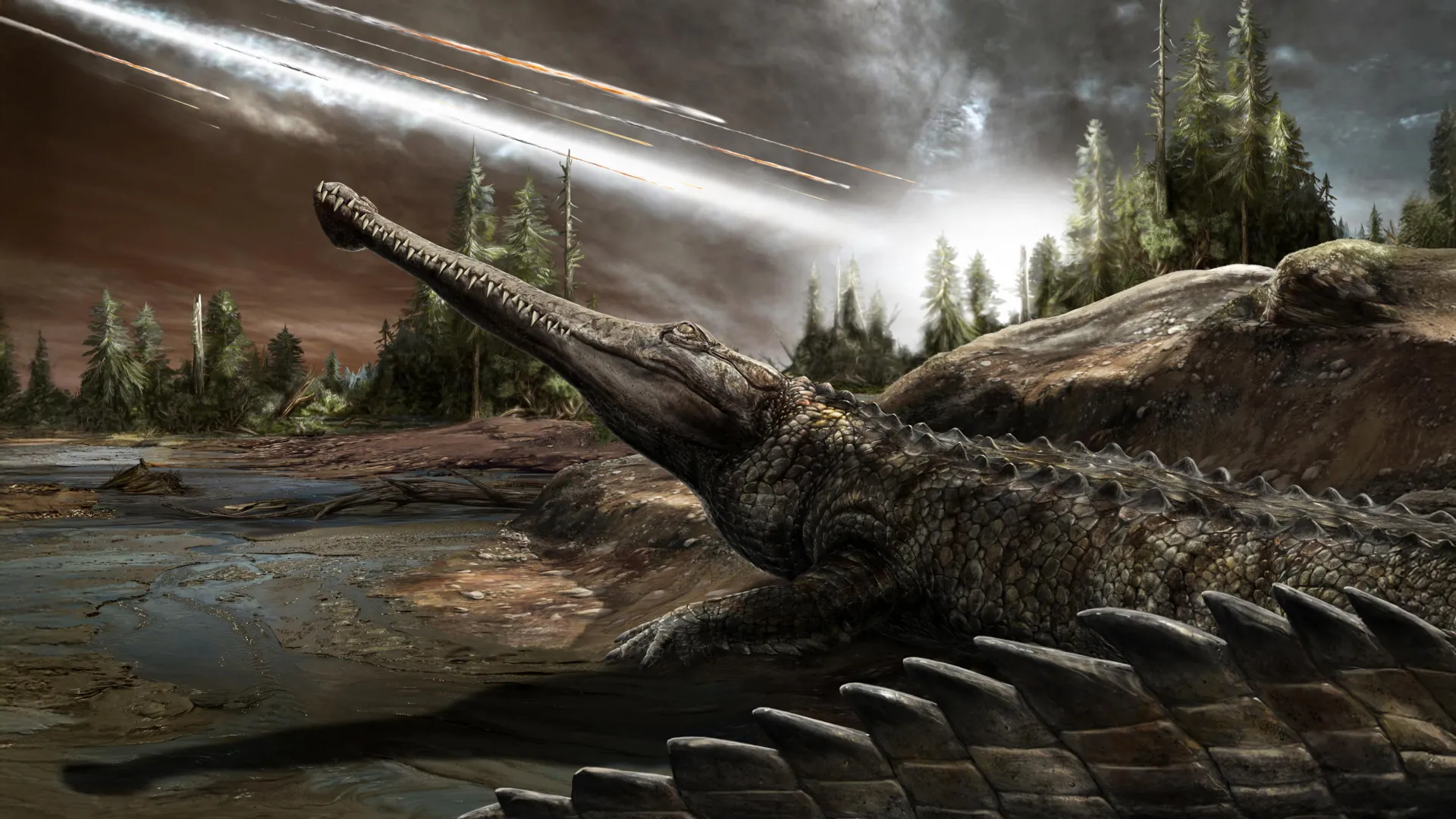
Sixty-six million years ago, a massive asteroid strike triggered a cataclysmic environmental collapse, resulting in the extinction of non-avian dinosaurs and nearly 75 percent of all life on Earth. While the dramatic end of the Cretaceous Period remains one of the most studied events in paleontological history, the survival of the crocodilian lineage has long puzzled scientists. New research led by University College London (UCL) suggests that the secret to their longevity was not merely biological resilience, but a sophisticated, long-term evolutionary strategy of tracking stable, warm climates across the globe.
The study, published in the journal Science Advances, provides a comprehensive look at 245 million years of evolutionary history. By analyzing over 7,000 fossils and records from more than 400 species, researchers reconstructed the environmental preferences of the broader crocodilian family, known as Pseudosuchia. The findings indicate that while other prehistoric animals attempted to adapt to shifting global temperatures, crocodilians consistently migrated to follow their preferred thermal niche, moving toward the tropics during cooling periods and expanding into higher latitudes when the planet warmed.
A Chronology of Climate Persistence
The evolutionary history of the crocodylomorph lineage began in the Triassic Period, roughly 250 million years ago. During this era, these creatures were not confined to the swampy, aquatic environments associated with their modern descendants. The Pseudosuchia lineage was characterized by immense morphological diversity; it included bipedal land predators, heavily armored herbivores, and massive apex hunters.
Throughout the subsequent Jurassic and Cretaceous periods, these animals remained remarkably tethered to their thermal requirements. During the Early Eocene, roughly 50 million years ago, the Earth experienced a significant "hothouse" phase where global temperatures were approximately 10°C higher than today. During this period, crocodilians thrived in regions that would be considered inhospitable today, including parts of North America, Europe, and even the Antarctic circle. As the planet gradually cooled over the next several million years, these populations systematically retreated toward the equator.
This pattern of climate-tracking explains how they managed to survive not only the end-Cretaceous extinction but also the Permian-Triassic mass extinction, the most severe in Earth’s history. By maintaining a niche that favored stability over rapid, specialized adaptation, they effectively "outwaited" periods of global instability that decimated more specialized organisms.
Modeling the Chicxulub Impact
To understand why the asteroid impact of 66 million years ago favored crocodiles while sealing the fate of the dinosaurs, the research team employed advanced computer simulations. These models accounted for the immediate aftermath of the Chicxulub impact, including the injection of sulfur and ash into the atmosphere, which triggered a "nuclear winter" scenario characterized by a sharp reduction in sunlight and a precipitous drop in global temperatures.
The simulations tested various degrees of environmental disruption. In scenarios where sunlight was reduced by 5% to 10%, the models showed that tropical and subtropical regions near the equator remained sufficiently warm to support crocodilian life. These equatorial refuges acted as critical lifeboats for the lineage. While the dinosaurs, many of which required larger caloric intakes and were restricted by their highly specialized biological niches, faced a collapsing food web, the crocodilians were already positioned in the most stable zones on the planet.
Only in extreme, low-probability scenarios—where sunlight was reduced by 15% or more—did the models show these equatorial refuges becoming unsuitable. The fact that the environment remained habitable in moderate-to-severe models suggests that the "climate-tracking" behavior was the decisive factor in their survival.
Morphological Diversity vs. Thermal Consistency
Dr. Alfio Alessandro Chiarenza, the lead author of the study, emphasized that the common perception of crocodiles as "living fossils"—implying they are evolutionary dead-ends—is a profound misunderstanding of their biological success. "Crocodiles are often called living fossils, but their ancestors and relatives changed enormously throughout their history," Dr. Chiarenza stated. "They ranged from giants the size of a bus that could have devoured a T. rex, to small, cute animals with the face of a pug."
The study highlights that while their body plans, locomotion, and dietary habits underwent radical shifts to occupy different ecological roles, their relationship with climate remained remarkably consistent. This internal "thermal compass" allowed them to remain flexible enough to survive, despite their apparent physiological rigidity.
There were, however, two notable exceptions identified in the study that demonstrate the lineage was capable of adaptation when pushed to the limit. During the Cretaceous Thermal Maximum, roughly 94 million years ago, temperatures soared to 14°C above modern levels, and a specific branch of the family evolved the ability to tolerate extreme heat. Similarly, 34 million years ago in Australia, a group adapted to arid, desert-like conditions during a period of extreme rainfall reduction. These exceptions serve as evidence that while they preferred warm, stable environments, the lineage was not entirely incapable of evolutionary deviation.
The Modern Challenge: Habitat Fragmentation
While the study provides a robust explanation for past survival, it also raises urgent concerns regarding the current epoch. The primary survival strategy of the crocodilian lineage—moving to track suitable climates—is now under threat. In the past, the planet was a continuous, interconnected map of potential habitats. Today, the expansion of human civilization, including urban sprawl, large-scale agriculture, and infrastructure projects, has created insurmountable barriers to wildlife migration.
Professor Philip Mannion, a co-author of the study, warns that the historical resilience of the crocodile is not a guarantee of future safety. "If crocodiles mostly coped with past climate change by moving towards suitable habitats, today’s species will need room to move as the planet warms," Mannion noted. "The loss of suitable areas to roads, farms, and cities is making that harder."
This analysis suggests that the very strategy that allowed crocodilians to survive the extinction of the dinosaurs—the ability to migrate to favorable conditions—is being nullified by the fragmented nature of modern geography.
Scientific Implications and Future Research
The study, supported by The Royal Society, the Leverhulme Trust, and the National Environment Research Council (NERC), provides a new framework for understanding the interplay between climate and extinction risk. By focusing on the thermal niche, researchers can better predict which modern species are most at risk during the current, human-induced climate crisis.
Furthermore, the research underscores the importance of "modest energy requirements" and "flexible diets" in survival. As ectothermic animals, crocodiles possess a significant metabolic advantage over endothermic species during periods of food scarcity. Their ability to enter states of low activity during suboptimal conditions complements their geographic mobility.
As climate models continue to improve, the data gathered from this study will likely be used to map the future viability of habitats for a wide range of reptiles and amphibians. The lesson from the end of the Cretaceous is clear: survival in a changing world is rarely about being the largest or the most powerful; it is about having the geographic flexibility to move when the environment shifts, and the metabolic efficiency to wait out the worst of the volatility. As the planet enters another period of rapid, anthropogenically driven temperature change, the historical record suggests that the ability to move—and the availability of land to move into—may be the ultimate deciding factor in preventing a new wave of extinctions.