The automotive landscape of the United States underwent a profound transformation at the dawn of the 1960s. For decades, Detroit’s "Big Three"—General Motors, Ford, and Chrysler—had dominated the domestic market by manufacturing increasingly massive, powerful, and resource-heavy passenger vehicles. However, shifting consumer preferences and the nascent realization that urban congestion and efficiency demanded agile alternatives forced a strategic pivot.
The industry’s initial response came in 1960 with a wave of home-grown compact cars led by General Motors’ Chevrolet Corvair, the Chrysler Valiant, and the Ford Falcon. These vehicles proved that American motorists were willing to downsize for better maneuverability and fuel economy. Yet, the commercial truck sector followed an entirely different trajectory. While passenger car divisions experimented with compact designs, the light-truck market remained heavily anchored to traditional, full-sized utility platforms.
The Japanese Mini-Truck Influx and the Big Three Response
While domestic manufacturers focused on large-scale trucks or awkward, car-based utility vehicles—such as the Corvair forward-control models and the Falcon-based Ranchero ute—international competitors identified a gaping hole in the American market. Datsun began exporting compact, dedicated utility trucks to the West Coast during the first half of the 1960s, quickly followed by Toyota.
These imports offered a rugged, body-on-frame architecture, rear-wheel-drive configurations, and robust bed capacities that lacked the car-like compromises of domestic utes. They looked and functioned like "real" trucks, capturing the imagination of tradesmen, suburbanites, and youth culture alike.
As the mini-truck segment gained significant market momentum, U.S. automakers bypassed expensive ground-up domestic development in favor of strategic badge-engineering partnerships. Ford struck a deal with Mazda to rebadge its B-series truck, introducing it to the American market as the Courier for the 1972 model year. Simultaneously, General Motors partnered with Isuzu to import the Isuzu Faster, which was rebranded and sold across North America as the Chevrolet LUV—a compact truck that automotive historians frequently regard as being vastly ahead of its time.
The Timing of Crisis: Fuel Shortages and Chrysler’s Late Entry
The strategic pivots by Ford and General Motors proved exceptionally fortuitous. When the first major global fuel crisis struck in 1973, altering the economic calculus of daily driving and commercial fleet management overnight, the Courier and the LUV were positioned perfectly to absorb panicked consumer demand. Alongside their Japanese-branded counterparts, these captive imports provided a lifeline for buyers desperate for fuel-efficient cargo haulers.
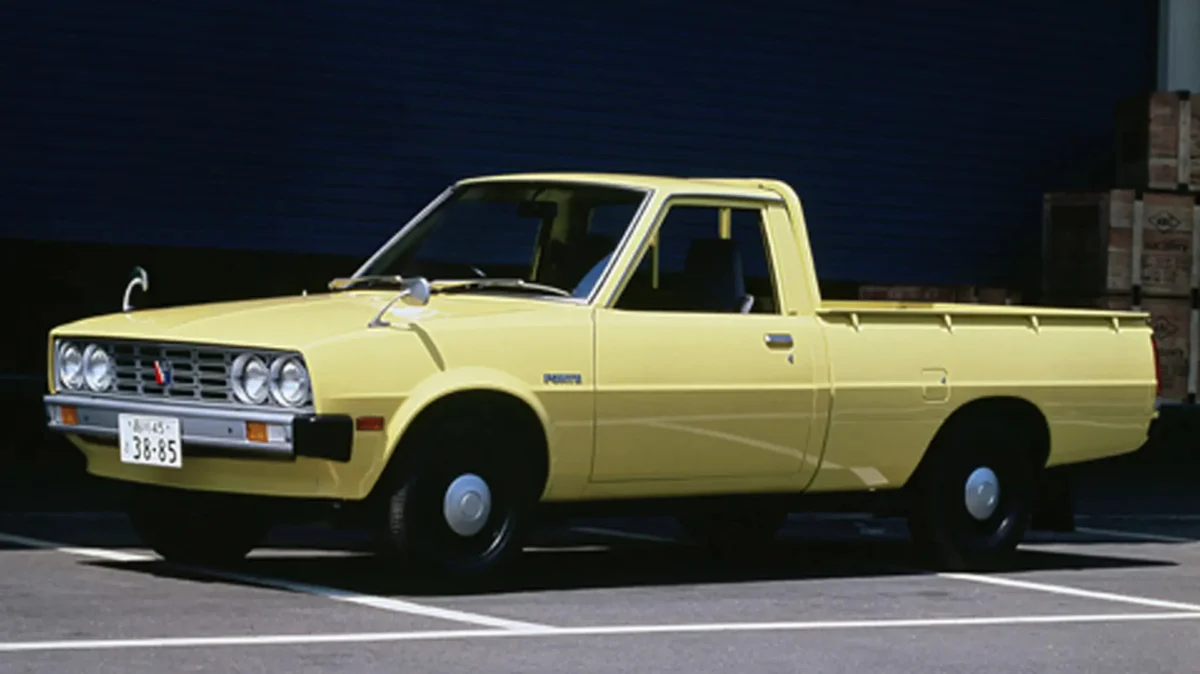
Chrysler, however, lagged significantly behind its Detroit competitors. While Ford and GM capitalized on the early-to-mid-1970s economic tremors, Chrysler’s entry into the compact truck arena did not materialize until late in the decade. Based on the Mitsubishi Forte, the Dodge D-50 finally made its debut in 1979—seven full years after the arrival of the Courier and the LUV.
This vehicle, which would be renamed the Dodge Ram 50 in 1981, established a critical foothold for Chrysler in a segment that was rapidly maturing from a niche alternative into a cornerstone of American automotive utility. (It is worth noting that Mitsubishi’s Forte utility vehicle bears no corporate or mechanical relation to Kia’s later compact passenger sedan of the same name).
Dimensions and Engineering: How Big Was the Diminutive Dodge?
To understand the engineering philosophy of the late-1970s and 1980s mini-truck era, one must examine the literal dimensions of these machines. Unlike modern compact pickups, which have grown substantially to accommodate modern safety regulations, creature comforts, and crash-structure requirements, the pickups of that era were genuinely compact.
A 1979 Dodge D-50 pickup possessed a smaller physical footprint than a contemporary Honda Civic sedan. The D-50 measured 184.6 inches in length and 65 inches in width, whereas a modern Civic sedan is approximately 0.2 inches longer and nearly six inches wider. When contrasted against a modern self-described "compact" pickup like the Ford Maverick, the size disparity becomes even more pronounced: the Maverick is 15.2 inches longer, 7.6 inches wider, and a full 8 inches taller than the vintage Dodge.
Beneath the sheet metal, the D-50 relied on modest powertrain architectures designed for efficiency rather than raw towing performance. The standard powerplant was a 2.0-liter overhead-cam inline-four cylinder engine, producing 93 horsepower and 108 pound-feet of torque, mated to a four-speed manual transmission. For buyers seeking enhanced performance, the D-50 Sport introduced a 2.6-liter inline-four generating 105 horsepower and 139 pound-feet of torque, paired with a five-speed manual transmission featuring overdrive. A three-speed automatic transmission remained an available option across both variants.
Despite its diminutive physical dimensions, the D-50’s utility metrics were remarkably robust. The vehicle boasted a maximum payload capacity of 1,400 pounds. By 1981, engineers had optimized the platform to achieve a payload rating of 1,525 pounds, allowing the vintage compact truck to out-carry modern unibody compact trucks like the modern Ford Maverick, which features a 1,500-pound payload limit.
Corporate Restructuring and the Birth of the Ram 50
The year 1981 served as a major turning point for Dodge’s commercial vehicle division, marked by strategic rebranding and mechanical expansion. Although the Ram brand did not officially split into a completely independent division from Dodge until 2009, corporate leadership began laying the groundwork for the brand’s truck identity early on.
As Chrysler restructured its truck lineup for the 1981 model year, executives integrated the Ram nomenclature into the commercial portfolio, officially transforming the compact utility vehicle into the Dodge Ram 50.
Building on this momentum, the 1982 model year introduced the Ram 50’s first four-wheel-drive configuration. Marketed under the moniker "Power Ram 50," this variant expanded the truck’s appeal to regions prone to severe winter weather and off-road applications. Furthermore, in response to lingering consumer demand for high-efficiency torque, Chrysler offered an optional diesel powerplant in the Ram 50 between 1983 and 1985, cementing the truck’s reputation as a versatile workhorse.
The Ram 50 and Its Contemporaries: Mapping the Smallest Dodge Pickups
The Dodge Ram 50 proved to be a durable commercial asset, spawning a second generation in 1987 that remained in production until 1994. Yet, despite its compact dimensions, the Ram 50 was neither the smallest pickup truck ever manufactured by Dodge, nor was it even the smallest Dodge pickup available during its own production era.
That distinction belongs to the Dodge Rampage.
Produced exclusively from 1982 through 1984, the Rampage was a car-based coupe utility vehicle engineered from the platform of the front-wheel-drive Dodge Omni 024. While the Rampage shared a similar overall footprint to the Ram 50—being only one inch shorter in length and roughly 1.8 inches wider—its architectural design resulted in a significantly lower profile. The Rampage stood a full nine inches shorter in height than the Ram 50 and offered a payload capacity approximately 380 pounds lighter than its body-on-frame sibling.
To find even more radical space-saving configurations in Dodge’s historical catalog, analysts must look back to the forward-control pickups of the 1960s. Dodge’s market entry in that category, the A100, was more than a foot shorter in overall length than the Ram 50.
This dramatic reduction in length was the inherent engineering benefit of the cab-forward body style. In these vehicles, the driver sat directly above the front wheels—a layout mirrored by European commercial vehicles such as the Volkswagen Type 2 Transporter pickup. By eliminating the traditional protruding engine bay and front hood, engineers drastically reduced the vehicle’s total length.
Powerplants in these forward-control machines were typically mounted either in the rear, as seen in the Transporter and Chevrolet Corvair trucks, or tucked directly beneath the passenger cabin, as configured in the Dodge A100 and the Ford E100.
Because of this space-efficient layout, the Dodge A100 measured a mere 170 inches in total length. To put this engineering footprint into contemporary perspective, the A100 was roughly equivalent in length to modern sports cars and low-slung roadsters, such as the Toyota GR86/Subaru BRZ twins (which measure just under 168 inches) and the BMW Z4 (which measures 170.7 inches).
Broader Implications and Industry Impact
The journey of Detroit’s compact and mini-truck experiments—from the badge-engineered imports of the 1970s to specialized domestic variations like the Ram 50 and Rampage—highlights an enduring industry lesson regarding agility and market timing.
When macroeconomic shocks disrupted traditional consumer purchasing habits, American automakers were forced to look beyond domestic borders to satisfy emerging segments. The reliance on Japanese engineering during the fuel crises not only kept domestic dealership lots viable through turbulent economic cycles, but it also permanently altered consumer perceptions regarding the viability of small-scale commercial utility.
Today, as modern automotive markets grapple with shifting powertrain mandates, electrification, and demands for hyper-efficient urban transport, the legacy of vehicles like the Dodge Ram 50, the Chevrolet LUV, and the Ford Courier serves as a reminder that utility and size are not inextricably linked. The historical appetite for efficient, manageable, and highly capable compact trucks laid the essential groundwork for the modern multi-billion-dollar compact pickup market that continues to thrive today.