Deep within the lush, emerald canopy of the South American rainforest, along the winding banks of the Lawa River, a high-stakes struggle for survival and sovereignty is unfolding. The village of Kawemhakan, home to the Indigenous Wayana people, sits at the epicenter of a geopolitical and environmental crisis. While the Surinamese government maintains a legal gold mining sector that yields approximately one million ounces of the precious metal annually, the reality in the country’s remote interior is far more chaotic. Here, illegal mining operations, often fueled by foreign capital and local complicity, are carving deep scars into the landscape, threatening the food security and health of the very people who have served as the forest’s traditional guardians for generations.

A Geography of Lawlessness
The Lawa River serves as the natural boundary between Suriname and French Guiana, a geographic feature that has effectively turned the region into a frontier zone largely immune to the rule of law. In this isolated pocket of the Amazon, government presence is nearly non-existent. Instead, the area is governed by a tenuous balance of power between Indigenous leaders, transient mining crews, and international traders.
The primary lifeline for Kawemhakan is its modest, dirt-packed airstrip. It is the village’s only practical connection to Paramaribo, the nation’s capital, and this infrastructure provides the Wayana leadership with their most significant bargaining chip. By controlling access to the air bridge, Chief Ipomadi Toko Pelenapün has historically managed to exert some influence over the influx of miners and traders. However, this leverage is increasingly insufficient against the sheer scale of the gold rush currently sweeping the region.

Chronology of Conflict and Exploitation
Gold has been present in the Lawa River area for over a century, but the intensity of its extraction has shifted dramatically in recent decades. The Wayana people, who have long lived in balance with the river, first permitted small-scale mining in the 1960s. Over the last several years, however, the situation has devolved.
The COVID-19 pandemic acted as a catalyst for a more aggressive era of exploitation. During this period, the Spence family, a local group with long-standing ties to the area, began to consolidate power. Once viewed as allies who assisted in mapping the region and constructing the village airstrip, the family’s role shifted as they began to employ intimidation tactics. Witnesses describe the Spences arming themselves and recruiting local youth to extort other mining camps.

By 2023, the friction reached a breaking point. Following widespread complaints from fellow miners and community members, the Spence family’s influence appeared to wane, and they departed the Kawemhakan area. Their abandoned residence remains a stark monument to a volatile chapter in the village’s history. Yet, their exit has not brought stability; instead, it has ushered in the arrival of larger corporate entities, including international mining firms, which bring a new set of complex challenges regarding land tenure and environmental standards.
Environmental and Demographic Data
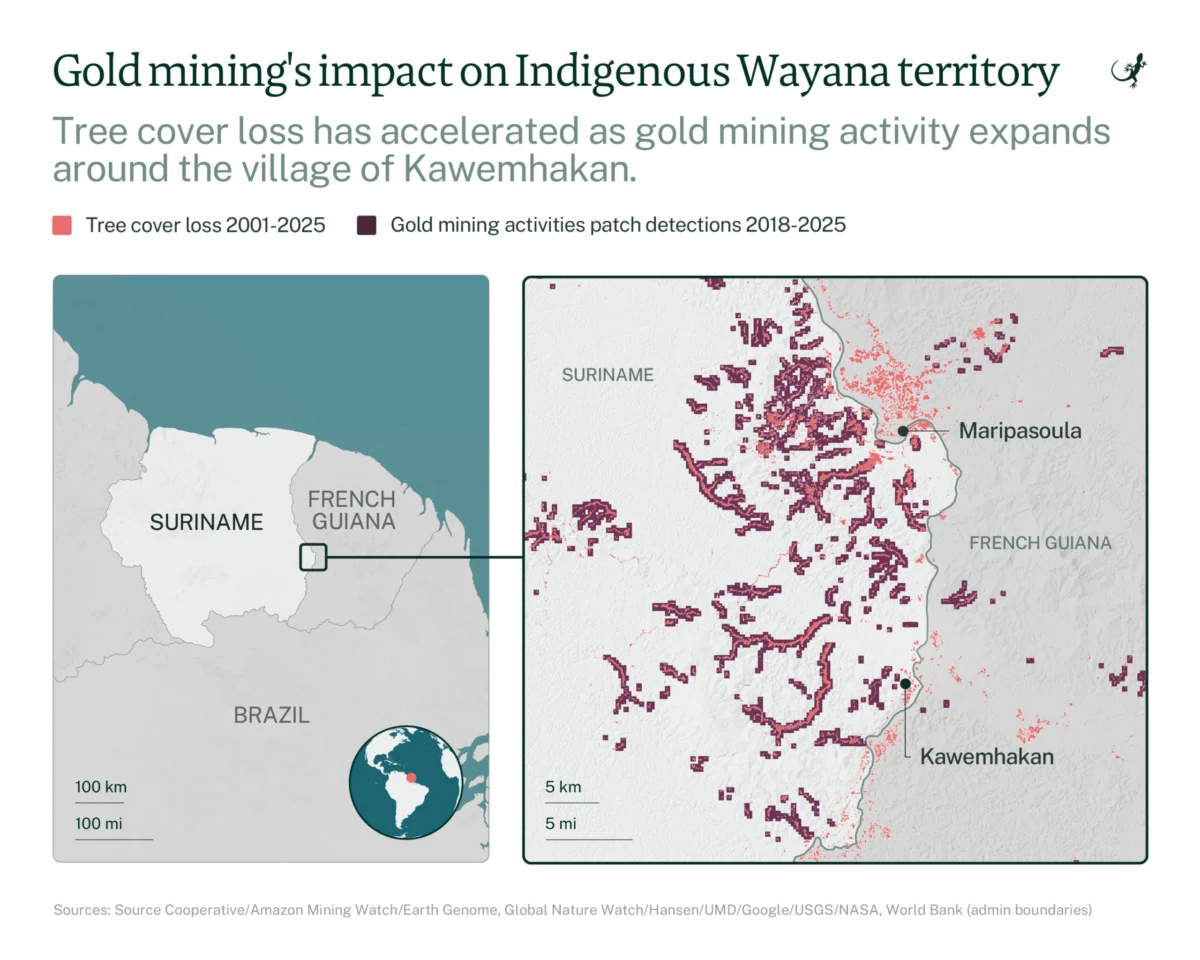
The scale of the devastation is quantifiable. According to data provided by the Monitoring of the Andean Amazon Project (MAAP), an initiative of the NGO Amazon Conservation, the border region between Suriname and French Guiana lost approximately 25,000 hectares of forest between 2021 and 2024. Last year alone, an additional 2,800 hectares were cleared for mining, signaling an accelerating trend of deforestation.

This environmental degradation has direct consequences for the Wayana. The widespread use of mercury—a toxic element used to separate gold from sediment—has contaminated the river systems that the community relies on for fishing and drinking water. As the forest retreats, so too does the wildlife population, stripping the Indigenous inhabitants of their primary food sources. Despite this, the community remains in a state of legal limbo. Suriname is currently the only nation in South America that has yet to formalize the land rights of its Indigenous populations. A 2007 ruling by the Inter-American Court of Human Rights mandated the state to grant these rights, yet the legislative process has remained stalled for over a decade.
The Corporate Shift: A New Frontier
The departure of local opportunistic miners has not led to a decrease in activity. Rather, the transition toward organized corporate mining is changing the nature of the struggle. Records from the Surinamese Chamber of Commerce indicate that several entities, such as X1 Eco Mining and X2 Clean Mining, were incorporated in late 2025 with mandates to extract natural resources.

The acquisition of these local concessions by foreign-backed companies, such as the Canadian-based Founders Metals, has raised alarms among local advocates. While corporate spokespeople assert that they are in the early stages of exploration and remain committed to legal compliance, the Indigenous community views this expansion with deep skepticism. Andre Verhoogt, Director of the Mulokot Foundation, notes that while the departure of the Spence family was a relief, the replacement of small-scale extortionists with large-scale industrial operations could permanently alter the region’s socio-economic landscape, potentially displacing the Wayana further from their traditional way of life.
The Struggle for Sovereignty and Education
Education remains a pivotal, yet difficult, pillar of the Wayana strategy for the future. Prior to 2020, the Mulokot Foundation operated a school in Kawemhakan, teaching students in Dutch to facilitate future employment opportunities outside of the mining sector. The pandemic forced the closure of the physical facility, and while the foundation intends to pivot to online learning, the lack of reliable infrastructure in the remote jungle makes this a daunting task.

Marciano Pelenapün, the son of the chief and a future leader, has taken a proactive approach by focusing on mapping. He believes that the first step toward self-determination is the creation of a definitive, community-led map of their ancestral territory. By clearly defining these boundaries, the community hopes to challenge the government’s habit of granting mining concessions on land that the Wayana have inhabited for generations.
Broader Implications and Future Outlook
The situation in Kawemhakan is a microcosm of the broader challenges facing the Amazon Basin. As global demand for gold remains high, the pressure on remote, resource-rich territories continues to mount. The Surinamese government finds itself in a precarious position; it has pledged to maintain 90% forest cover and adhere to international climate commitments, yet it struggles to enforce these policies in the deep interior.

The lack of a coherent land-rights framework in Suriname is the most significant obstacle to long-term sustainability. Without legal title to their land, the Wayana are forced to navigate a complex, often dangerous system where they are compelled to negotiate with miners and state officials on an unequal footing. Every ounce of gold extracted from the soil around Kawemhakan represents a choice between short-term economic gain and the long-term survival of an Indigenous culture.
For now, the Wayana remain in a state of watchful waiting. The airstrip remains a symbol of both their connection to the world and their vulnerability to it. As they continue to document mining activity through satellite imagery and seek political recourse in the capital, their struggle highlights the urgent need for a more equitable approach to resource management in the Amazon—one that prioritizes the rights of Indigenous communities over the insatiable global demand for precious metals. The path forward remains uncertain, but the message from the Lawa River is clear: the current trajectory of unregulated extraction is unsustainable, and without structural change, the Wayana territory faces an existential threat that no amount of gold can compensate for.