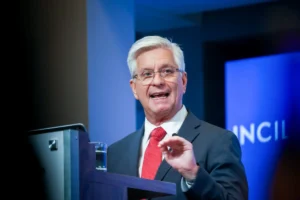
The landscape at Nvidia has undergone a seismic shift as the company formally announced on Monday the reinstatement of Jensen Huang as president, chief executive officer, and member of the board. Huang, who had stepped down on November 12 following a firestorm of controversy involving reports of extramarital affairs and alleged ties to a woman identified by some officials as a Chinese intelligence asset, returns to the helm effective immediately. The move follows intense pressure from the highest levels of the U.S. government, with reports confirming that President Trump played a decisive role in lobbying for Huang’s return, asserting that the CEO’s presence poses no threat to national security.
For Colette Kress, who served as interim CEO during the two-week power vacuum, the transition marks a return to her foundational role as Chief Financial Officer. However, her tenure as the primary architect of Nvidia’s financial strategy is now shadowed by a looming Securities and Exchange Commission (SEC) investigation into the company’s accounting practices. As the firm navigates a turbulent period of internal restructuring and external regulatory scrutiny, the professional future of its long-serving finance chief has become a subject of intense speculation within Silicon Valley and Wall Street.
A Timeline of Recent Volatility
The events leading to this moment have unfolded with unprecedented speed for a firm of Nvidia’s market capitalization. The sequence of events provides a critical lens through which to view the current governance challenges:
- November 12, 2026: Jensen Huang abruptly resigns as CEO amid public reports detailing personal conduct and potential national security concerns. The board appoints Colette Kress as interim CEO.
- November 17, 2026: Kress delivers Nvidia’s quarterly earnings call, attempting to project stability. During the call, she explicitly notes that the company is "rigorously evaluating future investments, commitments, and guarantees," hinting at internal pressure to rectify financial transparency.
- November 20, 2026: Reuters and other outlets report that the SEC has launched an investigation into Nvidia’s accounting practices, specifically questioning the nature of circular financing arrangements with AI startups.
- November 23, 2026: The Nvidia board votes unanimously to reinstate Huang, following direct communication from the White House regarding his clearance.
- November 24, 2026: Nvidia confirms the formal reinstatement, thanking Kress for her service while signaling a return to the previous executive hierarchy.
The Accounting Question: Circular Flows and Disclosure
At the heart of the regulatory focus is the relationship between Nvidia and the ecosystem of AI startups that rely on its hardware. Market analysts have long observed that Nvidia frequently facilitates the financing of these startups, which in turn use that capital to purchase Nvidia’s high-end graphics processing units (GPUs). This "circular flow of money" has raised questions among regulators about whether Nvidia’s revenue growth is being artificially inflated by its own balance sheet support.
Kathryn Harrigan, a professor at Columbia Business School, suggests that Kress is likely at the center of this scrutiny due to her role in overseeing these financial structures. "In my book, Ms. Kress is a person who is aware of the problem," Harrigan stated. "When I served on boards, I’ve gone through that, and it’s just endless depositions. It is a grueling process where the regulator rarely provides comfort regarding the outcome."
The investigation is further complicated by the company’s historical revenue reporting practices. Specifically, the SEC is reportedly examining Nvidia’s mid-2025 decision to cease listing Singapore as a primary geographic revenue location. This change occurred around the same time that Megaspeed, a Singapore-based customer, came under fire for allegedly evading U.S. chip export controls. Given that Megaspeed was also the firm where the woman linked to Huang’s recent scandal held an executive position, the nexus between personal conduct and corporate accounting has become the primary focus of federal investigators.
Corporate Governance and the CFO’s Burden
The role of the CFO is traditionally one of absolute fiscal oversight, but at firms experiencing hyper-growth like Nvidia, the line between aggressive expansion and regulatory non-compliance can blur. Shawn Cole, president of Cowen Partners Executive Search, emphasizes that the burden of such investigations typically falls heavily on the finance department.
"Nvidia’s potential exposure to securities class-action litigation, compounded by alleged gaps in its directors and officers liability insurance, raises serious questions about corporate governance," Cole said. "Kress could face intense scrutiny over what she knew about these financial exposures, when she knew it, and her role in the disclosure process."
The risk to Kress is not merely one of potential wrongdoing, but of reputational contagion. Research published in Contemporary Accounting Research titled "Fraud Firms’ Non-Implicated CFOs" indicates that even when a CFO is not directly charged with fraud, the association with a firm under investigation significantly diminishes their future employment prospects. For a professional with a resume that includes senior roles at Cisco, Microsoft, and Texas Instruments, this represents a career-defining inflection point.
The Political Shield vs. Financial Accountability
While Huang and Kress both face the same regulatory environment, their positions are distinct. Huang’s reinstatement was facilitated by direct executive branch intervention, a rarity in modern corporate governance. This suggests that Huang maintains a level of political insulation that Kress, as the internal financial watchdog, does not share.
During her time as interim CEO, Kress attempted to steer the company toward a more conservative fiscal stance. Her public comments regarding being "disciplined and selective" in future support of startups were likely a direct response to the mounting pressure from auditors and the board. However, this shift in strategy may not be enough to shield her from the fallout of the current investigations.
Industry Implications and Future Outlook
As Nvidia moves forward under the reinstated leadership of Huang, the company must contend with the reality that its financial transparency is under a microscope. The board’s decision to bring Huang back suggests a prioritization of his vision and market influence over the immediate optics of the governance scandal. Yet, the presence of an ongoing SEC investigation means that the "extraordinary foundation" Kress spoke of on November 12 is now being audited for stability.
The broader market impact is significant. Nvidia serves as a bellwether for the entire artificial intelligence sector. If the SEC determines that the company’s revenue recognition practices were misleading, the resulting restatements could force a broader repricing of the AI market. For Kress, the road ahead involves balancing the demands of a high-pressure, politically-backed CEO with the strict, often unforgiving requirements of federal financial regulators.
Whether Kress remains at the firm in the long term remains an open question. While she has expressed commitment to the company’s mission, observers note that the environment at Nvidia has changed irrevocably. If the investigations uncover systemic failures in financial risk management, the internal blame-shifting often associated with such crises may necessitate a leadership change in the CFO office. As it stands, Kress remains the steward of Nvidia’s finances, but she is effectively operating under a cloud that has yet to disperse, leaving her tenure as both CFO and a potential future CEO candidate in a state of suspended animation.
Ultimately, the events of the past two weeks have demonstrated that even the most valuable companies in the world are not immune to the intersection of personal scandal and federal oversight. As Nvidia attempts to return to "business as usual," the focus will shift from the innovation of its chips to the integrity of its ledgers. For Colette Kress, the coming months will be defined by the outcome of these probes—and whether she can navigate the scrutiny without becoming the focal point of the consequences.