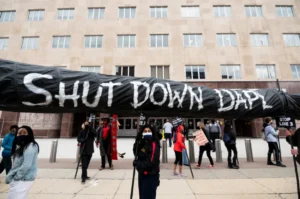
The legal battle over the future of America’s aging fossil-fuel infrastructure reached a critical juncture on Friday when a federal appeals court issued a landmark ruling against the federal government. The U.S. Court of Appeals for the D.C. Circuit determined that the Department of Energy overstepped its legal authority when it mandated that the J.H. Campbell coal-fired power plant in Michigan remain operational past its scheduled retirement date.
The decision marks a significant judicial check on the executive branch’s invocation of emergency powers to prop up legacy fossil-fuel generation. While the ruling does not immediately shutter the facility, it establishes a stringent judicial precedent for how the executive branch can apply emergency statutes to energy markets. As environmental organizations celebrate the decision as a victory for the rule of law and public health, the ruling also sets the stage for broader legal confrontations regarding several other coal-fired facilities operating under similar federal mandates nationwide.
Background and Context of the Energy Emergency Declaration
The controversy stems from a concerted push by the federal government to preserve traditional energy sources amid shifting economic and environmental landscapes. On his first day in office in January 2025, President Donald Trump signed an executive order declaring a "national energy emergency." This declaration directed federal agencies to utilize every available statutory mechanism to maximize domestic energy production, placing a heavy emphasis on fossil fuels to meet rising electricity demands.
Administration officials have consistently defended these directives by pointing to potential grid vulnerabilities, capacity shortfalls, and the massive energy demands of rapidly expanding artificial intelligence data centers across the United States. According to the administration, keeping legacy generation assets online is a vital stopgap measure to prevent widespread blackouts and ensure economic stability.
However, critics and environmental advocates have argued that the emergency declarations are being used as a pretext to subsidize and protect the declining coal industry at the expense of public health, environmental standards, and market-driven transitions toward renewable energy sources. The J.H. Campbell facility in West Olive, Michigan, became the epicenter of this nationwide policy conflict.
Chronology of the J.H. Campbell Power Plant Dispute
The trajectory of the J.H. Campbell facility illustrates the friction between federal energy directives and regional utility planning:
- May 2024: The 64-year-old J.H. Campbell coal-fired power plant was originally scheduled to permanently close its doors, with utility operators preparing for decommissioning.
- May 2024 (Just before closure): The Department of Energy intervened at the eleventh hour, invoking short-term emergency powers under Section 202(c) of the Federal Power Act. The agency argued that regional grid reliability threats and burgeoning power demands from data centers constituted a national emergency, forcing the plant to keep running.
- January 2025: President Trump formalized the administration’s broader energy strategy by declaring a national energy emergency upon taking office, reinforcing the operational mandates placed on legacy plants.
- Mid-2025: Legal challenges mounted by environmental coalitions moved through the federal court system, culminating in oral arguments regarding the statutory limits of the Federal Power Act.
- August 2025: Parallel administration policies saw approximately $4 billion allocated to compensate companies for terminating offshore wind projects along the East Coast.
- September 25, 2026: The U.S. Court of Appeals for the D.C. Circuit delivered its ruling, decisively rejecting the Department of Energy’s justification and declaring the emergency order an overreach of statutory authority.
The D.C. Circuit Court Ruling and Legal Analysis
Writing for the panel, Appeals Court Judge Cornelia Pillard dismantled the federal government’s expansive interpretation of Section 202(c) of the Federal Power Act. The court emphasized that the emergency statute was never designed to serve as a routine instrument for industrial policy, defining it instead as a narrow, last-resort backstop intended strictly for acute, unforeseen crises.
Legal experts have hailed the decision as a masterclass in reestablishing the boundaries of administrative law. Ted Kelly, director and lead counsel for U.S. Clean Energy at the Environmental Defense Fund—one of the primary organizations involved in the litigation—noted that while the ruling leaves the theoretical concept of the president’s "energy emergency" declaration intact, it severely curtails its practical application.
"You can say there’s an energy emergency as much as you want—even if you’re the president," Kelly observed. "But what you can actually do depends on what the real facts on the ground are and what the law actually lets you do in different situations."
Gavin McCabe, senior litigating counsel at the Natural Resources Defense Council, which also participated in the lawsuit, pointed out the inherent contradictions in the administration’s energy portfolio management. McCabe questioned the logic of keeping obsolete, high-emission facilities on life support while simultaneously paying billions of dollars to dismantle ready-to-deploy renewable energy infrastructure.
"Why would the administration be blocking sources of energy that are ready to come online in favor of keeping online something that has been set to be retired?" McCabe asked. "There appears to be a pretext that the president wants to help coal industry supporters. And this is one of the ways to attempt to do that."
Environmental Toll and Economic Costs in West Olive
Beyond the constitutional and statutory debates, the continued operation of the J.H. Campbell plant has imposed heavy tangible costs on both the local environment and utility ratepayers.
According to data compiled by environmental groups, the Campbell facility is the heaviest polluter among the seven fossil-fuel plants forced to remain open by the administration. Since the emergency order was issued, the 64-year-old plant has released approximately 1,000 tons of nitrogen oxides, 2,000 tons of sulfur dioxide, and 140 tons of particulate matter into the atmosphere.
For the approximately 3,000 residents living in the immediate vicinity of West Olive, Michigan, these emissions carry direct health consequences. The Environmental Defense Fund estimates that the cumulative pollution could trigger up to 100 new cases of asthma among local community members.
The financial toll has been equally substantial. Keeping the facility online since May of last year has incurred operational and maintenance costs totaling $259 million. The utility operating the plant, Consumers Energy Company, has actively sought to recover these multimillion-dollar expenses from its customer base, which spans Michigan and 10 neighboring states. This financial burden has sparked outrage among consumer advocacy groups, who argue that ratepayers are being forced to subsidize an inefficient and legally compromised fossil-fuel asset.
Broader Industry Implications and Future Legal Outlook
The D.C. Circuit Court’s ruling carries monumental implications for energy policy across the United States. For months, several legal challenges targeting the remaining six federally mandated fossil-fuel plants have been effectively paused as courts awaited a definitive ruling on the J.H. Campbell case. Because the legal arguments across these various lawsuits share a common foundation—challenging the misuse of Section 202(c) of the Federal Power Act—legal analysts expect Friday’s precedent to trigger a wave of favorable decisions for environmental plaintiffs.
Despite the clarity of the appellate court’s decision, the immediate fate of the J.H. Campbell plant remains uncertain. The court order does not automatically mandate an immediate shutdown of the facility. Environmental advocates are pressing for the Trump administration to voluntarily rescind the emergency order in light of the judicial setback. Should the administration refuse, plaintiffs intend to seek direct judicial enforcement to halt operations.
However, the federal government retains several procedural avenues to delay implementation. Legal experts note that the administration could petition the D.C. Circuit for a full-court rehearing (en banc) or elevate the dispute to the Supreme Court of the United States. Such moves would prolong the legal limbo surrounding the facility, allowing the plant to continue operating while higher courts weigh the merits of executive authority versus statutory limitations.
Meanwhile, the broader national energy landscape continues to feel the shockwaves of the administration’s interventionist policies. Observers point out the striking juxtaposition between the administration’s aggressive defense of aging coal infrastructure and its efforts to suppress the renewable energy sector. By mid-August, federal agencies had committed approximately $4 billion in compensatory payouts to corporate entities specifically to halt offshore wind energy projects. Together, those canceled or delayed wind initiatives possessed the generation capacity to power more than 15 million homes across the East Coast.
As the legal battles proceed through the federal court system, the clash between executive emergency powers and established statutory boundaries will continue to shape the trajectory of American electricity generation. Friday’s ruling has firmly established that presidential declarations alone cannot override the literal text of federal energy laws, setting a high bar for federal intervention in the ongoing transition of the nation’s power grid.