The American residential real estate sector continues to demonstrate a surprising level of durability in the face of a mounting "wall of worry" that includes stubborn inflation, surging energy costs, and a transformative labor market shaped by artificial intelligence. However, as the summer of 2026 progresses, the housing market faces its most significant challenge yet: a convergence of high mortgage rates and a volatile geopolitical landscape. With the conflict involving Iran entering what analysts are calling "Stage 2.0," the stability of the 10-year Treasury yield and the subsequent impact on mortgage pricing have become the focal points for economists and prospective homebuyers alike.
The current market tracker indicates a subtle but perceptible cooling in activity. This shift follows a week where mortgage rates remained stubbornly above the 6.64% threshold—a level that has historically served as a psychological and financial ceiling for housing demand over the past several years. As the industry moves into the latter half of the year, it must also contend with increasingly difficult year-over-year comparisons, particularly as the market undergoes a structural shift similar to the one witnessed in mid-June of 2025.
The Geopolitical Catalyst: Iran Conflict Stage 2.0
The escalation of hostilities in the Middle East has introduced a significant variable into the 2026 economic equation. The transition into "Stage 2.0" of the Iran conflict has directly influenced global oil prices, which in turn has sent ripples through the U.S. bond market. Historically, geopolitical instability drives investors toward the safety of government bonds, which would typically lower yields. However, the inflationary pressure of rising oil prices has counteracted this "flight to quality," keeping the 10-year Treasury yield at the upper bound of recent forecasts.
Since the onset of renewed strikes and maritime disruptions in early July 2026, the Federal Reserve has maintained a watchful and somewhat aggressive posture. While the central bank typically remains silent during brief fluctuations in energy costs, the sustained upward trajectory of crude oil has emboldened the "hawks" within the Federal Open Market Committee (FOMC). Last week, several Fed officials signaled that if energy-driven inflation persists, the timeline for potential rate cuts may be pushed further into 2027, or worse, additional hikes could be considered to stabilize the dollar.
Analyzing the 10-Year Yield and Mortgage Rate Forecasts
At the beginning of the year, the 2026 HousingWire forecast established specific channels for both the 10-year Treasury yield and the 30-year fixed mortgage rate. Thus far, both metrics have remained within these predicted ranges, despite the unforeseen intensity of the Iran conflict. The 10-year yield has hovered near the peak of the forecast channel, driven by a combination of domestic economic data and international turmoil.
The relationship between the 10-year yield and mortgage rates is the primary mechanism through which global events affect the local homebuyer. When the yield rises, mortgage lenders must increase rates to maintain profitability and account for risk. The 6.64% mark for mortgage rates has proven to be a critical inflection point. Data from the last three years suggests that whenever rates exceed this level, buyer traffic in the primary residential market slows significantly. With current rates hovering just above this mark, the market is currently testing the limits of consumer endurance.
The Critical Role of Mortgage Spreads
A vital, yet often overlooked, component of current rate stability is the improvement in mortgage spreads. The "spread" represents the difference between the 10-year Treasury yield and the 30-year fixed mortgage rate. In a stabilized market, this spread typically ranges between 1.60% and 1.80%. During the volatility of 2023 and 2024, spreads ballooned, reaching levels that would have pushed today’s mortgage rates toward 8%.
As of the most recent data, mortgage spreads stood at 1.97%, a slight increase from 1.95% the previous week. While still higher than the historical average, this is a marked improvement from the crisis-level spreads of the mid-2020s. Had spreads remained at 2023 levels, the housing market would likely have entered a period of total stagnation. The current relative compression of these spreads has acted as a buffer, preventing mortgage rates from spiraling toward 7.5% or 8% despite the rise in bond yields. This "spread cushion" is essentially the only factor currently keeping the dream of homeownership viable for a large segment of the population.
Weekly Pending Sales and the Demand Curve
Pending home sales provide the most immediate look at buyer sentiment, reflecting contracts signed but not yet closed. The data for the most recent week shows a traditional rebound following the Fourth of July holiday lull, yet the underlying trend remains cautious. Year-over-year, pending sales were slightly negative, a result attributed to the sustained period of rates remaining above 6.64%.
Analysts note that the "easy" year-over-year comparisons are now behind us. In mid-June 2025, the housing market saw a brief but significant surge in activity, creating a high bar for 2026 to clear. As we move into the late summer and autumn months, the difficulty of matching last year’s performance will increase. If mortgage rates do not retreat below the 6.5% mark, the market could see a more pronounced decline in pending sales as the "lock-in effect"—where homeowners refuse to sell because they hold ultra-low rates from the early 2020s—continues to constrain turnover.
Mortgage Purchase Application Trends
Purchase application data, which tracks the number of people applying for a mortgage to buy a home, saw a 7% week-over-week decline. While a seasonal dip is expected during this time of year, the 2% year-over-year decrease is more telling. This marks only the third time in 2026 that purchase applications have turned negative on an annual basis.
The AI-driven transformation of the labor market has also begun to manifest in this data. While the "AI economy" has created significant wealth in certain sectors, it has also introduced a layer of job insecurity in others. Prospective buyers in professional services and tech-adjacent roles are showing increased hesitation, opting to wait for more clarity on both their long-term employment prospects and the direction of the Federal Reserve’s interest rate policy.
Housing Inventory and the "New Normal" of Listings
The inventory landscape in 2026 remains a paradox. While overall inventory levels have slowed since the mid-June 2025 peak, the market is not seeing the massive accumulation of homes that characterized previous downturns. New listings have entered their seasonal decline, with the "peak weeks" of spring failing to produce the volume seen in the pre-pandemic era.
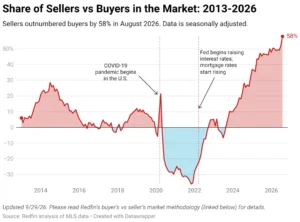
In 2026, the market has only surpassed 80,000 new weekly listings four times. To put this in perspective, during the housing bubble years of 2006-2008, new listings frequently ranged between 250,000 and 400,000 per week. The current lack of inventory acts as a floor for home prices; even as demand softens due to high rates, the scarcity of available homes prevents a significant price correction. This "inventory drought" ensures that the market remains technically in favor of sellers, even if the number of buyers has thinned.
Price-Cut Percentages and Valuation Forecasts
One of the most reliable indicators of a shifting market is the percentage of homes seeing price reductions. Historically, about one-third of all listings undergo a price cut before finding a buyer. In 2026, price-cut percentages have generally remained lower than in 2025, largely because inventory growth has been so constrained.
The 2026 home-price forecast initially called for a modest national decline of 0.62%. However, current data suggests that this forecast may have been too bearish. Most major home price indexes are currently showing growth between 1% and 2%. The lack of supply is effectively canceling out the downward pressure that 6.7% mortgage rates would typically exert on pricing. Unless a significant wave of inventory hits the market—perhaps triggered by a broader economic recession or a resolution to the "lock-in" effect—home prices appear likely to end the year with slight gains rather than the predicted losses.
Broader Implications and the Week Ahead
As the market looks toward the final weeks of July, three factors will dictate the trajectory of the housing sector: the evolution of the Iran conflict, upcoming Treasury bond auctions, and the release of new home sales data.
The Iran conflict remains the primary "wildcard." Unlike previous geopolitical flares, this conflict is unfolding during active market hours, leading to real-time volatility in oil futures and bond yields. If the situation escalates further, the Federal Reserve may feel compelled to maintain a "higher for longer" interest rate environment to combat the resulting energy inflation, which would keep mortgage rates elevated.
Bond auctions scheduled for the coming week will also be crucial. They will serve as a litmus test for international appetite for U.S. debt. If demand for these bonds is weak, yields will rise, dragging mortgage rates higher and potentially pushing them past the 7% mark—a level that has historically brought the housing market to a virtual standstill.
In conclusion, while the 2026 housing market has shown remarkable resilience, it is currently operating on a thin margin of safety. The interplay between international conflict and domestic monetary policy has created a high-interest-rate environment that is testing the limits of affordability. While the absence of a listing surge prevents a price crash, the high cost of borrowing is undeniably cooling the pace of sales. Stakeholders should prepare for a period of low-volume, high-price stability, provided that mortgage spreads continue to hold and the geopolitical situation does not trigger a more severe global economic shock.