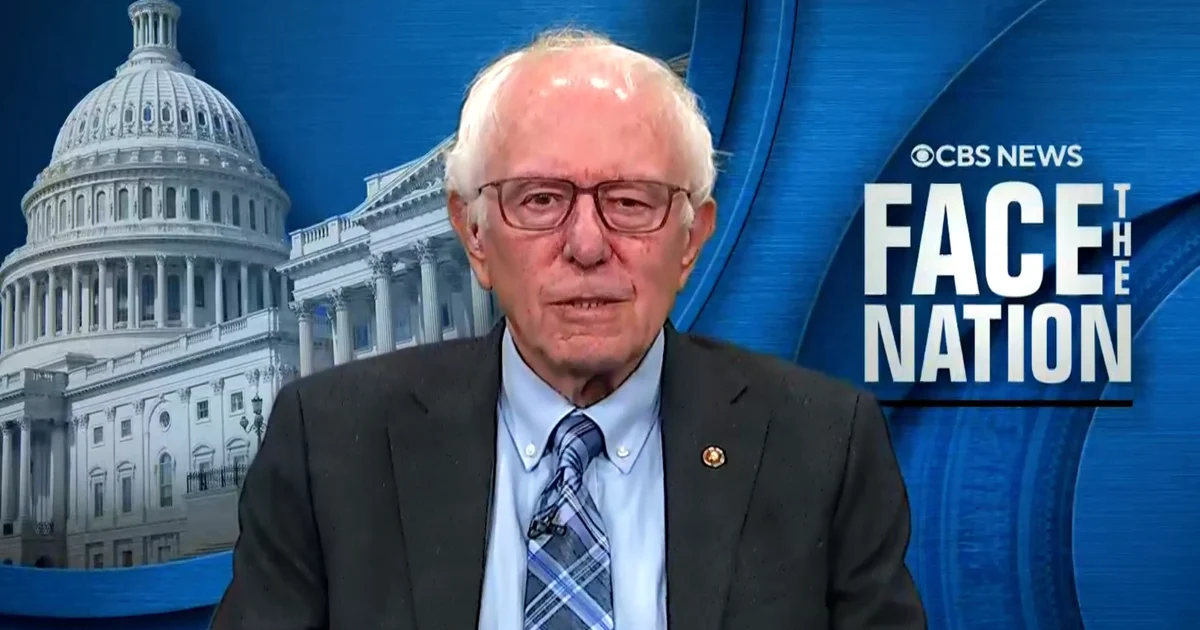
The fiercely contested 2026 Michigan Senate race has intensified national scrutiny following a weekend appearance by Senator Bernie Sanders on CBS News’ "Face the Nation with Margaret Brennan." Sanders launched a scathing critique against national Republican figures and local campaigns, condemning what he characterized as overt, unvarnished racism and Islamophobia directed at the Democratic senatorial nominee, Dr. Abdul El-Sayed.
The high-stakes political battle in Michigan, pivotal for control of the United States Senate in the ongoing midterm elections, has been dominated in its final stretch by fierce controversies over candidate background, foreign policy, and identity politics. As El-Sayed seeks to make history as the first Muslim elected to the United States Senate—running against Republican nominee and former U.S. Representative Mike Rogers—the race has laid bare deep ideological fractures both within the Republican party and across the Democratic coalition.
The Escalation of GOP Rhetoric and Sanders’ Condemnation
Appearing on national television, the Vermont independent senator did not mince words regarding the tactics deployed by the GOP campaign apparatus against El-Sayed, a medical doctor and former public health official. Sanders specifically targeted rhetoric originating from former President Donald Trump, Texas Senator Ted Cruz, and other high-profile Republican surrogates.
Republicans have repeatedly attempted to link El-Sayed to the Muslim Brotherhood—a transnational Islamist organization whose Egyptian and regional chapters were designated as terrorist groups by the Trump administration earlier this year. GOP messaging has gone so far as to imply that El-Sayed’s election could pose a direct security threat to Americans.
"That level of racism, overt absolute racism, is frankly disgusting and should appall every decent American," Sanders stated during his broadcast interview.
Sanders specifically condemned attack advertisements flooding Michigan airwaves, describing them as the most egregious examples of political fearmongering he has witnessed in his decades-long public career. "They are calling Abdul El-Sayed—who’s a medical doctor—they’re calling him a terrorist, a jihadist, really disgusting things," Sanders said. "And the fact that any Republican would stand behind those horrible ads is a disgrace."
Despite the hostility of the opposition campaign, Sanders expressed confidence in the resilience of Michigan voters. He predicted that the electorate would ultimately reject divisive identity-based attacks at the ballot box, asserting that El-Sayed’s positive vision for the state would prevail over what he termed political "ugliness."
Primaries, Party Fractures, and the Haley Stevens Defection
The controversy surrounding the Michigan Senate race is not solely confined to inter-party warfare between Democrats and Republicans. Intra-party friction has also severely damaged Democratic unity in the state, highlighted most acutely by a public rupture between El-Sayed and his primary opponent, former U.S. Representative Haley Stevens.
The rift deepened when Stevens publicly called on El-Sayed to forcefully condemn an outside political action committee advertisement. The disputed ad drew a direct link between U.S. military aid to Israel and rising domestic grocery prices—a framing that Stevens and several other centrist Democrats characterized as antisemitic.
El-Sayed rejected Stevens’ demand, accusing her of attempting to relitigate a bitterly fought primary election that concluded three months prior. El-Sayed maintained that he had no operational or structural control over independent expenditure groups, noting publicly that the ad "was not made by me" while clarifying that he disagreed with its specific argumentative framing.
The tension culminated shortly after Sanders’ Sunday morning television appearance. In a dramatic political development, Stevens announced a public endorsement of Republican nominee Mike Rogers. Stepping away from her party’s nominee, Stevens stated, "I don’t belong in Abdul’s campaign," while asserting that the core question on the ballot was a referendum on state identity and political decency. "What we are as Michiganders is not hate and is not what we are getting out from our Democratic nominee right now," Stevens said.
Addressing the fallout, Sanders sought to minimize the long-term impact of the primary fallout while acknowledging the emotional scars of a tight electoral battle. "Haley Stevens lost a very, very close primary. I can understand being upset about that," Sanders noted. However, the Vermont senator urged voters to focus on the broader legislative stakes of the midterm election cycle.
"So the people in Michigan understand, ‘Sure, we have disagreements with Abdul on this and that issue,’" Sanders remarked. "But from what I can see, all over the state, people are standing up. They’re going to stand with Abdul, take on somebody who will be nothing more than a rubber stamp for the Trump administration. That’s Mike Rogers."
For his part, El-Sayed adopted a measured approach to the defection, declining to mention Stevens by name during his Sunday remarks. Instead, he pivoted toward a unifying message focused on the broader populace. "This is a state of 10 million people who deserve a lot better from their government," El-Sayed stated. "I’m a lot more focused on the 9,999,998 that are not the ones who are talking about [this]."
Sanders and the Debate Over Antisemitism and Foreign Policy
A central pillar of the attacks against El-Sayed has focused on his outspoken criticism of the Israeli government’s military actions and policies in Gaza and the West Bank. During his "Face the Nation" appearance, Sanders addressed these criticisms head-on, drawing heavily upon his own Jewish heritage and family history to frame the boundaries of legitimate political discourse.
"I am Jewish. My father’s family was wiped out by Hitler. Anti-Semitism is an extraordinarily disgusting and dangerous ideology that has killed millions and millions of lives in the last century. We cannot tolerate anti-Semitism, period," Sanders stated unequivocally.
However, the senator drew a sharp, deliberate distinction between prejudice against Jewish people and legitimate political dissent directed against sovereign governments and their military strategies.
"To be critical of a racist, extremist government in Israel, and to say that American taxpayers should not spend a nickel supporting that government is not anti-Semitism," Sanders argued. "It is attacking a right-wing government, and I would say the same about any other government on earth. Does not reflect the nature of the religion of the people who are in that country. So I reject that."
Sanders’ defense reflects a broader, ongoing debate within the progressive wing of the Democratic Party regarding U.S. foreign aid to Middle Eastern allies, human rights conditions, and the extent to which criticism of foreign governance intersects with domestic religious and ethnic tensions.
Chronology of the Michigan Senate Race Developments
- August 2026: Dr. Abdul El-Sayed narrowly defeats former Rep. Haley Stevens in a contentious and high-profile Democratic primary election to secure the party’s nomination for the U.S. Senate seat in Michigan.
- Early Fall 2026: The general election campaign intensifies, with Republican nominee Mike Rogers and national surrogates—including former President Donald Trump and Texas Sen. Ted Cruz—increasingly targeting El-Sayed’s Muslim faith and Arab-American heritage.
- Late October 2026: An outside progressive political action committee releases an advertisement drawing correlations between U.S. military assistance to Israel and American inflation, prompting immediate condemnation from centrist Democrats.
- Late October 2026: Haley Stevens publicly demands that El-Sayed condemn the outside group’s ad, labeling its framing antisemitic. El-Sayed dismisses the demand as an attempt to relitigate the primary, noting he did not produce the ad and disagrees with its assertions.
- November 1, 2026: Sen. Bernie Sanders appears on CBS News’ "Face the Nation," fiercely denouncing GOP Islamophobia and racist rhetoric while urging Democrats to unite behind El-Sayed against Republican opponent Mike Rogers.
- November 1, 2026 (Post-Broadcast): Haley Stevens publicly breaks with the Democratic Party apparatus, endorsing Republican candidate Mike Rogers and criticizing El-Sayed’s campaign messaging.
- November 2, 2026: Dr. Abdul El-Sayed downplays the defection, choosing to focus his campaign messaging on the broader economic and social concerns of Michigan’s electorate ahead of election day.
Broader Implications for the Midterm Elections
The bitter ideological battle playing out in Michigan serves as a powerful microcosm of the wider political dynamics shaping the 2026 midterm elections nationwide. As both major political parties fight for control of a closely divided United States Senate, the contest in the Great Lakes State illustrates how national security rhetoric, religious identity, and foreign policy debates are increasingly bleeding into domestic electoral politics.
For the Democratic Party, the race tests the durability of the progressive-moderate coalition. The public defection of a prominent party figure like Haley Stevens to a Republican candidate highlights deep internal fissures over foreign policy stances concerning Israel and Palestine, as well as party discipline following brutal primary fights. Conversely, the aggressive defense mounted by national figures like Bernie Sanders underscores the progressive wing’s determination to protect candidates who face identity-based attacks and to frame the election as a clear choice between economic populism and alignment with the Trump administration.
For Republicans, the heavy reliance on rhetoric targeting El-Sayed’s religious background and foreign policy positions represents a strategic effort to energize conservative and security-focused base voters in a critical battleground state. By attempting to yoke the Democratic nominee to foreign terrorist designations and controversial foreign policy debates, the GOP aims to alter traditional demographic voting patterns in Michigan.
As voters head to the polls, the outcome of the Michigan Senate race will not only determine the balance of power in Washington D.C., but it will also establish a significant political precedent regarding the boundaries of acceptable campaign discourse concerning race, religion, and foreign policy in modern American democracy.