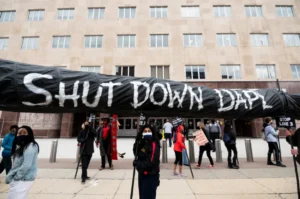
In a landmark decision that has sent shockwaves through the legal and public health communities, the U.S. Court of Appeals for the Fifth Circuit ruled on September 4, 2026, that residents of Jackson, Mississippi, do not possess a constitutional right to municipal drinking water free of toxic lead, nor a right to receive truthful information from public officials regarding the safety of their water supply. The ruling, delivered by Judge Kurt D. Engelhardt, effectively shuts the door on a high-profile class-action lawsuit filed by citizens who alleged that the city knowingly allowed hazardous levels of lead to persist in the water system while actively deceiving the public about its safety.
The majority opinion, written by Judge Engelhardt, underscored a narrow interpretation of constitutional protections, asserting that the federal judiciary is not a venue for addressing every instance of government mismanagement or negligence. By declining to recognize the "right to be free from exposure to contaminated water" and the "right to accurate information from public officials," the court has established a significant legal precedent that places the burden of remediation squarely on the shoulders of state-level tort law and the electoral process, rather than federal civil rights litigation.
A Timeline of Crisis and Legal Conflict
The roots of the litigation trace back to the systemic failure of Jackson’s water infrastructure, which has plagued the city of 150,000 residents for years. The crisis reached a boiling point in 2022, when a group of residents filed a federal lawsuit against the city. The plaintiffs contended that the city’s municipal water system had become heavily contaminated with lead, a potent neurotoxin, and that local authorities were aware of the contamination but failed to disclose the severity of the situation to the public.
The legal journey of the case has been marked by significant volatility. After the initial filing in 2022, the case wound its way through the federal court system, eventually landing before a three-judge panel of the Fifth U.S. Circuit Court of Appeals. In November 2025, that panel issued a ruling that favored the plaintiffs, allowing the claims regarding the city’s alleged deception and failure to provide safe water to move forward toward discovery.
However, the legal landscape shifted dramatically when the full Fifth Circuit court took up the case. The September 2026 en banc decision overturned the previous progress, effectively stripping the plaintiffs of their primary federal cause of action. The court’s decision leaves the residents of Jackson with limited recourse, specifically directing them to pursue civil tort claims—legal actions intended to provide financial compensation—and to use the political ballot box to demand changes in municipal leadership.
The Human Toll: Lead Poisoning and Vulnerable Populations
The impact of the water crisis in Jackson is not merely an abstract legal debate; it is a profound public health concern. According to census data, nearly 25% of Jackson’s population consists of children under the age of 18. This demographic is particularly susceptible to the irreversible damage caused by lead exposure.
Lead is a heavy metal that interferes with the development of the human nervous system. For children, even low levels of exposure are associated with a range of permanent health issues, including significantly lowered IQ, impaired executive function, behavioral problems, seizures, and stunted brain development. The plaintiffs in the 2026 case highlighted this reality, citing children within their own community who have been diagnosed with lead poisoning. These families are now grappling with the lifelong costs associated with specialized educational services, medical interventions, and long-term disability support.
Public health experts have long emphasized that the "right to know" what is in one’s water is not a luxury, but a necessity for basic survival and health preservation. Caroline Leary, general counsel at the Environmental Working Group, emphasized in a recent statement that the failure to communicate risks effectively denies citizens the ability to protect their families from avoidable, permanent neurological injury.

Dissenting Opinions and the "State-Created Danger" Doctrine
The Fifth Circuit’s decision was not unanimous. Judge Catharina Haynes, writing in the dissent, provided a sharp rebuke to the majority, arguing that the court failed to apply the "state-created danger" doctrine. This legal theory holds that the government can be held liable if it affirmatively acts to create or increase a risk to an individual’s safety.
Judge Haynes noted that the plaintiffs’ allegations—that the city knew of the lead contamination and lied about it—are highly plausible and, if true, constitute a clear instance where government action exacerbated the danger to the public. This doctrine has been adopted by at least 10 other federal appellate circuits across the United States, suggesting that the Fifth Circuit’s decision puts it at odds with a broader national trend in constitutional jurisprudence.
Pat Parenteau, an emeritus law professor at the Vermont Law School, characterized the ruling as a "travesty." Parenteau argues that the federal courts have historically recognized that the government cannot act with deliberate indifference to the physical integrity of its citizens. By denying the plaintiffs the right to enter the discovery phase of the trial, the court has prevented the public from ever seeing the internal communications and evidence that might confirm whether city officials knowingly endangered the health of their constituents.
Broader Implications for Municipal Accountability
The implications of this ruling extend far beyond the borders of Jackson, Mississippi. By determining that the U.S. Constitution does not mandate a baseline level of safety for municipal water, nor a requirement for transparency regarding utility hazards, the court has created a significant hurdle for future environmental justice cases.
Legal analysts suggest that this decision may discourage citizens in other municipalities from seeking federal protection when their local governments fail to provide basic infrastructure. If the federal courts refuse to recognize bodily integrity in the context of contaminated public utilities, the responsibility for oversight falls entirely on state and local regulatory agencies, which may lack the resources, independence, or political will to hold powerful entities accountable.
Furthermore, the court’s suggestion that citizens should simply "elect representatives who will better manage the public-water system" has been met with skepticism by civil rights advocates. In many urban centers, political power is often constrained by systemic poverty, lack of tax revenue, and aging infrastructure, making the process of "voting out" negligence a long and arduous path that does little to address immediate health crises.
The Path Forward: Tort Law vs. Constitutional Rights
With the federal constitutional path effectively closed, the legal battle for the residents of Jackson now shifts toward the state court system. Tort law provides a mechanism for individuals to seek monetary damages for injuries caused by the negligence or misconduct of others. However, unlike constitutional litigation, which can force systemic changes and government transparency, tort law is primarily compensatory. It compensates for harm already done but does not necessarily compel the immediate, massive infrastructure upgrades required to fix a city’s water system.
As the residents of Jackson look toward the future, the legal community remains divided on the long-term consequences of this ruling. While some legal scholars view the decision as a strict and proper adherence to the limits of the Constitution, others see it as a retreat from the fundamental role of the judiciary in protecting the most basic human rights of the citizenry.
The struggle in Jackson serves as a stark reminder of the intersection between civil rights and environmental policy. As infrastructure across the United States continues to age, the question of whether a citizen has a constitutional right to safe, clean water—and the truth about what is flowing through their pipes—remains an unresolved and critical point of contention in American society. Whether this ruling will prompt a new wave of legislative action to codify these rights, or whether it marks the beginning of a decline in federal environmental accountability, remains to be seen. For now, the families in Jackson continue to live with the consequences of a system that, according to the federal court, is not constitutionally obligated to ensure their water is safe or that the information they receive about it is true.