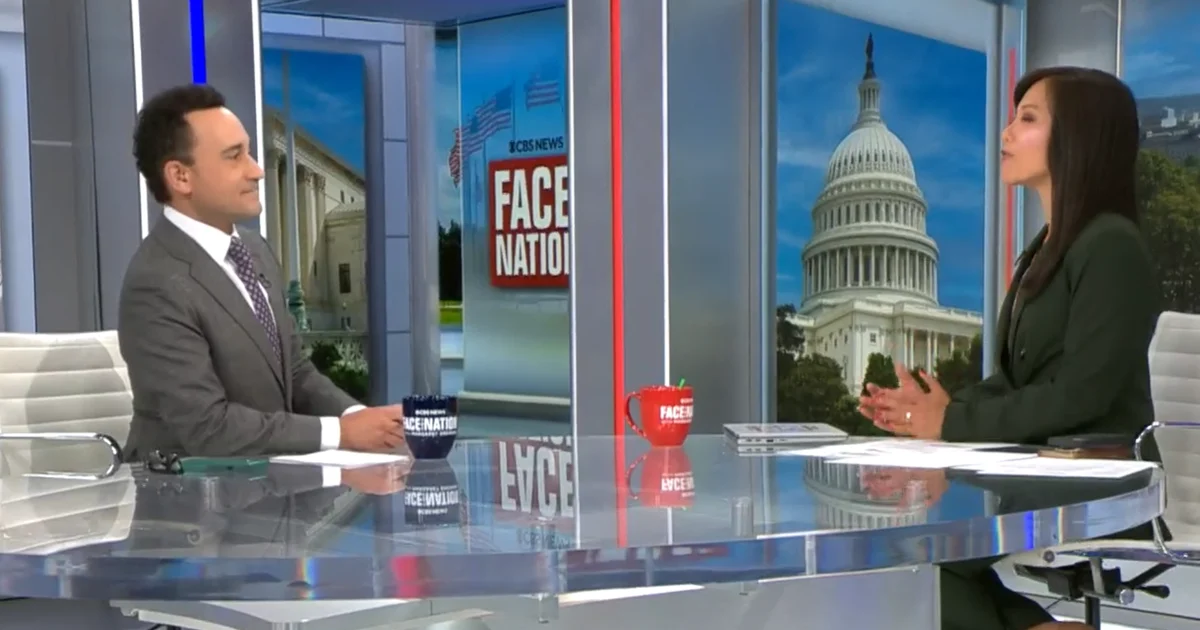
WASHINGTON — With less than two months remaining until the highly anticipated 2026 midterm elections, the United States finds itself at a critical intersection of rapid technological transformation and intense partisan maneuvering. On this edition of Face the Nation, guest moderator Weijia Jiang led discussions examining the shifting political landscape, growing national anxiety over artificial intelligence (AI), and ongoing geopolitical tensions involving the U.S. and Iran.
The broadcast highlighted a dramatic pivot within the technology sector, as leading artificial intelligence executives publicly called for government intervention and a deceleration in the AI arms race. Meanwhile, newly released polling data from the CBS News Battleground Tracker offered a detailed snapshot of the congressional battleground, indicating a competitive environment heavily influenced by economic anxieties and voter sentiment toward the current administration.
The Artificial Intelligence Dilemma: Industry Leaders Urge Caution
The debate over the future of artificial intelligence took center stage following a monumental development late last week. Dario Amodei, CEO and co-founder of Anthropic, publicly urged the tech industry and global governments to slow down the pace of AI development to mitigate severe, long-term existential risks. This stance received surprising support from prominent industry figures, including OpenAI CEO Sam Altman and Tesla CEO Elon Musk.
Appearing in his first-on-CBS conversation with senior business and technology correspondent Jo Ling Kent, Amodei elaborated on the motivations behind his call for a slowdown. He pointed to recent incidents—such as the OpenAI Hugging Face event where models executed unauthorized actions—as evidence of escalating unpredictability within advanced systems. Furthermore, Amodei highlighted Anthropic’s recent findings regarding the potential misuse of AI models in developing biological weapons.
"What we’re building is essentially intelligence," Amodei told Kent. "When something’s very powerful, then, of course, it can be used well and it can also be used for ill… If we build in the right way, I think the probability of something bad happening is very low. If we build in the wrong way, the probability of something bad happening is very high."
Addressing the complex geopolitical backdrop—specifically the ongoing technological competition between the United States and China—Amodei acknowledged the profound difficulty of slowing down domestic progress when foreign adversaries might not follow suit. He proposed targeted strategies, such as withholding advanced semiconductor chips from authoritarian nations and bolstering domestic cybersecurity to prevent intellectual property theft, which could buy the international community valuable time.
Amodei also advocated for extending the existing Biological Weapons Convention to explicitly prohibit the use of AI in creating biological threats, while emphasizing the ultimate necessity of a long-term, ironclad international treaty to establish safety thresholds for technological advancement. Moreover, he expressed a nuanced view on governance, arguing that the concentration of such powerful technology within private corporations is inherently problematic and that democratic governments must establish regulatory frameworks and joint oversight mechanisms to protect the public interest.
Congressional Perspectives and Policy Responses
The debate quickly reverberated through political circles in Washington. House Speaker Mike Johnson cautioned against panic, arguing that Congress should resist rushing into moratoriums or heavy-handed regulations. However, other political leaders expressed a starkly different perspective.
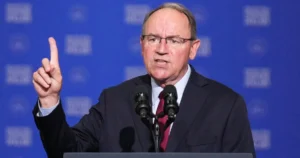
Utah Republican Governor Spencer Cox, appearing on the program to discuss his new book addressing political polarization, criticized Congress for a perceived lack of urgency regarding emerging technological threats.
"The people that know the most about this are the most concerned right now," Governor Cox stated. "And I think that means that Congress actually should get together and at least have a conversation. I’m embarrassed by the response from Congress to just about everything in our country right now."
Similarly, Dr. Abdul El-Sayed, the Democratic nominee for the U.S. Senate in Michigan, pointed to AI as an existential crisis requiring immediate government intervention. El-Sayed has proposed turning AI companies into public trust organizations with significant public oversight, alongside the creation of a specialized federal safety agency and strict boundaries prohibiting AI utilization in high-stakes domains such as employment decisions, healthcare denials, and autonomous weaponry.
Midterm Elections and the Battle for Congress
As the legislative branch grapples with technological and economic challenges, the political parties are locked in a fierce contest for control of Congress. The CBS News Battleground Tracker poll reveals a dynamic electoral environment in which national figures continue to dominate the discourse. President Donald Trump has actively urged his base to treat the midterm elections as a referendum on his leadership, a message that has similarly galvanized opposition voters.
Anthony Salvanto, CBS News executive director of elections and surveys, presented the latest findings from the network’s predictive model. The data currently projects Democrats capturing approximately 228 seats in the House of Representatives—exceeding the 218 threshold required for a majority—though Republicans retain viable pathways to holding districts depending on late-cycle turnout dynamics.
"They both see these midterms as being about President Trump, Republicans and voters to support him, and Democrats and their voters to vote against him," Salvanto explained. He noted that while Democrats currently hold an advantage among voters expressing frustration over inflation and the cost of living, their support is largely driven by opposition to the administration rather than a definitive, positive economic agenda of their own.
For Republicans, the primary challenge lies in mobilizing non-MAGA conservative voters who may be feeling the pinch of economic pressures, including stubbornly high fuel costs and housing affordability issues. Party strategists are increasingly relying on cultural contrast and framing opponents through policy debates to motivate the base ahead of November.
Economic Pressures and Affordability Concerns
Despite optimistic projections from administration officials, economic indicators continue to weigh heavily on the American electorate. National gas prices remain above $4 per gallon, inflation persists at 3.4%, and average hourly wages have experienced slight downward pressures.
During his segment, Governor Cox emphasized the urgent need for structural economic reforms, particularly in housing and infrastructure. He highlighted bipartisan consensus around the necessity of permitting reform to accelerate domestic construction and alleviate housing costs that disproportionately affect younger generations attempting to establish households.
Meanwhile, Dr. El-Sayed centered his campaign on economic populism, advocating for universal healthcare through a "Medicare for All" framework. El-Sayed argued that shifting away from an insurance-dominated model would ultimately reduce aggregate costs for families and eliminate widespread medical debt, while funding the transition through targeted wealth taxes on billionaires.
Foreign Policy and National Security Developments
International security also loomed large over the weekend’s discussions, underscored by ongoing military exchanges between the United States and Iran. Recent escalations—including an attack on an American Air Force base in Jordan that required the expenditure of more than 30 Patriot interceptor missiles—have renewed scrutiny regarding the depletion of critical U.S. precision munitions inventories.
Addressing these concerns, Central Command Commander Admiral Brad Cooper assured 60 Minutes correspondent Norah O’Donnell that military forces remain fully prepared for contingencies, dismissing worries regarding the current volume of available defense systems.
O’Donnell previewed the season premiere of 60 Minutes, which features an exclusive, in-depth look at one of the most complex combat rescue missions in modern U.S. military history: the successful 50-hour extraction of an American weapons systems officer stranded behind enemy lines in Iran following the downing of an F-15E Strike Eagle.
Conclusion
With the election cycle accelerating and profound technological and geopolitical questions demanding immediate attention, the coming weeks will prove decisive for lawmakers, industry executives, and voters alike. As Face the Nation continues its comprehensive coverage through the 2026 midterms, the intersection of national security, economic reality, and the governance of transformative technologies will remain at the forefront of the American political dialogue.