The expansion of curbside organic waste collection across North America represents one of the most significant shifts in modern municipal sanitation. According to comprehensive data from BioCycle’s nationwide surveys, the number of U.S. households with access to dedicated food scrap collection surged by 49 percent over a two-year period, climbing from 10 million to 14.9 million households. This rapid infrastructure deployment aligns with mounting regulatory and environmental pressures to divert organic matter away from municipal landfills, where it accounts for roughly 24 percent of incoming solid waste and serves as the single largest contributor of fugitive methane emissions, generating an estimated 58 percent of landfill-derived methane releases according to the U.S. Environmental Protection Agency (EPA).
Despite the rapid proliferation of green bins—alternatively known in various jurisdictions as brown bins, organics carts, or food scrap containers—municipalities face a persistent and formidable hurdle: user participation. Reported program engagement varies dramatically by region, ranging from near-universal adoption in select progressive municipalities to stagnant participation rates dipping below 30 percent in others. This stark participation gap directly undermines municipal climate targets. An unutilized green bin is far from a neutral environmental outcome; it represents wasted public investment, unrealized methane reduction, and organic material continuing to generate greenhouse gases in anaerobic landfill environments.
The Behavioral Obstacles to Organic Waste Compliance
To understand why millions of households abandon curbside composting initiatives, waste management researchers and municipal administrators look beyond initial enthusiasm. While program drop-off is frequently attributed to consumer confusion regarding acceptable organic materials, missed collection schedules, or general inconvenience, frontline sanitation workers and municipal coordinators point to an unglamorous yet pervasive deterrent: the psychological and physical barrier of bin maintenance.

Organic waste is inherently moist. Produce is predominantly water, and as food scraps degrade within a countertop caddy or curbside cart, cellular breakdown releases significant liquid volumes. In a traditional curbside setup, loose scraps or thin, failing bags rest directly against the interior floors and walls of the bin. This leachate pools at the base, creating a sticky, foul-smelling residue that rapidly attracts insects, flies, and vertebrate scavengers such as raccoons and rodents.
For the average homeowner, the resulting chore—scrubbing decomposing organic sludge from the deep recesses of a 64-gallon plastic cart—is frequently cited as the tipping point where convenience yields to avoidance. Over time, the cumulative friction of cleaning a foul bin leads residents to quietly phase out their composting habits, reverting all kitchen waste back to the general refuse stream.
International municipal case studies underscore the impact of mitigating this logistical friction. Between 2023 and 2024, the Essex County Council in the United Kingdom implemented a year-long Food Recycling Project targeted at more than 375,000 households. By distributing a comprehensive household toolkit consisting of an informational leaflet, a high-visibility waste bin sticker, and complimentary rolls of certified compostable liners, the council sought to ease the operational burden of sorting and containing food waste. Within the first three months following the distribution, food recycling tonnage increased by an average of 21 percent compared to a designated control group—more than double the council’s initial 10 percent diversion target.
While municipal subsidies such as free liner giveaways demonstrably boost short-term compliance, they represent a recurring fiscal expenditure that most local governments cannot sustain indefinitely. Consequently, urban planners and sanitation experts are increasingly evaluating passive, consumer-funded mechanical innovations designed to eliminate the root cause of bin contamination without imposing ongoing administrative costs on municipal budgets.

Quantifying Household Food Generation Realities
A critical miscalculation in many municipal organics programs involves the scaling of containment infrastructure. Households are frequently issued massive, standardized curbside carts designed to accommodate both yard trimmings and weekly food refuse. However, empirical data regarding actual household waste generation reveals a significant mismatch between container capacity and consumer output.
The MITRE-Gallup survey, representing the largest household food-waste study conducted in the United States to date, surveyed nearly 10,000 households to establish baseline metrics on domestic waste generation. The study found that the average American household discards approximately 6.2 cups of edible food waste per week, increasing to roughly 8.8 cups when factoring in inedible components such as vegetable peels, fruit cores, and bones. This total equates to slightly more than half a gallon of waste weekly.
Even among households generating waste well above the national statistical median, weekly food scraps fall drastically short of filling a standard municipal organics cart. Recognizing this discrepancy has shifted the focus of waste management strategies toward right-sizing the collection mechanism inside the cart. By utilizing a standard 13-gallon (49-liter) kitchen bag suspended securely within the larger municipal container, households can effectively isolate their waste without purchasing oversized, specialized commercial liners or attempting to line the entirety of a massive curbside bin.
Technological Interventions and Airflow Mechanics
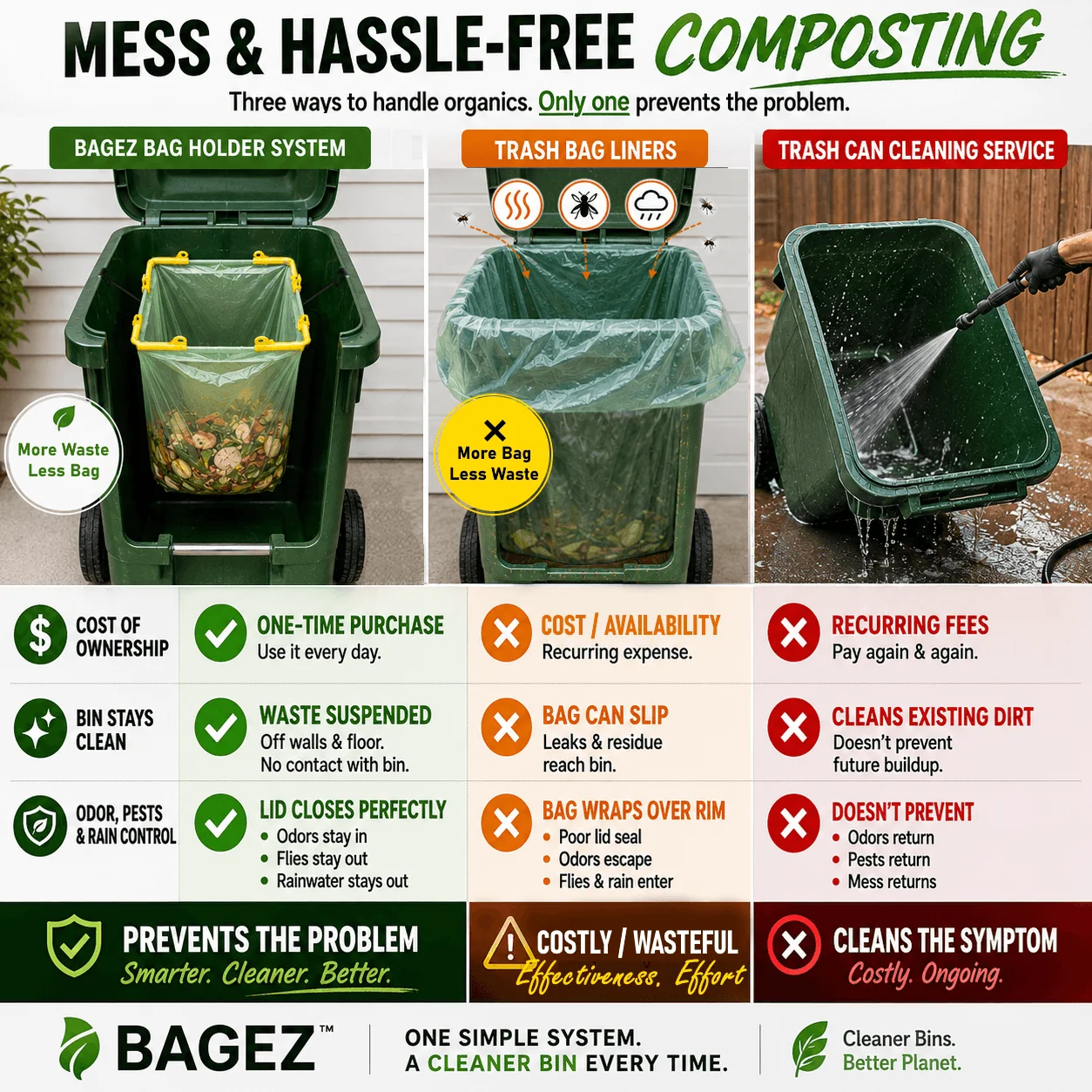
Addressing the physical mechanics of bin contamination requires interrupting the direct contact between degrading organic waste and the interior surfaces of the collection cart. Mechanical devices such as BagEZ—a folding steel rack equipped with specialized locking clips—have emerged as practical tools to solve this structural dilemma.

The device operates on a straightforward principle: a standard kitchen bag is locked onto a rigid steel frame that grips the interior rim of the municipal bin, suspending the bag in mid-air. By keeping the bag elevated, waste is directed entirely into the liner rather than against the cart’s walls. Crucially, this elevation permits continuous airflow around all exterior surfaces of the bag. Condensation and moisture migrating through the permeable bag material are allowed to evaporate naturally rather than pooling into a stagnant puddle at the bottom of the container.
This unimpeded airflow fundamentally alters the micro-environment within the bin. Without standing liquid, the chemical reactions that produce pungent volatile organic compounds are significantly curtailed. Furthermore, maintaining a dry internal environment enhances the efficacy of basic household odor and pest management techniques. Traditional interventions, such as dusting the bin floor with baking soda or applying food-grade diatomaceous earth to deter fly larvae, historically failed because moisture instantly deactivated the powders. In a dry, suspended containment system, these preventative measures retain their structural integrity.
Additional low-cost strategies complement mechanical suspension systems. Placing a few layers of newsprint beneath the suspended bag provides an immediate safety buffer against accidental bag punctures, while natural deterrents—such as cloth sachets infused with peppermint and clove oils tied to the exterior handles—disrupt the olfactory receptors of mammalian scavengers, rendering the bin chemically unappealing to local wildlife.
Regulatory Compliance and Program Integrity
While containment innovations streamline the user experience, municipal program administrators emphasize that technological adaptations must strictly adhere to local waste-hauling regulations. Composting facilities and anaerobic digestion plants operate under rigid contamination thresholds. Introducing non-approved plastics, inappropriate liner materials, or prohibited packaging into a curbside organics cart can result in municipal haulers skipping collection entirely or flagging an entire truckload for hazardous contamination, leading to heavy municipal fines or the rejection of the load at processing facilities.

Waste management authorities strongly encourage residents to verify acceptable organic materials and liner specifications through regional sorting tools, such as the Earth911 national recycling search database, before altering their domestic waste-handling routines. Programs vary significantly across North America; while some municipalities mandate certified compostable bags, others require paper bagging or enforce strict zero-bag policies where materials must be deposited loose.
Broader Implications for Municipal Climate Action
The intersection of behavioral psychology, household mechanics, and municipal sanitation underscores a vital truth for modern environmental policy: infrastructure alone does not guarantee ecological outcomes. As urban centers strive to meet ambitious net-zero carbon targets and divert millions of tons of organic waste from landfills, bridging the participation gap requires lowering the day-to-day friction experienced by individual residents.
By transforming green bin maintenance from an unpleasant, labor-intensive chore into a clean, manageable routine, municipalities and consumers alike can protect environmental investments. Ensuring that organic waste streams remain uncontaminated, odor-free, and structurally contained removes the primary psychological barrier keeping citizens from engaging with municipal diversion programs. Ultimately, optimizing the final link in the residential waste chain ensures that public infrastructure functions as intended, converting domestic food scraps into valuable compost and renewable energy while directly suppressing fugitive methane emissions across the continent.