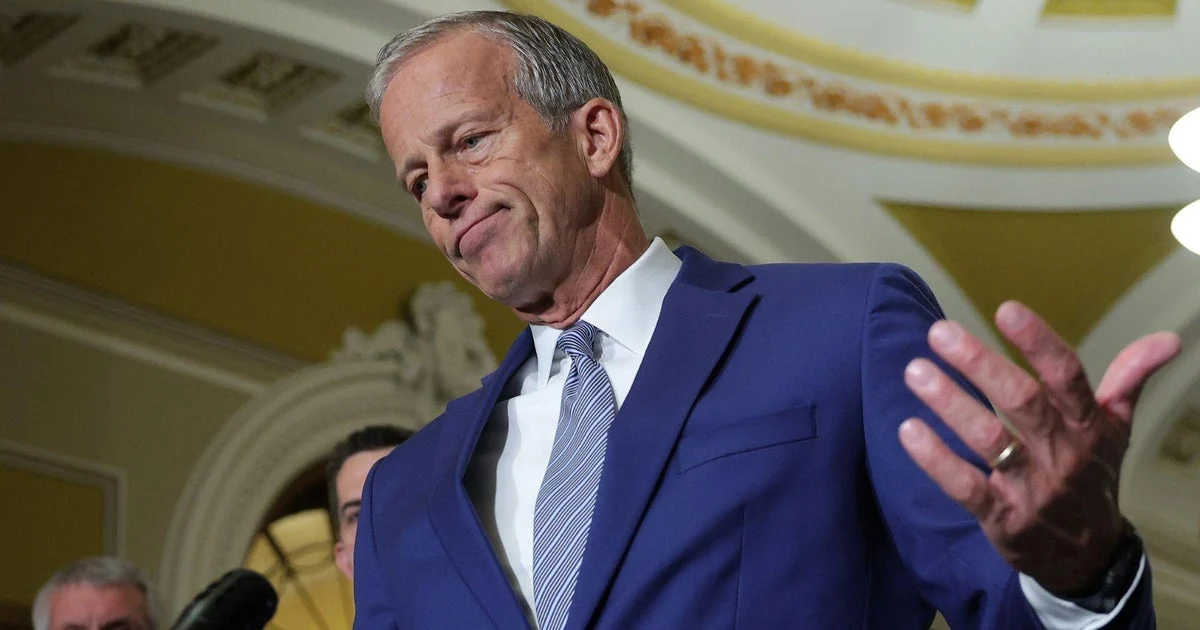
WASHINGTON — Senate Majority Leader John Thune announced Wednesday that it remains an open question whether the Republican conference possesses the unified support necessary to advance a massive $350 billion defense package along strict party lines before the end of the year. The legislative deliberation follows mounting pressure from the Trump administration for an immediate fiscal infusion into the Pentagon before Democrats assume control of the upper chamber.
The debate underscores the high-stakes legislative maneuvering characterizing the final weeks of the current congressional session. Senate Republicans have spent recent days weighing whether to utilize the budget reconciliation process for the third time under the second Trump administration. This procedural tool would enable the GOP to bypass the standard 60-vote filibuster threshold, passing the Pentagon’s request with a simple majority. However, the path forward is fraught with procedural hurdles, internal caucus divisions, and a rapidly shrinking legislative calendar.
The Lame-Duck Pressure Cooker and the Reconciliation Dilemma
The push for rapid defense funding has accelerated due to growing concerns among defense hawks that incoming Democratic congressional leadership will scale back military expenditures. Opponents of ongoing conflicts, particularly regarding military engagement with Iran, are widely expected to resist large-scale supplemental defense outlays.
Following a series of closed-door Republican conference meetings on Wednesday, Senator Thune indicated that lawmakers are continuing to evaluate all available options. While reconciliation remains on the table, leadership is also assessing whether a bipartisan approach through the normal appropriations process might yield a viable alternative.
Utilizing reconciliation to
pass $350 billion in new defense spending would allow Republicans to sidestep potential Democratic opposition. Nevertheless, the mechanism triggers a complex and time-consuming legislative process known as a "vote-a-rama," during which senators can offer an unlimited number of amendments. These marathon voting sessions frequently stretch overnight, severely testing the endurance of the chamber.
Compounding the challenge is the severely limited schedule. The Senate is officially scheduled to remain in session for only three additional weeks before adjourning for the winter holidays. Compounding the urgency, control of the chamber shifts to Democratic leadership in the new year, placing a hard deadline on the current majority’s ability to dictate policy priorities without bipartisan consent.
Congressional and Administration Perspectives
Senate Budget Committee Chairman Ron Johnson of Wisconsin, whose committee would be tasked with initiating the reconciliation package, told reporters that the conference is unlikely to advance a reconciliation bill immediately. However, he emphasized that leadership is "not taking it off the table at all."
Senator Thune echoed a similar sentiment regarding the timeline, noting that a window of opportunity remains even if action is deferred past the Thanksgiving holiday. When questioned about the feasibility of initiating the process within the week, Thune responded cautiously, characterizing it strictly as an available option.
The legislative debate was further fueled by a closed-door briefing between Deputy Defense Secretary Steve Feinberg and Senate Republicans during a midday lunch meeting. Prior to the briefing, Thune stressed to reporters that the administration bore the responsibility of making a compelling case to skeptical members of the caucus, confirming top-line funding figures, and justifying the urgency of the request.
"And I think to confirm, obviously, what a lot of our defense hawks have been saying, and that is that we’re running out of everything, and that if we’re to defend the country, we need a significant amount of funding for defense, which probably isn’t going to happen through the normal appropriations process of the Democrats," Thune stated ahead of the meeting. "He’s got to make that argument and persuade enough Republicans to get to 50."
Following the session, when asked why leadership believed Democrats might cooperate on military funding, Thune acknowledged the uncertainty surrounding the opposition’s stance. "I don’t know that they will, but we think that we ought to at least explore that possibility," he said. "I think that’s kind of a consensus view that our members have at the moment, and there are multiple ways in which we can do that. So we’re working through it."
Broader Infrastructure Funding and Competing Priorities
Defense spending is not the only fiscal priority competing for space in a potential year-end reconciliation vehicle. Senate Republicans have also weighed packaging supplemental funding for the Federal Aviation Administration (FAA) into the budget process.
That consideration follows a high-profile technology outage last week that triggered a rare nationwide ground stop, paralyzing commercial aviation and drawing intense scrutiny to the nation’s aging air traffic infrastructure. Transportation Secretary Sean Duffy met with Senate Republicans on Tuesday to present a request for $50 billion to overhaul the system. Despite the urgency highlighted by the outage, lawmakers emerged from the meeting exhibiting considerable skepticism toward the proposed price tag, complicating any effort to bundle the aviation funds with the defense package.
Historical Precedent Under the Second Trump Administration
The current deliberations occur against a backdrop of aggressive legislative utilization of budget reconciliation by congressional Republicans during the current presidential term.
Last year, the GOP successfully navigated a massive defense, policy, and tax agenda through the reconciliation process, overcoming internal policy disagreements to secure passage of President Trump’s primary legislative platform. More recently, earlier this year, Republicans deployed reconciliation a second time to force through emergency funding for Department of Homeland Security immigration enforcement agencies.
That earlier measure became necessary after months of legislative gridlock, driven by Democratic refusals to appropriate funds without substantial accountability reforms. The political standoff had intensified following a controversial incident earlier in the year in Minneapolis, where federal law enforcement agents fatally shot two American citizens, sparking national protests and a protracted congressional stalemate over border and interior enforcement budgets.
Chronology of Recent Legislative and Executive Actions
- Earlier This Year: Federal law enforcement incident in Minneapolis triggers prolonged congressional debate over Department of Homeland Security funding and accountability reforms.
- Mid-2026: Congressional Republicans utilize the budget reconciliation process for a second time in the administration to pass DHS immigration enforcement funding.
- November 2026: A critical system outage at L3Harris leads to a nationwide FAA ground stop, placing civil aviation infrastructure at the forefront of legislative debates.
- Tuesday, November 17, 2026: Transportation Secretary Sean Duffy meets with Senate Republicans to request $50 billion for FAA system modernization, meeting with widespread skepticism.
- Wednesday, November 18, 2026: Deputy Defense Secretary Steve Feinberg holds a closed-door briefing with Senate Republicans to advocate for a $350 billion Pentagon funding boost.
- Wednesday Afternoon, November 18, 2026: Senate Majority Leader John Thune addresses the press, declaring that securing party-line votes for a defense reconciliation package by the end of the year remains an "open question."
Fact-Based Analysis of Implications
The choice facing Senate leadership carries profound implications for civil-military relations, federal budgeting, and the political dynamics of the upcoming 110th Congress.
Opting for a party-line reconciliation package would allow the Trump administration to secure its desired defense baseline without making major policy concessions to the incoming congressional majority. However, forcing such a measure through a divided caucus with a razor-thin majority risks internal dissent, particularly from fiscal conservatives wary of expanding national debt or overusing a procedural mechanism originally designed strictly for budgetary adjustments.
Conversely, attempting to pursue a bipartisan path through regular appropriations risks severe delays or outright failure, given the fundamental philosophical divides over foreign policy, defense outlays, and strategic priorities in the Middle East. With only a three-week legislative window remaining before the holiday recess and the formal transition of chamber control, Republican leaders face a compressed timeline that leaves little margin for error as they navigate competing demands from the Pentagon, the Department of Transportation, and their own rank-and-file members.