The intersection of fine art and high fashion has long been a fertile ground for creative experimentation, yet few designers manage to inhabit both worlds with the technical rigor demonstrated by Naeem Khan. Operating at the helm of an established luxury label requires immense dedication, particularly amid ongoing macroeconomic volatility that has strained independent and legacy fashion houses alike. Despite these industry-wide pressures, Khan has quietly cultivated a parallel trajectory over the past several years as an accomplished fine artist. Collaborating with fellow artist Stanley Casselman under the collective moniker KACE, Khan has spent his recent off-hours mastering the canvas, a pursuit that has yielded surprising and commercially viable results as his artwork gains traction in contemporary galleries. This dual creative life profoundly influenced his latest runway presentation, resulting in a spring collection that translates the fluid dynamics, color theory, and composition of his paintings directly into wearable art.
Main Facts of the Spring Showcase
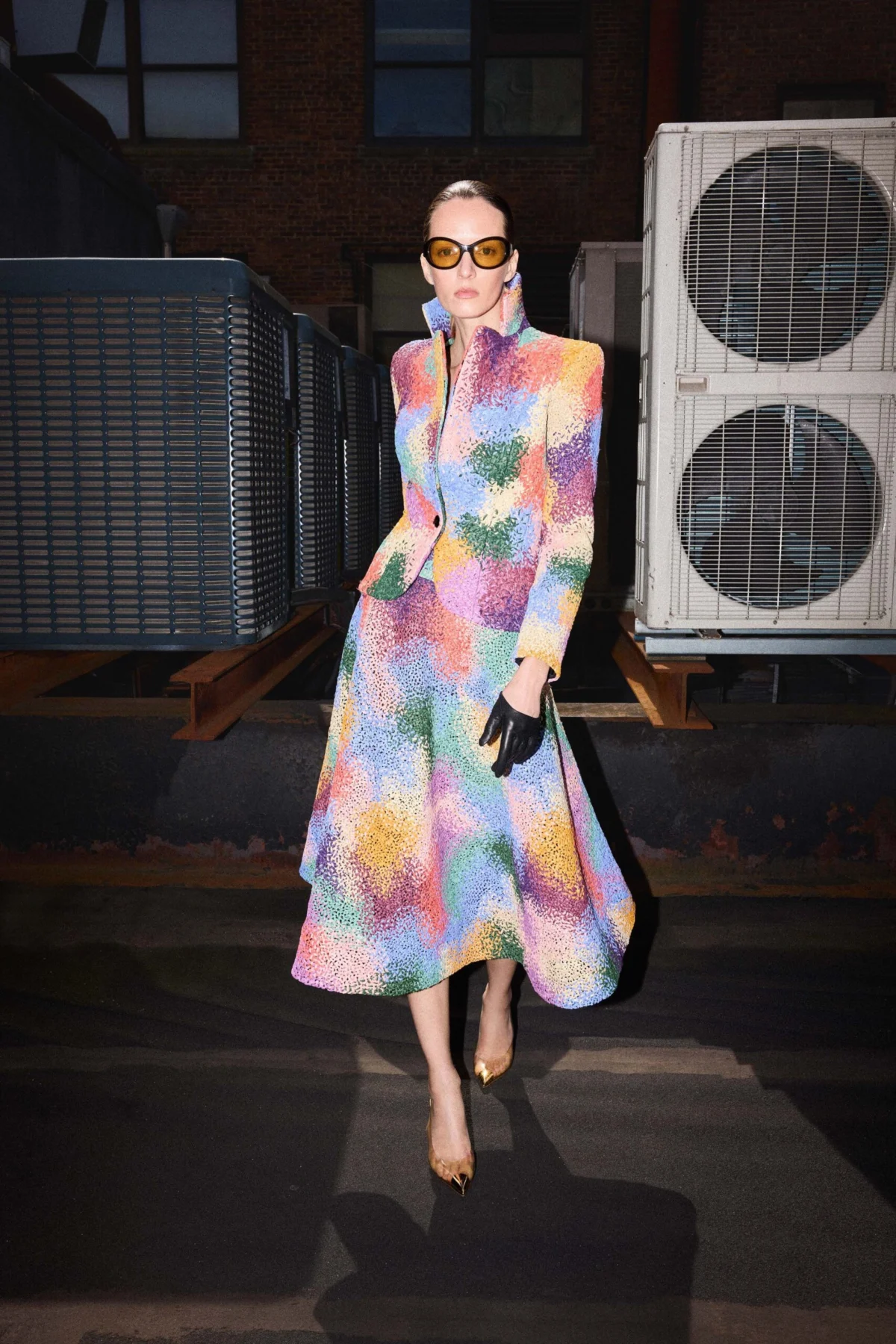
The core of Khan’s spring collection centers on an intensified exploration of his signature glitzy finishes, elevated this season by a deliberate fine-art methodology. Rather than merely applying decorative elements to traditional silhouettes, Khan approached the garment development process as if he were working on a blank canvas. This conceptual pivot was immediately evident in the opening look: a meticulously constructed blazer and skirt ensemble fashioned from hand-dyed raffia. The material was manipulated to evoke the delicate, translucent washes of a watercolor painting, utilizing soft pastels that set a contemplative yet vibrant tone for the rest of the presentation.
According to the designer, the entire color palette of the collection was directly lifted from his recent body of paintings, effectively mirroring the chemical and textural processes of his studio work onto fabrics such as silk, organza, and tulle. The second look further emphasized this artisanal approach, presenting a sheer miniature dress densely encrusted with hand-beaded multicolored florals, complete with three-dimensional fringed stems that added botanical depth. Throughout the runway show, Khan’s hallmark handwork—long celebrated by red-carpet stylists and private clients alike—took on a bolder, more experimental dimension, demonstrating that the designer is willing to take calculated risks with texture and scale.
Chronology and Evolution of the KACE Collaboration
The genesis of this collection can be traced back several years to the quiet incubation of Khan’s painting practice. As global supply chains faced disruptions and the retail landscape shifted following the pandemic, many designers sought solace or renewed inspiration outside the traditional fashion calendar. For Khan, this manifested in an intensive immersion into abstract painting alongside Stanley Casselman. The partnership, operating under the name KACE, allowed Khan to step away from the rigid structural requirements of garment construction and embrace the improvisational nature of paint on canvas.
Over the last 24 months, works produced by KACE began circulating within select private collections and art circles, signaling a legitimate transition from a therapeutic pastime to a recognized secondary career. This chronology is crucial to understanding the spring collection; the garments shown on the runway are the direct evolutionary outcome of years spent experimenting with pigment, layering, and scale in a fine-art context. By bringing these lessons back into the atelier, Khan has successfully closed the loop between his two creative outlets, establishing a chronological bridge where his studio paintings inform his runway pieces, and vice versa.
Supporting Data and Technical Mastery
The technical execution of the collection required advanced textile engineering and hours of painstaking hand-embellishment, hallmarks of Khan’s eponymous label. Among the standout pieces was a statement-making cherry blossoms gown, constructed entirely from laser-cut fabric petals that created a cascading, three-dimensional floral canopy. This reliance on modern laser-cutting technology combined with traditional hand-assembly illustrates the brand’s commitment to blending innovation with heritage craftsmanship.
Further highlighting this balance of playfulness and precision was a pastel-blue mini dress entirely covered in soft feathers, designed to capture the buoyant energy of post-pandemic celebratory dressing. Similarly, a beaded fringe miniature dress utilized an intricate ombré technique, seamlessly transitioning from an ethereal sky blue to a metallic silver. Perhaps the most striking example of Khan’s mastery of composition and scale was a simple black top coat embellished with white pearls. Rather than applying the embellishments uniformly, Khan engineered the design so that the pearls graduated from sparse placements at the shoulders to densely bunched clusters at the waist, creating a powerful optical hourglass effect. This piece, owing to its architectural construction and artistic detailing, elicited widespread critical acclaim, with industry insiders noting its museum-worthy caliber.
Official Responses and Industry Reception
While traditional press releases from luxury fashion houses often lean heavily on marketing hyperbole, the reception to Khan’s artistic pivot has been grounded in genuine appreciation for his technical prowess. Industry critics and retail buyers who attended the presentation noted a palpable sense of joy and liberation in the way the garments were developed. Observers pointed out that Khan’s willingness to experiment with new mediums—such as the watercolored raffia and the laser-cut cherry blossom petals—signals a renewed creative confidence.
Colleagues and long-time collaborators have remarked on the synergy between Khan’s paintings and his couture output. In the fashion community, designers who successfully branch into the fine arts often keep the two disciplines strictly partitioned. Khan, however, has chosen a transparently integrated approach, publicly acknowledging how his work with Stanley Casselman under KACE has sharpened his eye for color blending and spatial composition. This openness has resonated well with fashion critics, who view the collection not as a departure from his core aesthetic, but as a sophisticated maturation of it.
Broader Impact and Market Implications
The intersection of fashion and fine art is a well-trodden path, frequently utilized for marketing campaigns, capsule collections, and museum exhibitions. However, Khan’s approach offers a distinct economic and creative model for independent luxury labels navigating a complex global market. By diversifying his creative output through KACE, Khan has insulated his artistic identity from the purely commercial pressures of the ready-to-wear seasonal cycle.
Furthermore, this cross-pollination between painting and couture enhances the intrinsic value of Khan’s garments. In an era where consumers increasingly demand authenticity, provenance, and hand-crafted excellence, pieces like the pearl-embellished top coat or the watercolor raffia suit justify their high luxury price points through visible, irreproducible labor. As high-end consumers gravitate toward items that possess narrative depth and artistic integrity, Khan’s fine-art integration positions his brand advantageously within the upper tier of the global luxury market. By treating his spring collection as a living gallery of his studio work, Naeem Khan has not only revitalized his brand’s aesthetic vocabulary but has also established a blueprint for how designers can successfully synthesize multiple creative disciplines without compromising commercial viability.