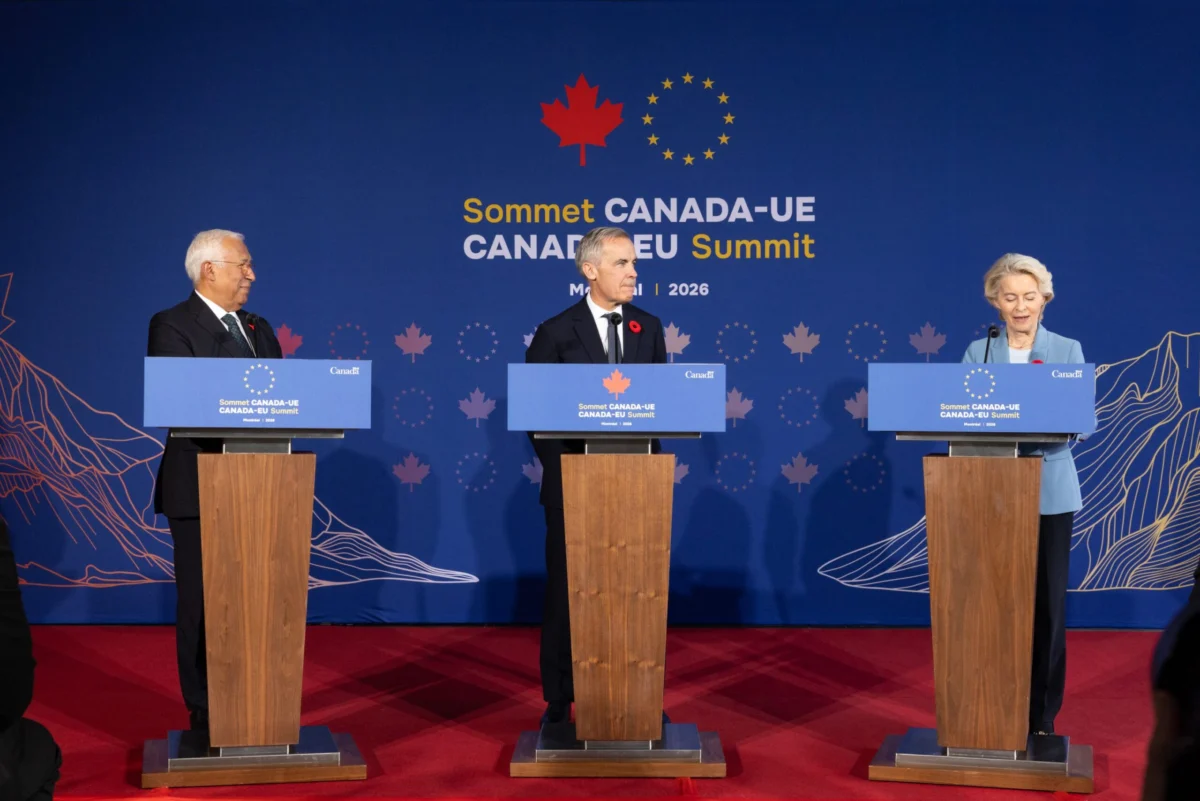
Canadian Prime Minister Mark Carney signaled a historic shift in North American foreign policy on Friday, announcing that Ottawa and Brussels are on track to finalize a landmark agreement by June. The proposed deal aims to establish Canada as the European Union’s first-ever "associate member," a status designed to fortify economic and security cooperation as both powers seek to insulate themselves from the growing volatility of the global order.
The announcement, delivered at the conclusion of a high-level summit in Montreal, follows years of escalating trade friction and diplomatic unpredictability stemming from Washington. Alongside European Commission President Ursula von der Leyen and European Council President António Costa, Carney unveiled the "Alliance for the Future," a multi-layered partnership intended to reduce reliance on the United States and provide a robust framework for autonomous decision-making.
The Strategic Pivot: A Response to Shifting Global Realities
The impetus for this alliance is rooted in the "headwinds" identified by von der Leyen—a reference to the protectionist trade policies and confrontational rhetoric emanating from the United States under President Donald Trump. With U.S. markets becoming increasingly weaponized through tariff threats and trade wars, Canada, which sent 71.7% of its merchandise exports to its southern neighbor in 2025, is seeking to diversify its economic dependencies.
For Canada, the move is framed as a long-term insurance policy. By integrating more deeply with the European single market, Ottawa aims to hedge against future shocks, ensuring that its economy remains anchored to stable, multilateral regulatory frameworks. Prime Minister Carney was emphatic that the alliance is not an act of hostility against the United States, but rather a proactive measure for self-determination. "It is about reinforcing sovereignty," Carney stated. "So we can live our lives as we choose, and have the full freedoms that people enjoy in the European Union and in Canada."
Chronology of the Montreal Summit and Future Milestones
The path to this "ever-closer association" began in earnest following recent diplomatic tensions, culminating in the two-day Montreal summit. The timeline for integration is aggressive:
- March 2026: Canadian Cabinet ministers are scheduled to hold preliminary planning sessions with their European Commission counterparts to harmonize regulatory standards.
- June 2026: Prime Minister Carney is slated to attend European Council meetings in Brussels, where the final terms of the "associate member" status are expected to be negotiated and ratified.
- 2027: The next formal summit is set as the deadline for defining the comprehensive "ever-closer association," moving beyond the initial framework established this week.
Economic and Technological Integration
The agreement extends far beyond traditional trade. The joint announcement highlighted several critical sectors where Canada and the EU intend to fuse their technological and industrial capacities:
Digital Trade and Artificial Intelligence: Canada and the EU concluded negotiations on a digital trade agreement designed to lower the barriers for tech firms operating across the Atlantic. By aligning data privacy and AI governance standards, the two powers hope to create a seamless digital ecosystem that can compete with the tech giants of Silicon Valley and Beijing.
Critical Minerals and Energy: In a move to secure supply chains, Canada signed a pact allowing the European Investment Bank to finance Canadian critical minerals projects. As Europe looks to transition to green energy, Canadian lithium, cobalt, and nickel are set to become vital commodities. Furthermore, the two parties have committed to a feasibility study on exporting Canadian liquefied natural gas (LNG) to Europe, a move that would provide the bloc with a more stable energy alternative to volatile global markets.
Supercomputing Initiative: Canada will join the European "JUPITER" supercomputing initiative. Prime Minister Carney noted the stark disparity in research capacity, observing that JUPITER can perform complex simulations in 24 hours that currently take Canada’s most advanced systems six months. This access is expected to catalyze breakthroughs in climate modeling, drug discovery, and cybersecurity.
Official Responses and the "Hostile Act" Controversy
The reaction from the United States has been immediate and skeptical. President Trump has publicly characterized the proposed partnership as a "hostile act," suggesting that any deviation from North American economic integration could trigger retaliatory tariffs.
Inside the European camp, however, the consensus is that the alliance is both necessary and overdue. European Council President António Costa noted that the relationship is being crafted to be unique in international law. "Our relationship is so special that we want to create something new: to go beyond a simple association, everything short of full EU membership," Costa said.
While the term "associate member" remains the preferred language of the leaders, the joint declaration released on Friday used the more cautious phrasing of an "ever-closer association." This nuance suggests that negotiators are navigating sensitive constitutional questions regarding how a non-European state can interact with EU supranational institutions without triggering internal political opposition in member states.
Broadening the Scope: Security and Education
The "Alliance for the Future" is not limited to economics. The two sides announced significant advancements in defense and security cooperation, focusing on:
- Arctic Security: As climate change opens northern shipping routes, Canada and the EU have pledged to coordinate on the surveillance and protection of the Arctic, an area of increasing geopolitical competition.
- Cybersecurity and Foreign Interference: A new border security arrangement will facilitate intelligence sharing to counter state-sponsored misinformation and cyber-attacks.
- Academic Exchange: Negotiations are underway to expand Canadian participation in the Erasmus+ program, which would allow thousands of students to move freely between Canadian and European universities, cementing the cultural and social bonds of the alliance.
Implications: A New Pillar of Global Governance
The decision to pivot toward the EU represents a fundamental reorientation of Canadian foreign policy. Since the mid-20th century, Canadian prosperity has been inextricably linked to the American economy. By aiming to double its non-U.S. exports over the next decade, the Canadian government is signaling that it no longer views the North American trade relationship as a sufficient guarantor of its long-term economic health.
From a geopolitical perspective, the creation of this alliance creates a new, albeit loose, power center. By combining Canada’s vast natural resources and strategic Arctic position with Europe’s regulatory weight and massive consumer market, the two parties are effectively creating a "third way" in global trade.
However, the path forward is not without risks. Canada faces the dual challenge of appeasing a volatile neighbor to the south while satisfying the complex, often bureaucratic, requirements of European integration. Whether the "associate membership" can survive the political pressures of the next few years remains to be seen.
As von der Leyen noted during her closing remarks, "These headwinds won’t stop blowing. This change is permanent." The emerging alliance suggests that Canada and Europe are betting on a future where regional sovereignty is protected not by isolation, but by the strategic pooling of assets, intelligence, and markets among like-minded partners. As negotiations head into the crucial June deadline, the world will be watching to see if this "ever-closer association" can serve as a template for a new era of international cooperation.