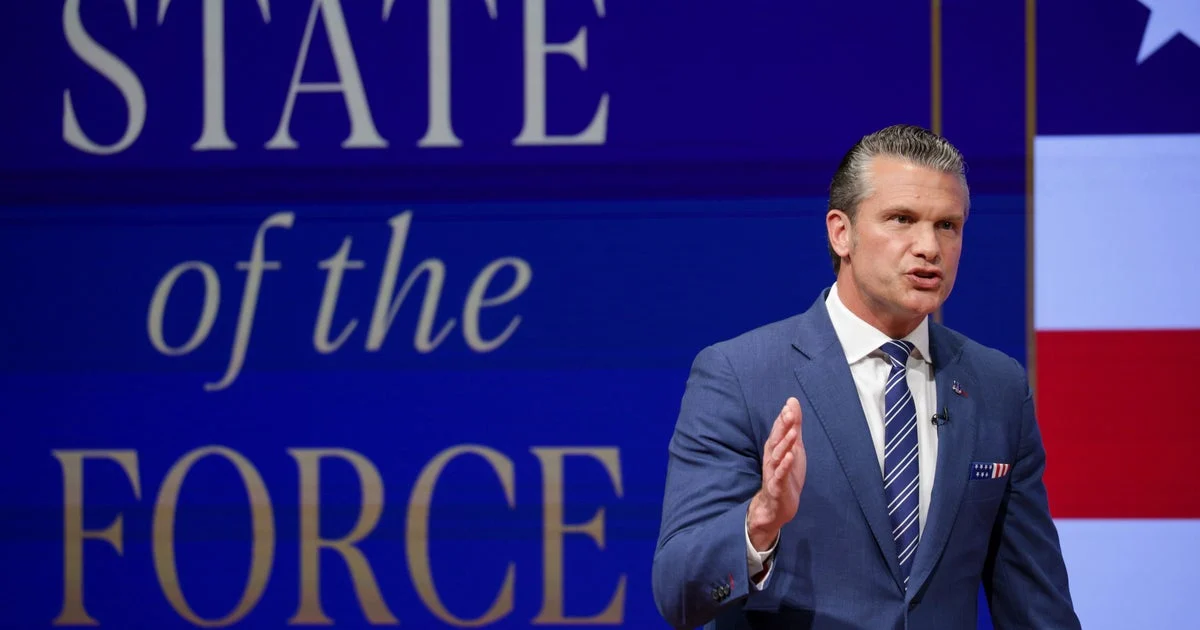
Defense Secretary Pete Hegseth announced during a high-profile address at Marine Corps Base Quantico in Virginia that the Department of Defense is eliminating approximately one in five generals and admirals across the United States armed forces. The sweeping restructuring combines the firing of select senior officers with the permanent elimination of high-level positions, marking one of the most aggressive personnel contractions in the modern history of the Pentagon.
The announcement, delivered during an event billed as the "State of the Force Address," aligns with the Trump administration’s overarching initiative to fundamentally reshape the culture, operational focus, and bureaucratic framework of the United States military. Hegseth characterized the massive downsizing not as a political purge—as critics have labeled the actions—but as a long-overdue measure of administrative accountability aimed at prioritizing lethality, efficiency, and unwavering civilian oversight.
The comprehensive shakeup comes at a pivotal moment for national defense, as the Pentagon seeks to recalibrate its strategic priorities toward great-power competition, technological modernization, and rapid force projection. By pruning the upper echelons of the military command structure, leadership aims to strip away perceived bureaucratic bloat that has accumulated over decades of complex coalition warfare and counterinsurgency operations.
Chronology of the Pentagon Command Restructuring
The reduction of flag and general officers is the culmination of a deliberate, multi-stage initiative that began shortly after the second Trump administration took office. The timeline of this systemic transformation highlights a methodical approach to altering the military’s top command tier:
- Late 2024 to Early 2025: Following the inauguration, Defense Secretary Hegseth immediately signaled a shift in military leadership criteria, initiating reviews of senior officer philosophies regarding mission focus and administrative priorities.
- May 2025: Hegseth formally issued a landmark one-page memorandum ordering a minimum 10 percent reduction across all active-duty flag and general officer ranks, alongside a steeper 20 percent cut within the National Guard. The directive explicitly tied the downsizing to the acceleration of innovation and the elimination of redundant bureaucratic layers.
- September 2025: Hegseth summoned hundreds of generals and admirals from around the globe to a historic meeting at Quantico, where he delivered sharp criticisms regarding military standards, appearance, and what the administration termed ideological drift within the ranks.
- Mid-2026: Throughout the spring and summer of 2026, the Department of Defense maintained active-duty general and flag officer counts hovering near statutory ceilings, balancing ongoing departures, retirements, and targeted removals.
- September 30, 2026: In his "State of the Force Address" at Quantico, Hegseth confirmed that the combination of targeted firings and structural slot eliminations had successfully achieved a cumulative 20 percent reduction across the board.
Supporting Data and Force Structure Metrics
To understand the scope of the Pentagon’s recent downsizing, it is necessary to examine the baseline personnel numbers governing the upper tiers of the U.S. military. Under federal law, the total number of active-duty general and flag officers across the Army, Navy, Marine Corps, Air Force, and Space Force is capped by Congress.
According to Defense Manpower Data Center workforce reports, the active-duty force maintained 848 generals and admirals in mid-2025, shifting slightly to 851 officers by July 2026. These figures operate within a congressional statutory limit codified at 857 active-duty flag and general officers, a ceiling designed to prevent unchecked growth in senior leadership billets relative to the overall end-strength of the armed forces.
Hegseth’s directive effectively implements a two-pronged reduction strategy: a direct personnel reduction of approximately 10 percent through administrative firings and forced retirements, paired with an additional 10 percent structural cut by permanently retiring vacant or superfluous general officer billets.
The cascading effects of these departures extend beyond the active-duty force. Since Hegseth assumed office, at least 20 high-profile generals, admirals, and senior civilian defense leaders have been forced out, resigned, or been terminated. This unprecedented turnover has reached the absolute apex of the military hierarchy, including the Chairman of the Joint Chiefs of Staff, the top uniformed service chiefs of the Army, Navy, and Air Force, and key civilian secretarial posts within the military departments.
Technological Modernization and Strategic Initiatives
Alongside the personnel reductions, Hegseth used the Quantico address to unveil major structural and technological initiatives intended to future-proof the armed forces. The centerpiece of these announcements was the creation of the Autonomous Warfare Command. This newly established four-star combatant command possesses service-like authorities designed to rapidly scale robotic and autonomous capabilities across the joint force. Defense officials have described the move as the fastest peacetime shift in modern military doctrine.
Furthermore, the Pentagon launched a 120-day strategic study titled "Project Meridian." This initiative is tasked with evaluating the future character of warfare and is led by an external advisory panel featuring technology entrepreneur Palmer Luckey, founder of defense tech firm Anduril; former House Speaker Newt Gingrich; and billionaire innovator Elon Musk.
In tandem with technological restructuring, the Department of Defense issued a formal call for state proposals to construct a new primary U.S. military base. Envisioned as a "Next Great American Base," the facility is intended to serve as a foundational hub for integrated defense operations, distributed command and control, and resilient cyber and technological capabilities.
To realign the pipeline of future military leadership, Hegseth also announced strategic partnerships with five higher education institutions—Louisiana State University, Liberty University, Tuskegee University, Mississippi State University, and Hillsdale College. These schools will establish new corps of cadets designated as distinguished military colleges, granting their graduates priority consideration for officer commissioning.
Official Responses and Stakeholder Perspectives
The aggressive restructuring has ignited a fierce debate among lawmakers, defense analysts, and former military officials regarding the appropriate size, scope, and culture of the military’s leadership tier.
Administration defenders and congressional allies argue that the reduction is a vital corrective to decades of administrative bloat. Proponents maintain that an overabundance of senior officers fosters risk aversion, stifles junior initiative, and slows down operational decision-making cycles. From this perspective, streamlining the command structure returns the military to a leaner, more agile footing capable of responding swiftly to contemporary threats from peer adversaries.
Conversely, critics and congressional Democrats have sharply denounced the methodology and intent behind the personnel cuts. Opponents argue that the administration is systematically purging decades of invaluable institutional knowledge and strategic experience for political reasons.
Senator Mark Kelly of Arizona voiced strong opposition following the announcement, stating that the administration is actively removing some of the military’s most accomplished and capable leaders. "We need strong leaders. These folks have decades of experience, some of the best leadership our military has ever had. He’s getting rid of them," Kelly told reporters.
Academic and defense policy experts remain divided on the long-term efficacy of the policy. Some analysts note that a high density of general officers is historically justifiable when managing complex global alliances, intricate weapons procurement programs, and multi-domain technological integration. Others contend that a leaner officer corps forces greater operational efficiency and clarifies lines of accountability.
Broader Impact and Implications for National Defense
The structural and cultural realignment underway at the Pentagon represents a foundational shift in civil-military relations and force management. By explicitly conditioning senior military advancement and retention on alignment with the administration’s strategic vision—summarized by leadership as a return to warfighting readiness and the stripping away of redundant bureaucracy—the Department of Defense is undergoing a profound transformation.
As the Autonomous Warfare Command stands up, Project Meridian delivers its strategic findings, and the newly designated military colleges begin producing officer candidates, the long-term impact of these reforms will become clearer. Whether the 20 percent reduction in flag and general officers enhances battlefield agility or creates operational strain amidst global security challenges will remain a central question for defense planners, military historians, and lawmakers for years to come.