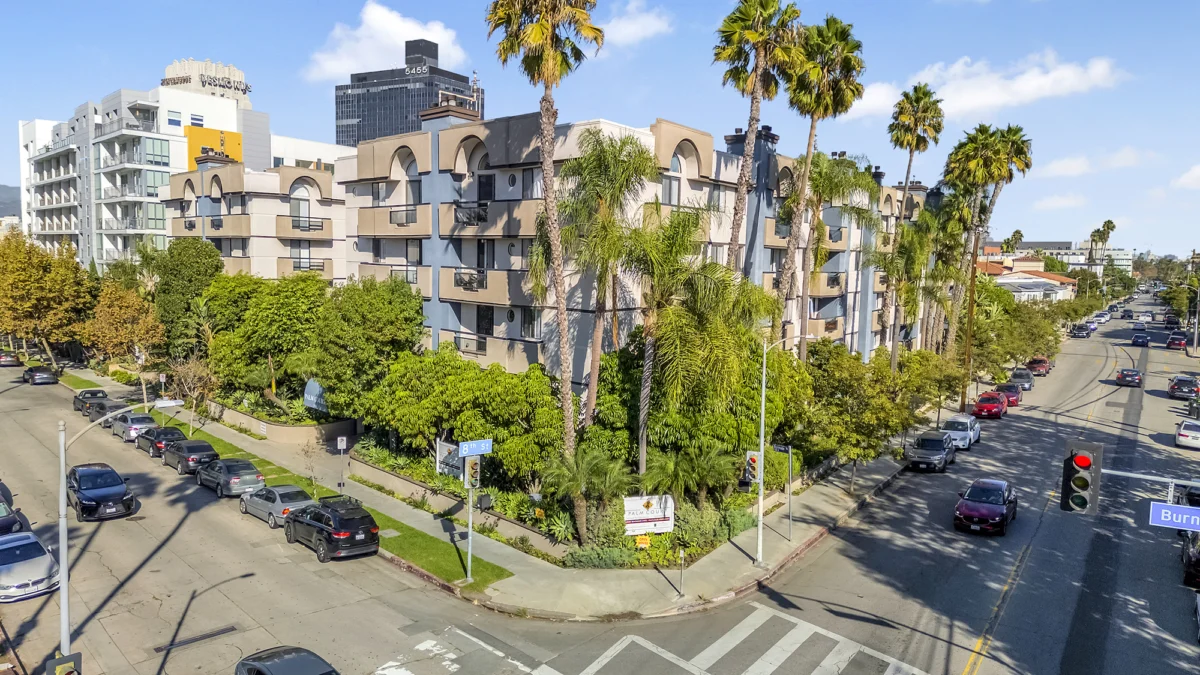
Prime Residential, a prominent real estate investment firm with deep roots in the Los Angeles housing market, has finalized the acquisition of Palm Court Apartments, a 132-unit multifamily complex situated in the heart of the Miracle Mile neighborhood. The transaction, valued at $51.3 million, represents a significant move for the firm as it expands its footprint in one of the city’s most sought-after residential corridors. The seller, an entity structured as a limited liability company and linked to Studio City-based Harrison Properties, offloaded the asset at a price point of approximately $388,000 per unit. Located at 740 South Burnside Avenue, the property serves as a stabilized asset in a high-demand area, benefiting from both historical significance and modern urban development.
The deal was facilitated by a specialized team from Marcus & Millichap. Brokers Jeff Louks, Gayle Factor, and Elliot Sabag acted as representatives for the seller, Harrison Properties, ensuring the close of a transaction that reflects the current valuation trends for mid-sized, high-quality multifamily assets in the Mid-Wilshire area. On the buy-side, Matt Ziegler of Marcus & Millichap procured Prime Residential, noting that the property had recently undergone a series of extensive capital improvements and interior upgrades. These renovations likely positioned the asset as a "turnkey" opportunity, allowing the buyer to command market-leading rents in a competitive landscape.
Architectural Profile and Property Amenities
Palm Court Apartments, completed in 1988, stands as a prime example of late-20th-century urban residential architecture designed to cater to a diverse demographic of professionals and families. The building’s unit mix is strategically diversified to capture various segments of the rental market. It comprises 48 one-bedroom units, 72 two-bedroom units, and 12 spacious three-bedroom apartments. This configuration is particularly valuable in the Miracle Mile district, where larger three-bedroom units are often in short supply compared to the influx of new studio-heavy developments.
Beyond its residential quarters, the property offers a suite of amenities designed to compete with modern luxury builds. Residents have access to a resort-style pool and spa area, a fully equipped fitness center, and private saunas. One of the standout features of the complex is its rooftop sundeck, which provides panoramic views of the Los Angeles skyline, including the Hollywood Hills and the nearby high-rises of Wilshire Boulevard. These facilities, combined with the recent upgrades mentioned by the brokerage team, ensure that the property remains a "Class A" or high "Class B" asset in the eyes of institutional investors.
Strategic Location and the Transit-Oriented Shift
The acquisition is underpinned by the property’s exceptional location. Miracle Mile is currently undergoing a period of profound transformation, driven largely by massive public and private investment in infrastructure and culture. Palm Court is located just blocks away from "Museum Row," which houses the Los Angeles County Museum of Art (LACMA), the Academy Museum of Motion Pictures, and the La Brea Tar Pits. The proximity to these cultural landmarks ensures a consistent draw for residents who value an urban lifestyle centered around arts and education.
Furthermore, the property is situated near major retail and culinary hubs, including The Grove and the Original Farmers Market. However, the most significant driver of long-term value for 740 South Burnside Avenue is its proximity to the Los Angeles County Metropolitan Transportation Authority’s (Metro) D Line (Purple Line) Extension. The new subway station at Wilshire Boulevard and Fairfax Avenue is set to revolutionize connectivity in the area, providing a high-speed transit link to both Downtown Los Angeles and the Westside. Real estate analysts have noted that properties within walking distance of these new transit nodes have seen increased investor interest, as they align with the city’s broader goals of transit-oriented development and reduced car dependency.
Prime Residential’s Regional Dominance
For Prime Residential, the purchase of Palm Court Apartments is more than just a single-asset acquisition; it is a reinforcement of their dominant position in the Mid-Wilshire submarket. The firm is most famously known as the owner of Park La Brea, a landmark residential community located just north of Miracle Mile. Prime Residential has owned Park La Brea since 1995, managing what is widely considered the largest apartment complex west of the Mississippi River.
Spanning 144 acres, Park La Brea consists of 4,249 rent-controlled units distributed across 18 high-rise towers and 175 garden-style buildings. The firm’s experience in managing large-scale, high-density housing in Los Angeles provides them with a unique operational advantage. By adding the 132 units of Palm Court to their portfolio, Prime Residential can leverage economies of scale in property management, maintenance, and leasing operations within a very tight geographic radius. This "clustering" strategy is a common tactic among sophisticated institutional investors looking to maximize efficiency in high-cost markets.
Analysis of the Los Angeles Multifamily Market
The $51.3 million sale comes at a time when the Los Angeles multifamily market is navigating a complex landscape of rising activity and regulatory headwinds. According to the most recent market reports from Marcus & Millichap, investment sales in the multifamily sector saw a roughly 25 percent increase during the 12-month period ending in March 2026. Los Angeles remains a titan in the national real estate market, accounting for more than 20 percent of all apartment trades across primary U.S. markets during that timeframe.
Despite this volume, the market is bifurcated. While mid-market deals are moving, the upper echelon of the market—specifically deals exceeding $10 million—has faced significant challenges. This slowdown is largely attributed to the City of Los Angeles’ Measure ULA, commonly referred to as the "mansion tax" or transfer tax. Effective since 2023, Measure ULA imposes a 4 percent tax on real estate sales over $5 million and a 5.5 percent tax on sales exceeding $10 million.
In the case of the Palm Court sale, the $51.3 million price tag would trigger a 5.5 percent transfer tax, amounting to approximately $2.82 million. These costs are often factored into the negotiation process and can lead to a gap between buyer and seller expectations. Market data indicates that transactions above the $10 million threshold were down by 50 percent in the year following the measure’s implementation compared to the year prior. The fact that the Palm Court deal closed at over $51 million suggests that the asset’s intrinsic value and strategic location were strong enough to overcome the friction caused by the transfer tax.
Rent Trends and Vacancy Projections
The economic fundamentals of the Los Angeles rental market continue to show resilience, though growth is moderating. At the start of 2026, the multifamily vacancy rate in Los Angeles held steady at 4.8 percent. This tight vacancy environment has allowed for modest rent growth; average effective rents increased by 1.4 percent year-over-year, reaching an average of $2,853 per month.
Looking ahead, Marcus & Millichap forecasts that the vacancy rate may tick up slightly to 5 percent by the end of the year. This projected increase is not due to a lack of demand, but rather a surge in supply. Approximately 8,500 new units are expected to be added to the Los Angeles market throughout the year. However, much of this new supply consists of luxury, high-rent units in areas like Downtown and parts of Hollywood. Established, renovated buildings like Palm Court often occupy a "sweet spot" in the market, offering modern amenities at a slightly more accessible price point than brand-new "Class A+" constructions, which helps maintain high occupancy levels even as new inventory arrives.
Broader Economic and Community Impact
The acquisition by Prime Residential is likely to be viewed as a vote of confidence in the Miracle Mile’s long-term viability. As interest rates begin to stabilize and the "bid-ask" spread between buyers and sellers narrows, more institutional capital is expected to flow back into the L.A. basin. For the residents of Palm Court, the transition to a large-scale owner like Prime Residential may result in more formalized management structures and continued investment in the property’s physical infrastructure.
From a city-wide perspective, the deal highlights the ongoing tension between the need for high-volume real estate transactions to fuel the economy and the regulatory environment designed to fund affordable housing through taxes like Measure ULA. While the tax has slowed some segments of the market, the Miracle Mile remains a "blue-chip" neighborhood where the demand for quality housing continues to outpace the regulatory hurdles.
As the Metro D Line nears completion and the cultural institutions along Wilshire Boulevard finish their respective expansions, the Miracle Mile is poised to become one of the most transit-accessible and culturally dense neighborhoods in the United States. Prime Residential’s acquisition of Palm Court Apartments ensures they remain a central player in this evolution, bridging the gap between their historic holdings at Park La Brea and the future of Los Angeles’ urban core. The $51.3 million price tag is a testament to the enduring value of well-located multifamily real estate in a city that remains a primary target for global investment.