
Sixty-six million years ago, the Chicxulub asteroid struck the Yucatan Peninsula with the force of billions of atomic bombs, triggering a global extinction event that wiped out the non-avian dinosaurs and fundamentally altered the trajectory of life on Earth. While the immediate aftermath of this cataclysm—tsunamis, wildfires, and a multi-year “impact winter”—is well-documented, recent geological research reveals a surprising, life-sustaining legacy buried deep within the crater’s subterranean structure. A long-term hydrothermal system, ignited by the immense heat of the impact, persisted for millions of years, potentially serving as a sanctuary for microbial life in the wake of the planet’s most destructive moment.
New findings published in the journal Communications Earth & Environment suggest that this subterranean environment remained active for approximately 8 million years—four times longer than previous estimates. Led by geologist and planetary scientist Annemarie Pickersgill of the University of Glasgow’s SUERC Center for Isotope Sciences, the research team utilized advanced radioisotopic dating of rock samples to reshape our understanding of the crater’s post-impact behavior.
The Mechanics of a Subterranean Oasis
The Chicxulub impact was not merely a surface-level event. The sheer magnitude of the kinetic energy transferred into the Earth’s crust caused deformation reaching 35 kilometers (nearly 22 miles) beneath the surface. This energy shattered and melted massive volumes of rock, creating a complex, porous network within the bedrock. As seawater from the surrounding Gulf of Mexico flooded into these fractures, it encountered the residual heat trapped deep within the Earth’s crust.
This interaction birthed a massive, long-lived hydrothermal system. Similar to the black smokers found along modern mid-ocean ridges, these vents likely pumped hot, mineral-rich water into the cold, dark depths of the post-impact ocean. For microscopic life forms struggling to survive the mass extinction occurring at the surface, these vents would have provided a stable, nutrient-dense refuge. The presence of such a system for nearly eight million years offers a compelling window into how life might recover and diversify in the aftermath of a global disaster.
Chronology of the Chicxulub Aftermath
To understand the longevity of this system, researchers examined core samples drilled from the crater in 2016. By analyzing the decay of potassium into argon within feldspar crystals—a reliable method for dating volcanic and impact-related rocks—the team established a clearer timeline of the cooling process.
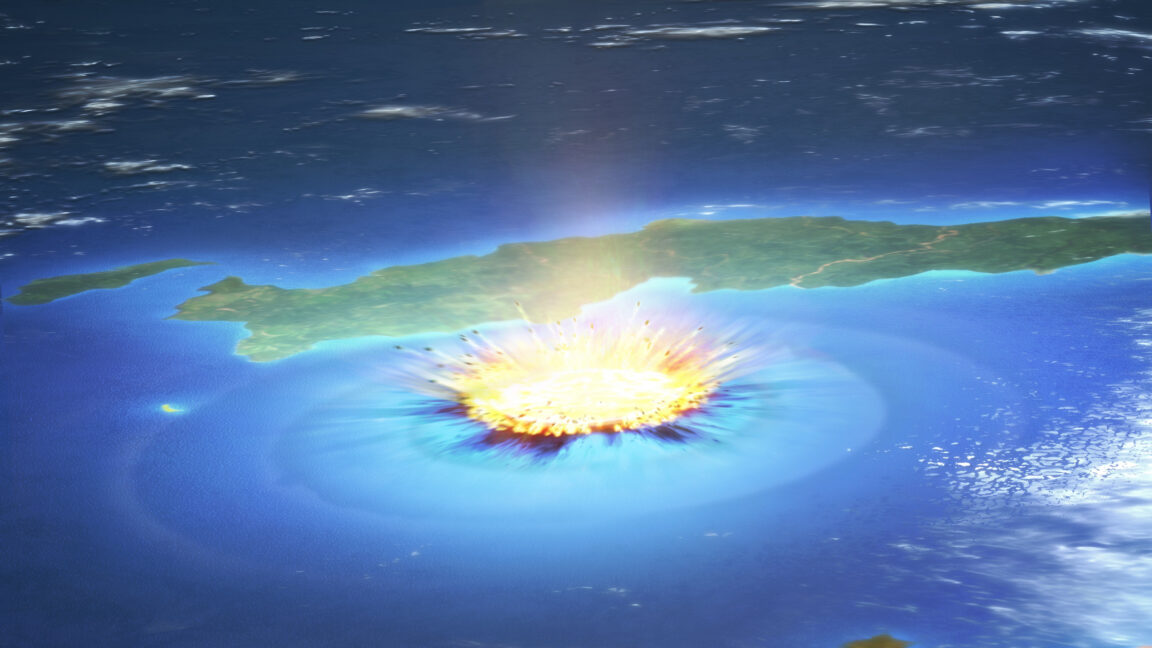
- T+0 (66 Million Years Ago): The asteroid strikes, creating a transient cavity and melting deep crustal material.
- 0–2.3 Million Years Post-Impact: The hydrothermal system operates at high temperatures, with cooling at a depth of one kilometer reaching roughly 90°C (194°F). This period represents the most intense heat flux.
- 2.3–5 Million Years Post-Impact: The system cools further to below 50°C (122°F). These temperatures are widely considered ideal for the proliferation of various extremophile microorganisms.
- 5–8 Million Years Post-Impact: Hydrothermal activity enters a waning phase, with fluid flow gradually subsiding.
- 8 Million Years Post-Impact (58 Million Years Ago): The system ceases to function as the crust reaches ambient thermal equilibrium.
This timeline demonstrates that the habitat was not a fleeting phenomenon. By providing stable thermal conditions for millions of years, the crater allowed for the potential establishment of complex microbial colonies, offering a rare look at how geological processes can buffer biological life against the effects of planetary-scale extinction.
Isotopic Analysis and Computational Modeling
The strength of the study lies in the triangulation of data between physical rock samples and computational simulations. The potassium-argon dating provided the empirical foundation, confirming that the heat signature within the crater lasted significantly longer than earlier, more conservative models had predicted.
Pickersgill’s team supplemented this by running high-fidelity computer simulations of the crater’s thermal cooling. These models accounted for the fluid dynamics of seawater moving through fractured, porous rock. The results of these simulations aligned closely with the isotopic data, confirming that the system would have remained in a "habitable zone" for temperatures between 50°C and 90°C for several million years.
While the researchers emphasize that they have not found definitive evidence of ancient microbes within the specific samples—a notoriously difficult task given the immense geological time elapsed—the conditions required for life were undoubtedly present. The findings provide a critical baseline for future studies, shifting the focus from whether the crater could have supported life to how we might identify the biological signatures of that life in the future.
Broader Implications for Astrobiology
The discovery that the Chicxulub crater hosted a long-term hydrothermal system has significant implications beyond terrestrial paleontology. Impact craters are ubiquitous across the solar system, appearing on Mars, the Moon, and the icy moons of Jupiter and Saturn. If a relatively small impact like Chicxulub could generate a multi-million-year habitable environment, the implications for other planetary bodies are profound.
"Chicxulub is still relatively small compared to the impact basins expected on early Earth and observed on other planetary bodies," Pickersgill noted in the study. "It is therefore possible that these larger impacts could have created even longer-lived hydrothermal systems and, hence, could have been able to maintain the temperatures and fluid flux required for habitable environments for a minimum of several million years."

This research suggests that large-scale asteroid impacts—often viewed exclusively as agents of destruction—may have played a dual role in the history of the solar system. By creating localized heat sources and driving chemical flux, these impacts may have periodically acted as crucibles for the development or survival of life on otherwise hostile worlds.
The Search for Life in Impact Craters
Despite the widespread nature of hydrothermal systems associated with impact craters, detecting biological remnants remains a challenge. There are approximately 70 known underwater impact craters globally that likely hosted hydrothermal activity, yet evidence of microbial colonization has been identified in only eight.
The primary difficulty lies in the degradation of biological markers over tens of millions of years. However, the study of the Chicxulub site provides a new roadmap for astrobiologists. By focusing on sites where the cooling duration was sufficiently long to allow for colonization, scientists can better target their search for biosignatures. The Chicxulub research proves that even if an impact causes a global collapse of surface ecosystems, the "plumbing" of the Earth itself can provide the energy and shelter necessary to sustain life’s momentum.
Conclusion
The Chicxulub crater remains one of the most studied geological sites on Earth, yet it continues to yield secrets that challenge our perception of the past. By extending the known duration of the crater’s hydrothermal system to 8 million years, the research team has highlighted a critical, often overlooked aspect of post-impact recovery.
As we look toward future exploration of the solar system, the story of the Chicxulub crater serves as a reminder that the boundary between a cataclysm and a cradle is often defined by the presence of energy, water, and time. Whether or not life flourished within the depths of the Yucatan crater remains an open question, but the evidence is now clear: the environment was ready, waiting, and warm for millions of years after the world above went dark. This work not only refines our understanding of the dinosaur extinction but also reinforces the resilience of life and its ability to find a foothold in the most unlikely of places.