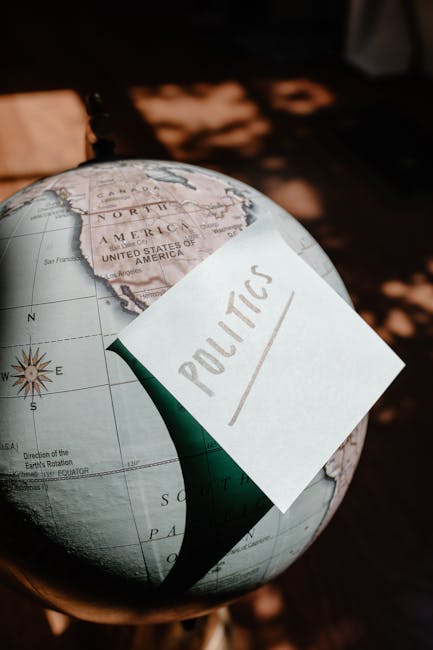
Navigating the Labyrinth: A Comprehensive Exploration of World Politics
World politics, a multifaceted and dynamic arena, encompasses the intricate web of interactions, power struggles, and policy decisions that shape the global landscape. At its core, it’s about the distribution and exercise of power between states, international organizations, non-state actors, and individuals on a planetary scale. Understanding world politics requires dissecting the motivations behind state actions, the influence of economic forces, the role of ideology, and the ever-present threat and reality of conflict. The international system, characterized by anarchy – the absence of a supreme global authority – necessitates states to rely on self-help mechanisms, fostering alliances, building military might, and engaging in diplomacy to secure their interests. Key theoretical lenses, such as realism, liberalism, constructivism, and Marxism, offer distinct frameworks for interpreting these dynamics. Realism emphasizes the primacy of states, their pursuit of power, and the inevitability of competition. Liberalism, conversely, highlights the potential for cooperation through institutions, interdependence, and the spread of democracy. Constructivism delves into the social construction of interests and identities, arguing that norms and ideas profoundly shape state behavior. Marxism focuses on economic inequality and the exploitation inherent in the global capitalist system. These theoretical perspectives, while often in tension, provide essential tools for analyzing the complex motivations and actions of global players. The rise of globalization has further complicated this picture, blurring traditional state boundaries and amplifying the interconnectedness of economies, cultures, and political movements. This interconnectedness presents both opportunities for collaboration and challenges in managing shared problems like climate change, pandemics, and cyber threats. The sheer volume of actors involved – from the G7 and the UN Security Council to multinational corporations, terrorist organizations, and influential NGOs – creates a complex and often unpredictable environment. Analyzing world politics, therefore, demands an appreciation for the interplay of these diverse forces and the constant negotiation of power, interest, and ideology.
The foundational unit of world politics remains the nation-state, a sovereign entity with defined territory, a permanent population, a government, and the capacity to enter into relations with other states. The Westphalian system, established in the 1650s, enshrined the principle of state sovereignty, granting each state exclusive authority within its borders. This principle, however, has been increasingly challenged in the contemporary era. The proliferation of international law, treaties, and norms, along with the growing influence of international organizations, has gradually eroded absolute state sovereignty. Moreover, internal dynamics within states, such as civil wars, ethnic conflicts, and humanitarian crises, can trigger external intervention, further complicating the notion of state autonomy. The concept of the "failed state" or "fragile state" highlights situations where governments lack the capacity to provide basic services, maintain order, or control their territory, often becoming breeding grounds for instability and transnational crime. The competition for resources, particularly energy and water, also fuels interstate relations and can be a significant driver of geopolitical tension. Control over strategically important shipping lanes, access to vital minerals, and dominance in emerging technological sectors all contribute to the ongoing power dynamics. Furthermore, the historical legacy of colonialism and its enduring impacts continue to shape contemporary international relations, influencing development trajectories, political structures, and regional conflicts in many parts of the Global South. The rise of new powers, notably China, has fundamentally altered the global balance, ushering in an era of multipolarity and challenging the unipolar moment dominated by the United States in the post-Cold War era. This shift necessitates a re-evaluation of existing alliances, the redefinition of international norms, and the development of new frameworks for global governance.
International organizations (IOs) play a crucial, albeit often debated, role in world politics. The United Nations (UN), established in the aftermath of World War II, serves as the primary forum for multilateral diplomacy, peacekeeping, and addressing global challenges. Its Security Council, endowed with the power to authorize military action and impose sanctions, holds significant sway. However, its effectiveness is often hampered by the veto power of its permanent members, reflecting the enduring influence of great powers. Other IOs, such as the International Monetary Fund (IMF) and the World Bank, wield considerable economic power, shaping development policies and providing financial assistance to member states. The World Trade Organization (WTO) attempts to regulate global trade, but faces challenges from protectionist tendencies and disputes over trade practices. Regional organizations, like the European Union (EU), the African Union (AU), and ASEAN, aim to foster cooperation and integration within specific geographic areas, addressing issues ranging from economic development and security to environmental protection. The effectiveness of these organizations is contingent on the political will of their member states and their ability to adapt to evolving global dynamics. Non-governmental organizations (NGOs), though not states, have emerged as significant actors, influencing policy agendas, advocating for human rights, environmental protection, and humanitarian aid. Organizations like Amnesty International, Greenpeace, and Médecins Sans Frontières (Doctors Without Borders) can mobilize public opinion, exert pressure on governments, and deliver vital services. Their growing influence underscores the diffusion of power beyond traditional state-centric models.
Economic power is inextricably linked to political influence in world politics. Globalization has intensified this connection, creating a complex interdependence between national economies. Trade, investment, and financial flows transcend national borders, impacting domestic policies and creating opportunities for both prosperity and vulnerability. The concept of economic statecraft, the use of economic tools for political purposes, is a cornerstone of international relations. This can involve imposing sanctions to coerce adversaries, offering aid to cultivate allies, or manipulating currency exchange rates to gain competitive advantages. Multinational corporations (MNCs) possess immense economic power, influencing labor markets, environmental regulations, and even government policies. Their ability to shift production and investment across borders gives them significant leverage. The distribution of global wealth and income, marked by persistent inequalities between developed and developing nations, remains a persistent source of tension and a driver of global political discourse. Development aid, foreign direct investment, and access to global markets are critical issues in the ongoing North-South dialogue. The rise of economic blocs and trade agreements, such as the Comprehensive and Progressive Agreement for Trans-Pacific Partnership (CPTPP) and the Belt and Road Initiative (BRI), reflect attempts by states to shape the global economic order to their advantage. The volatility of global financial markets, exemplified by the 2008 financial crisis, highlights the fragility of the interconnected global economy and the need for effective international financial regulation.
Ideology and culture play a potent, though often understated, role in shaping world politics. The enduring influence of liberal democracy as an ideal, despite its challenges and critiques, continues to shape the foreign policy objectives of many Western states. Conversely, authoritarian models, with their emphasis on state control and stability, offer alternative visions and are gaining traction in certain regions. The clash of ideologies, while less overtly ideological than during the Cold War, still manifests in debates over human rights, governance, and individual freedoms. Nationalist sentiments, often fueled by historical grievances and cultural identities, remain powerful forces in shaping state behavior and can lead to territorial disputes and inter-ethnic conflicts. Religious fundamentalism, in its various manifestations, can also become a potent political force, driving conflict and influencing the foreign policies of states and non-state actors. The concept of "soft power," coined by Joseph Nye, refers to the ability of a country to persuade others to do what it wants without force or coercion, through the attractiveness of its culture, political ideals, and policies. Cultural exchange, media influence, and the dissemination of information contribute to this subtle but significant form of power. The digital age has amplified the reach of ideologies and cultural narratives, enabling rapid dissemination of information and ideas, but also facilitating the spread of misinformation and propaganda. Understanding these ideological and cultural undercurrents is essential for deciphering the motivations behind foreign policy decisions and the dynamics of global power competition.
Conflict and security are perennial concerns in world politics. The nature of conflict has evolved, moving beyond interstate wars to encompass intra-state conflicts, terrorism, cyber warfare, and hybrid threats. The proliferation of weapons of mass destruction, particularly nuclear weapons, continues to pose an existential threat to global security, driving arms control negotiations and deterrence strategies. The concept of collective security, where an attack on one state is considered an attack on all, enshrined in organizations like NATO, aims to deter aggression through mutual defense pacts. However, the effectiveness of collective security arrangements depends on the unity and commitment of their members. Terrorism, a transnational threat, operates through clandestine networks and asymmetric tactics, posing a significant challenge to state security apparatuses. The rise of cyber warfare, where states and non-state actors exploit vulnerabilities in digital infrastructure, presents a new frontier of conflict, blurring the lines between peace and war and raising complex questions of attribution and deterrence. The security dilemma, the inherent instability of an anarchic international system where states arm themselves for defense, leading others to arm themselves in response, perpetuating a cycle of mistrust and potential conflict, remains a fundamental challenge. The quest for lasting peace necessitates addressing the root causes of conflict, including poverty, inequality, political exclusion, and historical grievances, alongside robust diplomatic efforts and the strengthening of international norms and institutions. The concept of human security, which prioritizes the safety and well-being of individuals rather than solely the security of the state, is gaining traction, advocating for a broader approach to security that encompasses economic, food, health, environmental, personal, community, and political security.
The future of world politics is marked by a confluence of accelerating trends and persistent challenges. Climate change, a planetary threat requiring unprecedented global cooperation, has emerged as a defining issue, influencing resource distribution, migration patterns, and geopolitical stability. The growing demand for renewable energy sources is reshaping global energy markets and fostering new geopolitical alignments. The demographic shifts, with aging populations in some developed countries and burgeoning youth populations in others, will have profound implications for labor markets, social welfare systems, and political stability. The rapid advancements in artificial intelligence and biotechnology present both immense opportunities and significant ethical and security dilemmas, demanding international dialogue and regulation. The ongoing struggle for influence between established powers and rising nations, coupled with the evolving nature of warfare and the persistent threat of economic instability, suggests a future characterized by continued volatility and the need for agile and adaptive approaches to global governance. The effectiveness of international cooperation in addressing shared challenges will be a critical determinant of global stability and prosperity. The erosion of trust in democratic institutions in some parts of the world and the rise of populism pose challenges to the liberal international order and necessitate a re-examination of how governance can be made more inclusive and responsive. Ultimately, navigating the labyrinth of world politics requires a continuous process of learning, adaptation, and a commitment to finding common ground in an increasingly interconnected and complex world. The pursuit of peace, prosperity, and sustainable development hinges on the collective ability of humanity to confront shared challenges with a spirit of cooperation and mutual understanding, even amidst inevitable competition and divergence of interests.
