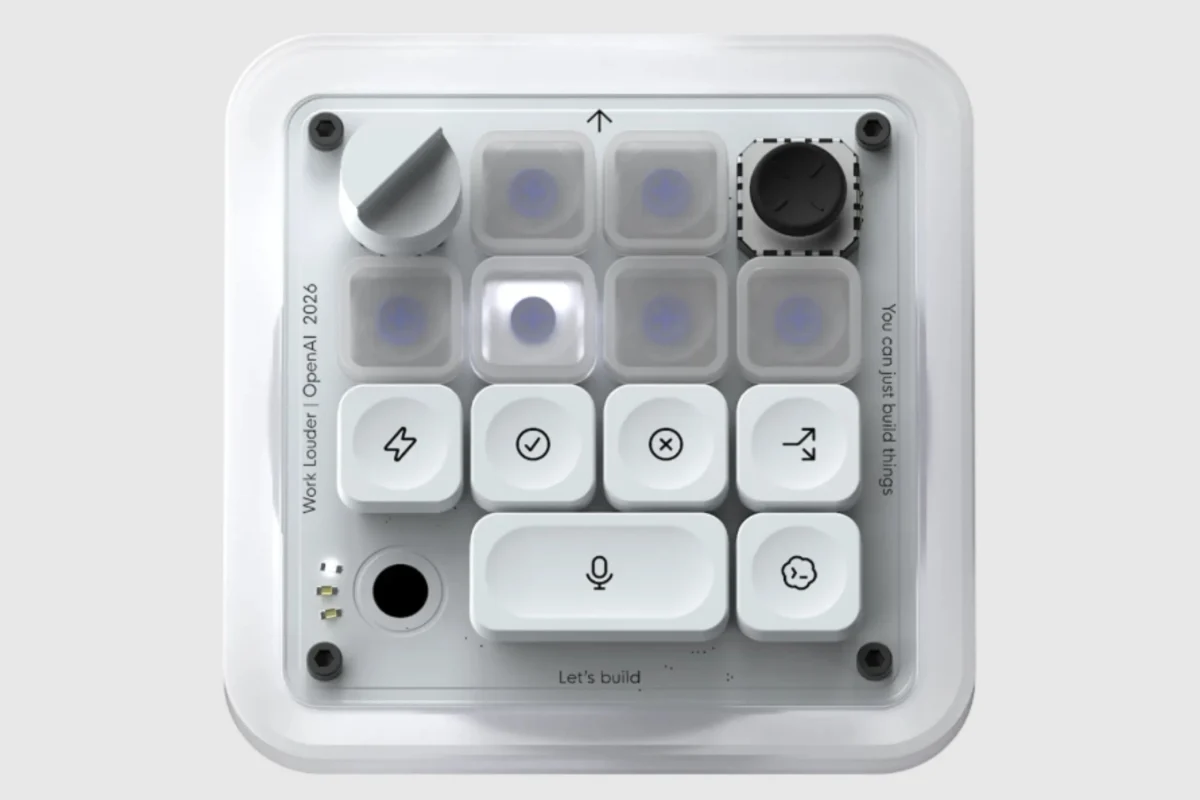
OpenAI, the vanguard of artificial intelligence research and development, last week marked a significant milestone with the launch of its inaugural piece of hardware: Micro. Developed in collaboration with specialty keyboard designer Work Louder, this compact, six-key macro pad is engineered to seamlessly integrate with ChatGPT and its agentic coding tool, Codex. While designed to appeal to a specific cohort of tech enthusiasts and professional developers, its introduction has been met with a mix of intrigue, skepticism, and a backdrop of escalating legal and strategic complexities for the AI giant.
OpenAI’s Strategic Pivot into Hardware: A Broader Industry Trend
The unveiling of Micro signals a deliberate expansion for OpenAI beyond its foundational software and research endeavors into the tangible realm of physical products. This strategic pivot is not an isolated incident but rather indicative of a burgeoning trend within the technology sector, where software-centric companies are increasingly exploring hardware to create more immersive, integrated, and proprietary user experiences. Companies like Google, Amazon, and even Meta have long understood the synergistic power of controlling both the software and hardware layers of their ecosystems. For OpenAI, a company that has rapidly transitioned from a non-profit research lab to a commercial powerhouse, this move could be interpreted as a natural evolution in its quest to embed AI more deeply into daily workflows and user interactions.
The broader AI hardware market, though still nascent for consumer-facing dedicated AI devices, is projected to grow significantly as artificial intelligence permeates more aspects of personal and professional life. Industry analysts suggest that by controlling the hardware interface, OpenAI aims to optimize the user experience for its AI models, potentially offering a level of performance and integration that generic input devices cannot match. This could also be a strategic move to build a proprietary ecosystem, ensuring that its AI models remain at the forefront of user interaction, much like Apple controls its software experience through its meticulously designed hardware.
Introducing Micro: Design, Functionality, and Collaboration
The Micro keypad, visually described as an "artisanal workplace novelty," embodies a minimalist yet robust design philosophy. Its development alongside Work Louder, a company renowned for its customizable and ergonomic mechanical keyboards, underscores a commitment to quality and a nod to the niche market of keyboard enthusiasts. Upon initial inspection, the device presents a sturdy build, suggesting durability that could even serve it as a high-end paperweight should its primary function not resonate universally.
A notable observation, echoed by several early reviewers, is the striking resemblance of Micro’s packaging to Apple’s signature aesthetic: an immaculate white box housing a sleek, clean product. This "Apple-coded" presentation, whether intentional or coincidental, adds another layer to the narrative surrounding OpenAI’s hardware ambitions, particularly given the ongoing legal skirmishes with the Cupertino tech titan.
Functionally, Micro is ingeniously simple yet powerful. It features a layout of twelve keys: six frosted "agent" keys positioned at the top, which are fully customizable to execute specific tasks within ChatGPT or Codex, and six command keys below them, designed to control these programs. Connectivity options include both Bluetooth for wireless convenience and a USB cable for a more stable, wired connection, catering to various user preferences and setups.
One of Micro’s most compelling features is its dedicated button for voice dictation. This allows users to verbally input commands or prompts directly into ChatGPT, streamlining the interaction process. By simply holding down the dictation button, speaking their request, and then tapping the adjacent "send" button, users can engage with the AI in a more fluid and hands-free manner, potentially boosting productivity for certain tasks.
Customization is at the core of Micro’s appeal. Within ChatGPT itself, a dedicated Micro tab provides a comprehensive interface for users to personalize their device. This includes adjusting the brightness of the key backlighting, as well as programming specific commands and projects to each key. This level of granular control is intended to allow users to tailor Micro to their unique workflows, transforming it into a highly personal and efficient AI companion. The color-coded feedback system – white for idle, blue for thinking, green for task completion, and red for error – offers intuitive visual cues, though it requires a learning period for users to memorize the key-project associations.
The Shadow of Legal Battles and Broader Hardware Ambitions
Micro’s launch did not occur in a vacuum but against a backdrop of significant corporate drama and burgeoning hardware aspirations. Just weeks prior to its unveiling, OpenAI found itself embroiled in a high-profile legal battle with Apple, which filed a lawsuit accusing the AI lab of trade secret theft. This legal confrontation has ignited what is widely anticipated to be a protracted and complex dispute, adding a layer of tension to OpenAI’s public image and strategic maneuvering. The timing of Micro’s release, with its "Apple-coded" packaging, only serves to amplify the irony and competitive dynamics at play.
Adding to the intrigue, reports also surfaced regarding another smart home product reportedly in development at OpenAI. This rumored device, also intended to pair with ChatGPT, has drawn particular attention due to its alleged development by former Apple engineers. This detail further fuels speculation about OpenAI’s long-term hardware strategy, suggesting a broader vision that extends beyond niche developer tools to potentially encompass more mainstream consumer electronics. The involvement of ex-Apple talent in these projects could be seen as a deliberate attempt by OpenAI to infuse its hardware initiatives with the design ethos and engineering prowess traditionally associated with Apple, perhaps aiming to replicate its success in creating highly integrated and user-friendly ecosystems.

Until these legal battles are resolved and OpenAI’s more ambitious hardware projects materialize, Micro stands as the company’s sole tangible offering in the hardware space. Its positioning as a specialized tool for "code monkeys" – a term often used affectionately for dedicated developers and programmers – underscores its initial niche appeal, while also hinting at the experimental nature of OpenAI’s hardware ventures.
User Experience, Market Reception, and the Productivity Conundrum
Initial reviews and user reactions to Micro have been notably mixed, particularly from its intended target audience: hard-core coders and AI power users. On platforms like Reddit, the device has largely garnered negative feedback, with some users dismissing it as "a prank and not a real product" and others expressing skepticism that serious coders would integrate it into their workflows. The independent outlet Aftermath delivered an even harsher critique, calling the $230 price tag "hard to justify next to cheaper DIY and off-the-shelf alternatives" and provocatively titling their review: "OpenAI’s expensive macropad feels engineered to piss me off specifically."
These criticisms highlight a fundamental challenge for any new productivity hardware: demonstrating a clear and compelling value proposition that surpasses existing tools. For many developers, custom macro pads and programmable keyboards are not new concepts, and there are numerous, often more affordable, options available that offer similar or even greater levels of customization. The learning curve associated with Micro, requiring users to memorize color codes and key assignments, also poses a barrier to immediate adoption. While the reviewer noted that "once I figured out how to program the keypad to my liking, I found it was actually pretty fun," this initial hurdle is significant for professionals who prioritize efficiency and seamless integration over novelty.
The core question remains: Is Micro functionally easier to use and more efficient than simply interacting with ChatGPT via a standard laptop keyboard and mouse? For many, the muscle memory and familiarity with conventional input methods are deeply ingrained. Investing time to learn a new device, no matter how innovative, must yield substantial productivity gains to justify the effort and cost. The reviewer’s honest admission – "Why would I spend a week learning how to program and operate this thing when I already know how to use my computer’s mouse and keyboard?" – encapsulates the dilemma faced by potential users.
However, for a specific segment of the market, Micro could indeed offer tangible benefits. For ChatGPT "power users" who frequently juggle multiple AI-assisted projects, the ability to assign different sessions to specific keys and seamlessly toggle between them, combined with the voice dictation feature, could significantly enhance workflow efficiency. This demographic, often characterized by a willingness to invest in specialized tools that offer even marginal productivity improvements, might find Micro a valuable addition to their setup. The appeal of "vintage-looking hardware with clicky buttons" also taps into a subculture of tech enthusiasts who appreciate tactile feedback and customizability in their peripherals.
OpenAI’s Broader Vision: Ecosystem Control and Future Implications
OpenAI’s foray into hardware, starting with Micro, suggests a broader strategic vision aimed at extending its influence beyond software APIs and web interfaces. By creating its own hardware, OpenAI could be seeking to:
- Enhance User Experience: Directly control the interface through which users interact with its AI, optimizing for speed, responsiveness, and unique features that might not be possible with third-party hardware.
- Foster an Ecosystem: Begin building a proprietary ecosystem around its AI models, similar to how Apple, Google, and Amazon have integrated hardware and software to create sticky user experiences. This could eventually lead to more sophisticated devices and tighter integration with OpenAI’s future AI advancements.
- Data Security and Privacy: While not explicitly stated for Micro, controlling the hardware layer can offer enhanced control over data input and processing, which could be crucial for privacy and security in sensitive AI applications.
- Innovation in Human-AI Interaction: Micro, with its voice dictation and customizable agent keys, represents an exploration into new paradigms of human-AI interaction. OpenAI may be using this initial product to gather insights and iterate on how users prefer to interact with complex AI systems in a physical space.
The challenges for OpenAI are significant. Entering the hardware market is notoriously difficult, requiring expertise in manufacturing, supply chain management, and distribution that differs vastly from software development. The lukewarm reception from the core developer community for Micro suggests that OpenAI will need to refine its value proposition and potentially lower price points for future hardware iterations if it aims for broader adoption.
The Road Ahead: Challenges and Opportunities
Ultimately, the success of Micro, and indeed OpenAI’s broader hardware ambitions, will depend heavily on several factors. For Micro, its appeal will be directly proportional to a user’s reliance on ChatGPT and their willingness to invest in specialized, premium tools. For the casual AI user, the device’s $230 price tag and learning curve may be prohibitive. However, for a dedicated power user with disposable income and a penchant for customizable tech, Micro could indeed "brighten your day a little."
Looking further ahead, the legal entanglement with Apple casts a long shadow over OpenAI’s hardware aspirations. The outcome of that lawsuit could significantly impact the company’s ability to innovate freely in hardware, particularly if intellectual property disputes become a recurring theme. The rumored smart home device, developed by former Apple engineers, also suggests a more ambitious and potentially disruptive long-term strategy that could pit OpenAI directly against established tech giants in the consumer electronics space.
OpenAI’s debut in hardware with Micro is more than just the launch of a fancy keypad; it is a declaration of intent. It signals the company’s evolution into a full-fledged technology provider aiming to shape not just the software, but also the physical interfaces through which humanity interacts with artificial intelligence. The journey will undoubtedly be fraught with challenges, from market skepticism and competitive pressures to complex legal battles, but it underscores a fascinating new chapter in the ongoing integration of AI into our daily lives. As the AI landscape continues to evolve at an unprecedented pace, OpenAI’s strategic moves into hardware will be closely watched as an indicator of the future trajectory of human-AI collaboration.