When the New England Clean Energy Connect (NECEC) transmission line officially commenced operations in January, it was heralded by policymakers and environmental advocates as a watershed moment for the Northeast’s transition toward a carbon-free power grid. The high-voltage direct current (HVDC) line, designed to funnel vast quantities of Canadian hydroelectricity into the Maine and Massachusetts markets, was expected to be the cornerstone of a regional decarbonization strategy. However, after its first six months of operation, a complex picture is emerging. Initial performance data suggests that the project has yet to deliver the substantial net increase in renewable energy that was originally promised, raising urgent questions about the reliability of international energy dependencies in an era of climate instability.
The early operational phase of the NECEC has been characterized by intermittent service and lower-than-expected throughput. Since January, the line has experienced approximately 27 days of total inactivity. While proponents argue these are merely the "teething pains" of a massive infrastructure project, critics point to a more concerning trend: total energy imports from Quebec into New England have risen only marginally. In fact, if current trajectories persist, the region may receive less total hydropower this year via two transmission lines than it did through a single line in previous high-performance years. This stagnation comes at a critical time, as New York City simultaneously begins to draw from the same Canadian resource pool via the newly active Champlain Hudson Power Express.
A Decade of Obstacles: The NECEC Chronology
The NECEC did not arrive easily. Its journey from a legislative concept to an active transmission corridor spans nearly a decade of legal, political, and environmental battles. The project’s origins lie in a landmark 2016 Massachusetts law, the Energy Diversity Act, which mandated the state to procure 1.6 gigawatts of offshore wind and 1.2 gigawatts of firm renewable energy. To meet the latter requirement, Massachusetts utilities sought to tap into the massive reservoir systems managed by Hydro-Québec, a state-owned utility in Canada.
The initial plan, known as the Northern Pass, proposed a 192-mile route through New Hampshire. That project was unceremoniously scrapped in 2019 after the New Hampshire Site Evaluation Committee denied its permit, citing concerns over the impact on the state’s tourism-heavy landscapes and local ecosystems. Following this defeat, developers pivoted to Maine, proposing a 145-mile route that would become the NECEC.
In Maine, the project faced even fiercer opposition. Environmental groups, local landowners, and rival energy producers—primarily those operating natural gas plants—formed an unlikely coalition to stop the line. In 2021, a statewide referendum saw Maine voters overwhelmingly support a measure to ban the construction of high-voltage lines in the Upper Kennebec Region, effectively halting the project. However, after years of litigation, a Maine jury ruled in 2023 that the project’s developers had acquired "vested rights" by starting construction before the law was changed. This legal victory cleared the way for the project’s completion, leading to the first flow of electricity in early 2024.
Technical Difficulties and the "New Road" Problem
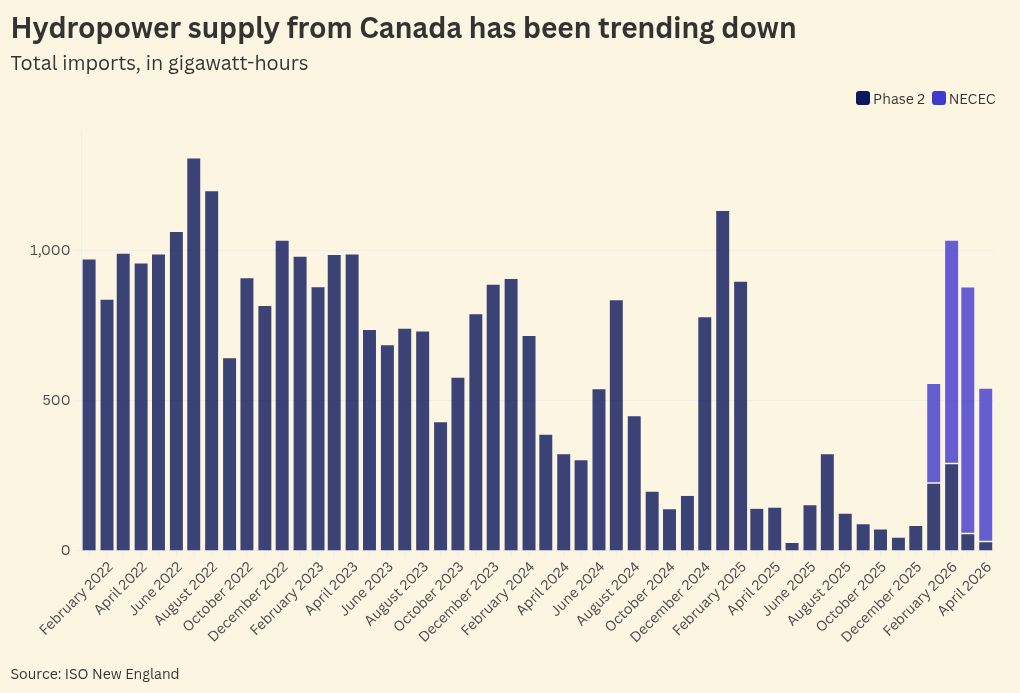
The promise of the NECEC was the delivery of 9.55 terawatt-hours of hydropower annually to Massachusetts, representing roughly 20 percent of the state’s total electricity demand. While Hydro-Québec has exported approximately 2.4 terawatt-hours over the NECEC through April, the broader regional impact has been underwhelming.
The primary issue is the performance of Phase 2, an older, existing transmission line that has traditionally carried the bulk of Quebec’s exports into central Massachusetts. Historically, Phase 2 was a robust artery for clean energy; in 2019, it carried over 12 terawatt-hours into the New England grid. However, as the NECEC ramped up, flows on Phase 2 plummeted. In early 2025, exports on the older line ceased entirely for nearly three weeks. Through the first four months of this year, Phase 2 has carried only half a terawatt-hour.
This shift suggests that the NECEC is not necessarily bringing "new" energy to the region but is instead acting as a secondary route for an existing, and currently shrinking, supply. Dan Dolan, president of the New England Power Generators Association, noted that net energy flows from Quebec are currently hovering near record lows. "We are running pretty close to the net energy flows we had in 2025, which were the lowest amount of imports that New England has ever gotten from Quebec," Dolan stated.
Furthermore, a rare phenomenon has emerged: New England has begun exporting electricity back to Canada. In the first four months of this year, more than 500 gigawatt-hours traveled north over the Phase 2 line. Because New England’s grid remains heavily dependent on natural gas, this means the region is burning fossil fuels to support Canada’s grid while simultaneously paying for "clean" imports on the NECEC line. This "circular" energy flow undermines the immediate carbon-reduction goals of the project.
The Role of Climate Change: Drought in the North
The underlying cause of these erratic energy flows is not merely technical, but environmental. Quebec has been grappling with prolonged drought conditions that have significantly impacted its hydroelectric reservoirs. Hydro-Québec’s system relies on massive basins that act as "batteries," storing water during wet seasons to be used for generation during peak demand.
When water levels are low, Hydro-Québec is legally and operationally bound to prioritize its domestic customers. Gilbert Bennett, a senior adviser for WaterPower Canada, explained that during dry cycles, the utility must manage its exports conservatively to ensure that Quebec’s homes and industries remain powered. This "domestic-first" mandate means that in years of low precipitation, the surplus available for export to the United States evaporates.
This climatic reality poses a strategic challenge for New England’s energy planners. The region has bet heavily on Canadian hydropower as a "baseload" renewable resource—a steady supply that can balance the intermittency of wind and solar. If climate change continues to disrupt precipitation patterns in the North, the reliability of that "battery" becomes suspect.
Economic Protections and Ratepayer Impacts
Despite the disappointing volume of energy, Massachusetts officials maintain that the NECEC remains a net positive for consumers. The contracts signed between Massachusetts utilities and Hydro-Québec include stringent performance requirements. If the Canadian utility fails to deliver the contracted amount of electricity, it is liable for financial penalties.
Joseph LaRusso, manager of the Clean Grid Program at the Acadia Center, emphasized that these "liquidated damages" are designed to protect ratepayers. "To the extent that imports are curtailed, Hydro-Québec is liable to make the electric utilities whole for the cost of replacement power," LaRusso explained. This means that if Massachusetts has to buy more expensive natural gas-fired electricity because the hydropower didn’t arrive, Hydro-Québec must essentially cover the price difference.
However, financial restitution does not solve the carbon problem. Even if the state is reimbursed for the cost, the carbon emissions from the natural gas plants used as "replacement power" are still released into the atmosphere, hindering the state’s progress toward its 2030 and 2050 climate mandates.
Regional Competition: The New York Factor
The strain on Quebec’s hydropower supply is expected to intensify with the activation of the Champlain Hudson Power Express (CHPE). This 339-mile line is designed to deliver 1,250 megawatts of hydropower directly into New York City, a municipality that has struggled to find local sites for large-scale renewable projects.
With both New York and New England now competing for the same hydroelectric resources, the pressure on Hydro-Québec is immense. The utility is currently embarking on a massive capital investment plan to increase its capacity, including the refurbishment of existing dams and the rapid expansion of onshore wind farms to supplement its hydro reservoirs. The goal is to create a more diverse and resilient supply that can meet both domestic demand and international export contracts even during dry years.
Future Outlook: A Sunny Day in May
Despite the rocky start, there are flashes of the potential the NECEC holds for the future. Proponents point to May 16 as a proof-of-concept for a decarbonized grid. On that day, a combination of high solar output in New England and full-capacity flow on the NECEC allowed the region to significantly dial back its natural gas generation. For a brief window, the combination of local renewables and imported hydropower met nearly the entire region’s demand, with excess power even being exported to New York.
"It really gets you thinking of the resources available and how they could be managed and shared in the future," LaRusso said of that day’s performance.
Industry experts like Gilbert Bennett remain optimistic about the long-term viability of the partnership. Climate models for the coming decades generally predict that northern regions like Quebec will become wetter, not drier, as the atmosphere warms. If these projections hold, the current drought may be a temporary hurdle rather than a permanent state. Furthermore, the integration of more wind power in Quebec could allow the utility to "save" its water in reservoirs during windy days, using the hydro plants only when the wind dies down, effectively turning the dams into a massive storage system for the entire Northeast.
For now, the NECEC stands as a symbol of both the ambition and the fragility of the clean energy transition. It highlights the necessity of long-distance transmission for a green grid, but also serves as a cautionary tale about the unpredictability of nature and the complexity of international energy markets. As New England navigates the remainder of 2024, the focus will remain on whether Hydro-Québec can stabilize its exports and whether the "teething pains" of the NECEC will finally give way to the steady flow of clean power the region so desperately requires.