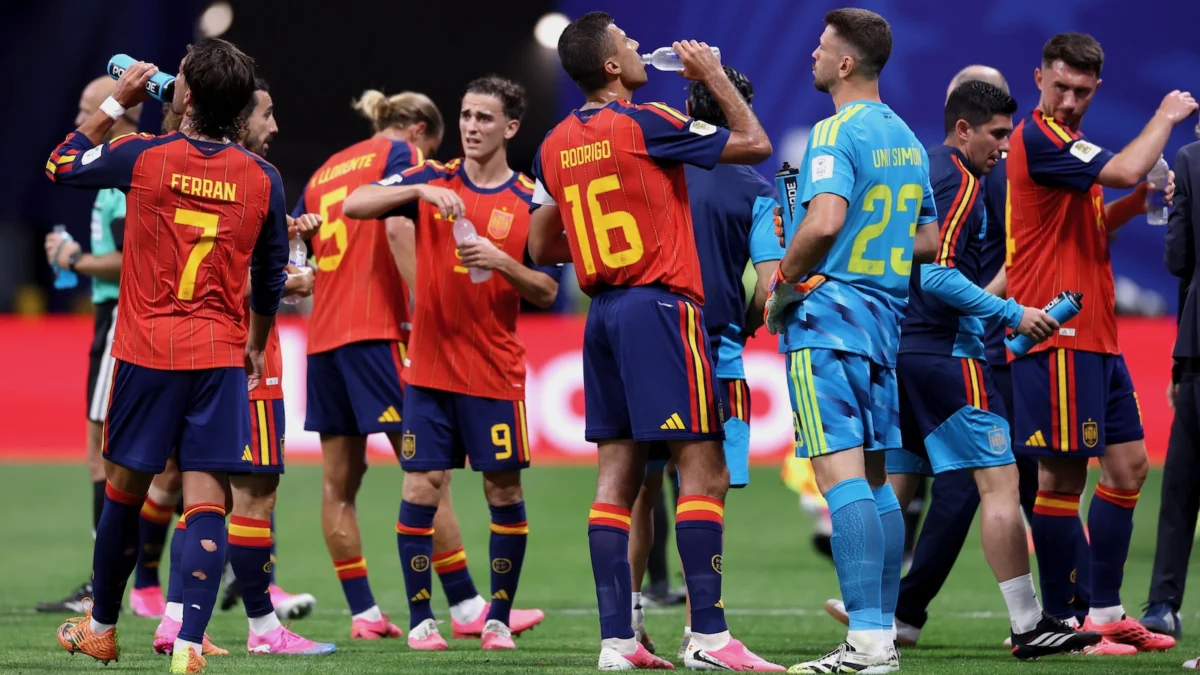
As the United States national team prepares to take the pitch against Australia this afternoon, the eyes of millions of soccer enthusiasts are fixed on the 2026 FIFA World Cup. However, for those who have not followed the sport closely since the previous tournament cycle, a jarring new element has fundamentally altered the flow of the game: mandatory three-minute hydration breaks. Implemented mid-way through each half, these pauses were introduced under the banner of player safety, yet they have rapidly become the center of a firestorm involving climate change, commercial interests, and the traditional integrity of "the beautiful game."
The controversy, dubbed "Water-gate" by British tabloids, has transcended the sports pages to become a case study in the challenges of hosting global events in an era of rising temperatures. While FIFA, the international governing body for association football, maintains that the breaks are a necessary response to the extreme heat conditions prevalent in North American summers, critics argue that the move is a thinly veiled attempt to monetize the sport’s historically commercial-free halves.
A Shift in the Regulatory Landscape
Historically, association football has been celebrated for its continuous play. Unlike American football or basketball, which are characterized by frequent stoppages, soccer features two 45-minute halves where the clock never stops. Before the 2026 tournament, "cooling breaks" were discretionary and highly regulated. Under previous FIFA protocols, referees were only permitted to authorize a three-minute break if the Wet Bulb Globe Temperature (WBGT)—a composite measure of temperature, humidity, wind speed, and solar radiation—exceeded 32 degrees Celsius (approximately 90 degrees Fahrenheit).
The new mandate for the 2026 World Cup marks a radical departure from this precedent. For the first time in the history of the tournament, these three-minute breaks are compulsory for every match, regardless of the environmental conditions. This includes games played in climate-controlled, indoor stadiums with sophisticated air conditioning systems, as well as evening matches where temperatures are significantly lower.
FIFA’s decision followed intense pressure from FIFPRO, the global union representing professional soccer players. Following a series of summer tournaments in the United States in 2025, FIFPRO released a scientific study highlighting the physiological toll of extreme heat on elite athletes. The organization argued that the traditional WBGT threshold was insufficient to protect player health in the face of increasingly frequent heatwaves. In a press release issued prior to the World Cup, FIFPRO stated, "It has never been more important to give space to scientific knowledge and find mitigation strategies that protect the health and wellbeing of our players."
The Commercialization Conflict
Despite the health-oriented justification, the implementation of mandatory breaks has sparked widespread skepticism. The primary point of contention is the lucrative nature of the pauses. Because the breaks occur at fixed intervals, they provide broadcasters with predictable windows for advertising—a commodity that has historically been absent from soccer broadcasts.
According to data reported by The Wall Street Journal, the financial stakes are immense. A 30-second advertisement during an early-round World Cup match can command roughly $200,000. For high-profile matches, such as those involving the U.S. National Team or traditional powerhouses like Brazil and Germany, the price for a 30-second spot can soar to $750,000 or more. With two hydration breaks per match, FIFA and its broadcasting partners have effectively created four minutes and twenty seconds of additional advertising inventory per game.
John Kosner, a former executive at ESPN, noted the strategic value of this change. "They’ve essentially divided the game into quarters," Kosner told The Wall Street Journal. "In doing so, they have made enormously valuable breaks in a sport that was previously very difficult to monetize mid-action."
While some broadcasters, such as the BBC in the United Kingdom and Telemundo in the United States, have opted to maintain their coverage with analysis and replays during the breaks, others have leaned heavily into commercialization. Fox, the primary English-language broadcaster in the U.S., has faced particular scrutiny. During the opening match of the tournament, Fox cut to a commercial break that lasted longer than the actual three-minute hydration period. Consequently, when the referee resumed play, viewers were still watching advertisements, causing many to miss the restart entirely. Fox later attributed the error to a missed signal from the referee, but the incident reinforced the perception that the breaks are designed for profit rather than player welfare.
Public and Player Reaction
The reaction from the global football community has been overwhelmingly negative. At a recent match between England and Croatia, the stadium erupted in boos when the referee blew the whistle for the first-half hydration break. On social media platforms like Reddit, fans have expressed frustration that the breaks disrupt the tactical "momentum" of the game. "FIFA ruined the beautiful game," wrote one user, while another complained about being "inundated with commercials."
Even the players, who are the intended beneficiaries of the policy, are divided. Virgil van Dijk, the captain of the Netherlands’ national team and one of the world’s premier defenders, suggested that a more nuanced approach would be preferable. "If it’s really hot, obviously it will be good to put them in," Van Dijk said during a press conference. "But I think you have to look at it in every game separately. Playing in 70-degree weather indoors with a mandatory break feels unnecessary."
The skepticism is shared by some within the coaching ranks. Chris Taylor, head coach of the Vermont Green FC men’s team—an organization specifically focused on climate justice and environmental awareness—questioned the uniformity of the rule. While Taylor acknowledges that hydration is critical in extreme conditions, he remains unconvinced by FIFA’s "one-size-fits-all" explanation.
"I don’t think the health of the players is their primary concern," Taylor remarked. "This World Cup has felt that every angle has been monetized. In soccer, every game has different lengths and different flows. Forcing a break in a game played at 74 degrees doesn’t ring true as a health-first policy."
The Climate Context: A Warming World
While the commercial motives are debated, the underlying reality of climate change cannot be ignored. The 2026 World Cup is being hosted across 16 cities in the United States, Canada, and Mexico, many of which are prone to extreme summer heat. Cities like Dallas, Houston, Miami, and Monterrey frequently see temperatures exceeding 100 degrees Fahrenheit in June and July.
Scientific data indicates that the risk of heat-related illness is a legitimate concern for athletes performing at high intensity. Heat stroke, heat exhaustion, and severe dehydration can lead to long-term organ damage or, in extreme cases, death. By making the breaks mandatory across the board, FIFA argues it is ensuring a "level playing field." The organization maintains that having different rules for different stadiums based on local weather would create an unfair competitive environment where some teams are forced to endure more physical strain than others.
"The use of hydration breaks is part of a focused attempt to ensure the best possible conditions for players," FIFA stated in its initial policy announcement. The governing body has remained firm in its stance, refusing to adjust the rule despite the backlash from fans and media.
Implications for the Future of Global Sports
The "Water-gate" controversy serves as a precursor for the future of international sports. As global temperatures continue to rise, major sporting events—from the Olympics to the Tour de France—will be forced to adapt their regulations to protect participants. However, the 2026 World Cup illustrates the tension that arises when these necessary adaptations intersect with the massive financial interests of global sports organizations.
For FIFA, the challenge is one of optics and trust. If the mandatory breaks continue to be perceived as a commercial "money grab," it may alienate a fanbase that prizes the traditional, uninterrupted flow of the game. Conversely, if FIFA were to revert to discretionary breaks, it would face the risk of a health crisis should a player collapse during a match played in extreme heat.
As the tournament progresses toward the knockout stages, the scrutiny on these three-minute windows is unlikely to fade. Whether the breaks are a vital safety measure for a warming planet or a strategic maneuver to boost ad revenue, they represent a permanent shift in how the world’s most popular sport is played and consumed. For now, fans will have to get used to the whistle blowing mid-half—and the commercials that inevitably follow.