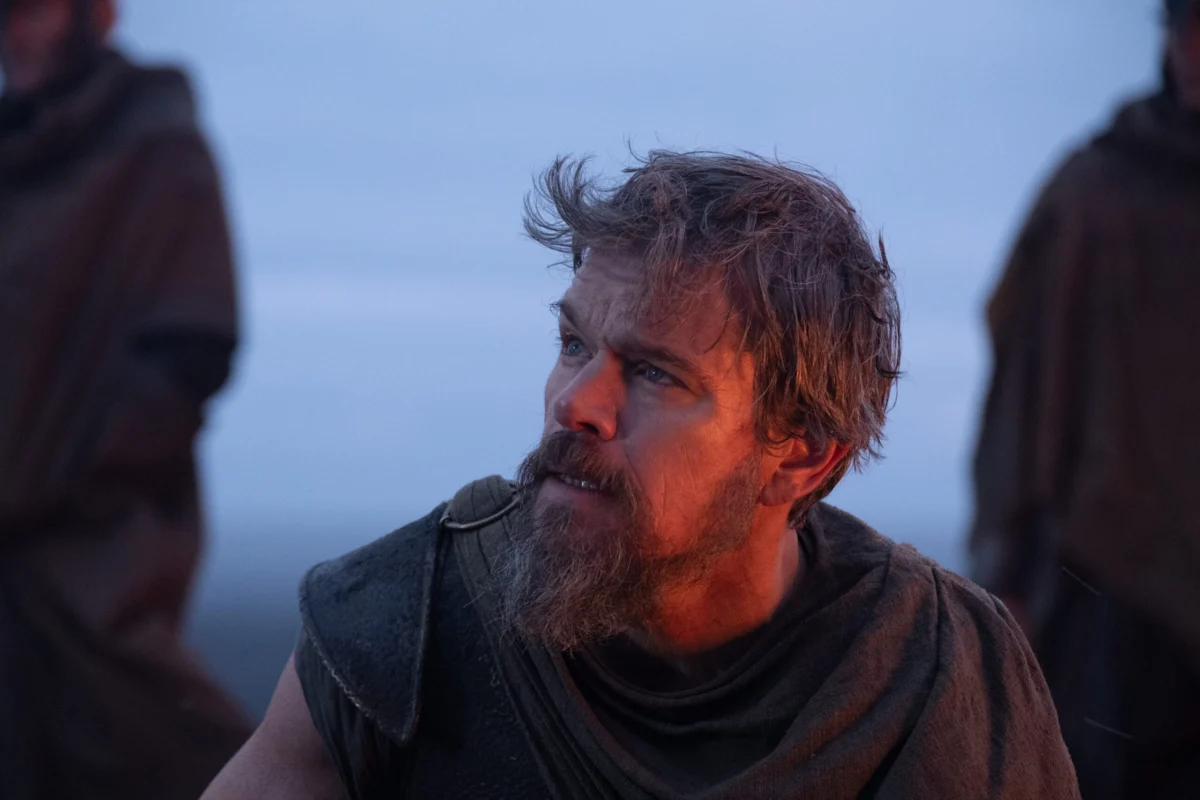
Christopher Nolan’s latest cinematic achievement, The Odyssey, has sparked intense global conversation following its theatrical release, specifically regarding its radical subversion of the source material’s conclusion. While the film, produced by Universal Pictures, maintains many of the hallmarks of Homer’s ancient Greek epic, it diverges sharply in its final act to deliver a meditation on guilt, the cyclical nature of warfare, and the heavy burden of leadership. Starring Matt Damon as Odysseus and Anne Hathaway as Penelope, the film explores the psychological aftermath of the Trojan War with the technical precision and non-linear narrative structures that have become synonymous with Nolan’s filmography. Unlike the classical text, where Odysseus returns to reclaim his throne and bloodily purge his home of suitors, Nolan’s interpretation concludes with an act of voluntary self-exile, leaving their son, Telemachus (played by Tom Holland), to navigate the future of Ithaca alone.
A Narrative Reimagining: From Triumph to Penance
The film’s departure from the 8th-century BCE poem is most evident in its treatment of Odysseus’s return to Ithaca. In Homer’s original work, the return of the king is a moment of restoration and violent justice. However, Nolan’s screenplay—which he wrote and produced—repositions the protagonist not as a triumphant hero reclaiming his birthright, but as a man shattered by the ethical implications of his own tactical genius. The film places a heavy emphasis on the "Trojan Horse," a stratagem that won the war for the Greeks but resulted in the total annihilation of Troy.
Throughout the film’s three-hour runtime, Odysseus is haunted by the memories of those he led to their deaths. This is most poignantly realized in a sequence set in the "Land of the Dead," a visual masterpiece captured on 70mm IMAX film. Here, Odysseus encounters Sinon, portrayed by Elliot Page. In the film’s lore, Sinon is the soldier who stayed behind to convince the Trojans to bring the wooden horse inside their gates—a mission that ultimately cost him his life. The interaction serves as the film’s moral pivot; Sinon confronts Odysseus with his lack of empathy, reminding the king that his brilliance was built upon the bodies of men who were treated as mere instruments of war.
The Climax in Ithaca: Recognition and Renunciation
The third act of The Odyssey follows the traditional structure of the "return of the king" but subverts the emotional payoff. Odysseus arrives in Ithaca disguised as a beggar, a narrative beat consistent with the original epic. This allows him to observe the degradation of his kingdom and the persistence of the suitors vying for Penelope’s hand. The tension culminates in the iconic "test of the bow," where Penelope declares she will marry the man who can string Odysseus’s massive bow and shoot an arrow through twelve axe-heads.
In Nolan’s version, the moment Penelope recognizes her husband is stripped of sentimental grandiosity. It occurs only after he successfully strings the bow—a feat of physical and psychological memory. However, the expected massacre of the suitors is replaced by a profound realization of shared trauma. Penelope, having spent twenty years defending the borders of her home and the integrity of the crown, finds herself at a crossroads. The film reveals that Penelope’s wait was not merely an act of passive loyalty, but one of strategic preservation.

The resolution of the film has left audiences and scholars debating Nolan’s intent. Rather than assuming the throne, Odysseus and Penelope decide that their presence would only tether Ithaca to the blood-stained past of the Trojan War. In a move that mirrors contemporary discussions on political accountability and the retirement of "war-time" leaders, the couple chooses to depart Ithaca by sea. This leaves Telemachus, portrayed by Tom Holland as a principled but untested young man, to assume the mantle of King. This transition symbolizes a clean break from the "Heroic Age" of the Trojan War, moving toward a new era governed by a generation that did not partake in the ancient world’s destruction.
Visual Motifs and the Symbolism of the Sun
Cinematographer Melinda Sue Gordon and Nolan utilize the setting sun as a recurring visual motif throughout the film, foreshadowing the ending. This imagery is rooted in a pivotal flashback to the beginning of the war, where a younger Penelope (Hathaway) urges Odysseus (Damon) to abandon his military obligations. She suggests they "sail away to chase the sun," an invitation to escape the inevitability of historical conflict.
Penelope’s philosophy in the film is one of cyclical realism; she posits that while civilizations inevitably collapse under the weight of war, they are also perpetually rebuilt, much like the daily rising of the sun. The final scene, which features Penelope and Odysseus sailing into the horizon as the sun sets, serves a dual purpose. It is simultaneously a punishment—a self-imposed exile for the horrors of Troy—and a fulfillment of Penelope’s long-held desire for peace and anonymity.
The film’s closing line, delivered by Odysseus, encapsulates the core theme: “A new dawn will break over the darkened world, when our mistakes will once again be forgotten.” This sentiment serves as a double-edged sword; it offers hope for the future under Telemachus’s rule while warning that humanity is prone to repeating the sins of the past once the memory of previous catastrophes fades.
Production Context and Technical Specifications
The Odyssey marks another collaboration between Nolan and Universal Pictures following the massive success of Oppenheimer. Industry analysts suggest the film’s budget exceeded $200 million, a figure reflected in the massive practical sets used to recreate the Bronze Age Mediterranean. True to Nolan’s commitment to celluloid, the film was shot entirely on a combination of IMAX 65mm and 65mm large-format film.
The casting of Matt Damon and Anne Hathaway brings a seasoned, weary energy to the roles of the royal couple. Damon’s portrayal of Odysseus is notably less "warrior-like" than previous cinematic iterations, focusing instead on the character’s intellect and subsequent psychological fracturing. Hathaway’s Penelope is portrayed as the intellectual equal of her husband, a ruler in her own right who has managed the socio-political pressures of Ithaca for two decades. The inclusion of Mia Goth as Melantho and Tom Holland as Telemachus provides a generational contrast, highlighting the tension between those who lived through the war and those who only know its legend.

Industry Reaction and Critical Analysis
Early critical responses have praised the film for its intellectual depth, though some traditionalists have expressed reservations about the departure from Homer’s ending. Film scholar Dr. Elena Kosta noted, "Nolan has transformed The Odyssey from a tale of homecoming into a tale of accountability. By having Odysseus choose exile, Nolan suggests that true heroism in the modern age is knowing when your time has passed and when your legacy has become too toxic for the future of the state."
Box office projections for the film remain high, with Universal Pictures expecting a strong performance in international markets, particularly in Europe and Asia, where the themes of historical legacy and war resonate deeply. The film’s unconventional ending is expected to drive repeat viewings as audiences attempt to parse the layered symbolism of the final sequences.
Chronology of the Film’s Narrative Structure
Nolan utilizes a "braided" narrative structure, weaving together three distinct timelines:
- The Present (Ithaca): Odysseus’s return in disguise and the eventual decision to leave.
- The Journey (The Mediterranean): A series of vignettes showcasing the "lost years," focusing on the psychological toll of the voyage rather than just the monsters encountered.
- The Past (Troy): Flashbacks to the final days of the Trojan War and the implementation of the Trojan Horse.
This structure allows the audience to see the direct correlation between Odysseus’s actions in Troy and his ultimate inability to sit on a throne in Ithaca. The guilt of the past informs the decisions of the present, making the final exile feel like an inevitable consequence rather than a sudden choice.
Implications for the Epic Genre
Christopher Nolan’s The Odyssey represents a significant shift in how Hollywood approaches classical mythology. By stripping away the divine intervention of the Greek gods—who are notably absent or relegated to metaphorical mentions in this version—Nolan grounds the story in human psychology and political consequence. The film sets a new precedent for "historical-mythological realism," suggesting that ancient stories are most relevant when they reflect the moral complexities of the contemporary world.
As the film continues its global rollout, the conversation remains centered on that final, haunting image of the ship sailing into the sunset. It is a conclusion that denies the audience the simple satisfaction of a "happily ever after," opting instead for a bittersweet reflection on the cost of war and the necessity of letting go. Through this lens, Nolan has not just adapted Homer; he has challenged the very idea of the "hero" for a new generation.