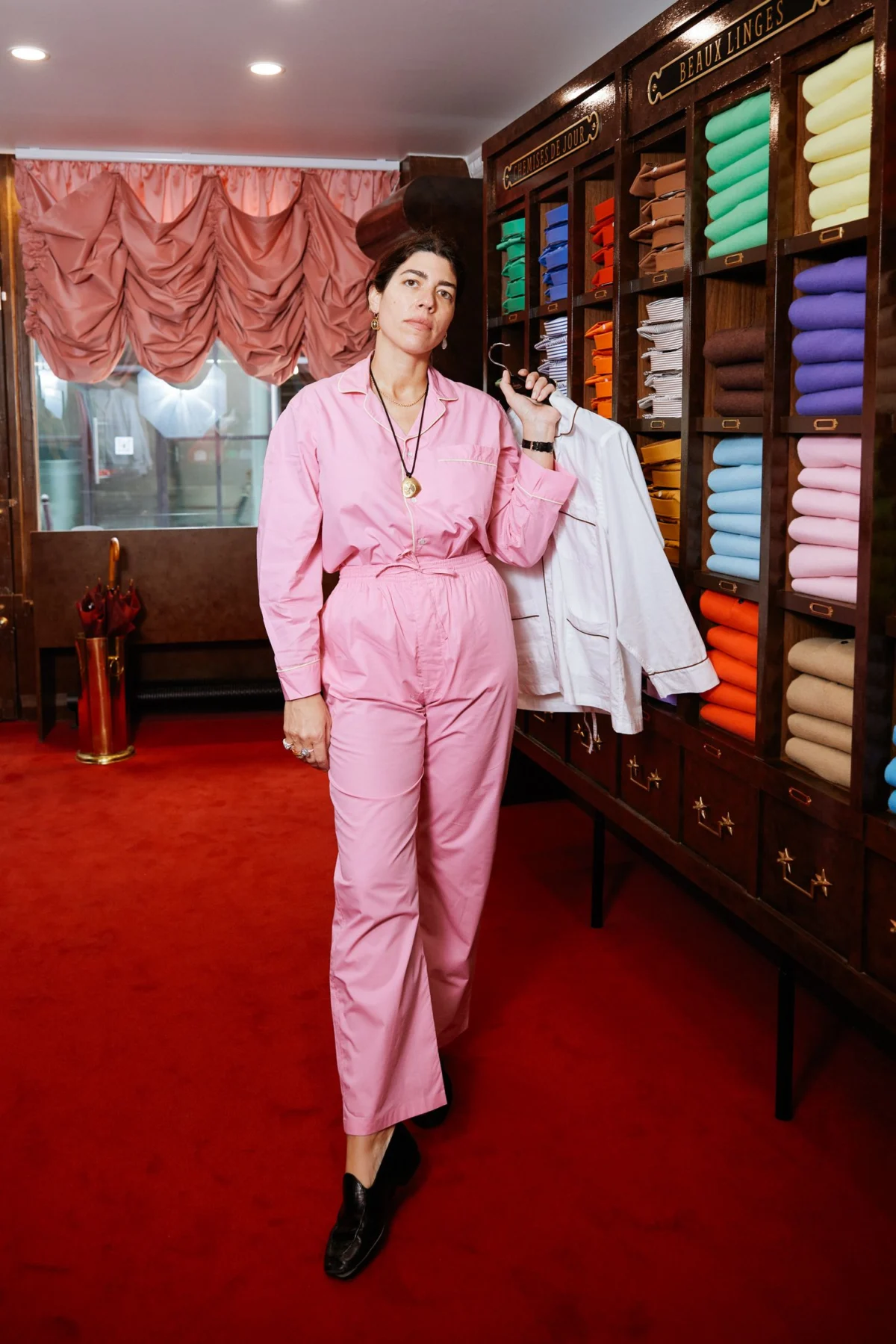
Lauren Rubinski, the acclaimed fine jewelry designer known for her signature chunky, gold chain-link chokers and whimsical signet rings, has pivoted her creative focus toward a new medium of expression: the quintessential button-down shirt. Her latest venture, Rubirosa’s, is an elegant neighborhood haberdashery located in the historic 7th arrondissement of Paris. Despite being a relatively new addition to the Rue de Grenelle, the boutique exudes a timeless, archival atmosphere, characterized by Art Deco-inspired signage, deep wood paneling, and wall-to-wall red velvet carpeting. The aesthetic is a deliberate choice by Rubinski, who sought to create a space that felt as though it had occupied the corner for decades.
Since its opening in June 2023, Rubirosa’s has operated without a website or a formal digital marketing strategy, relying instead on word-of-mouth among fashion’s inner circle. The boutique has quickly become a destination for the "cognoscenti"—those seeking refined unisex cotton shirting, vibrant cashmere knits, and supple leather loafers. For Rubinski, the shop is more than a commercial enterprise; it is a physical manifestation of her personal wardrobe philosophy, which emphasizes color, texture, and a "laissez-faire" approach to luxury.
The Evolution of a Neighborhood Landmark
The 7th arrondissement of Paris is renowned for its quiet sophistication, housing historic landmarks and established luxury residences. Rubirosa’s fits seamlessly into this landscape. The project took shape in under a year, driven by Rubinski’s desire for a creative outlet that reflected her daily uniform. The store’s interior design—featuring vintage haberdashery shelving and an immersive red velvet interior—serves as a backdrop for a collection that bridges the gap between traditional tailoring and contemporary casual wear.
The success of the initial boutique has prompted an immediate expansion. Rubinski is currently preparing to open a second, larger space measuring 750 square feet directly next door to the original location. Set to open in June 2024, this expansion signifies the growing demand for artisanal, physical-first retail experiences in an era dominated by e-commerce. The new space will allow for a broader range of offerings, further cementing Rubirosa’s status as a staple of Parisian style.

A Heritage Grounded in Bespoke Tailoring
Rubinski’s transition into apparel is rooted in a deep familial connection to the craft. Her father and grandfather were both bespoke tailors, and they instilled in her an exacting eye for quality, construction, and fabric execution. This heritage is evident in the technical details of Rubirosa’s shirting, which utilizes high-grade cotton poplin and meticulous piping.
However, Rubinski’s personal style philosophy is far from rigid. "I want to feel confident and strong, but I don’t need my clothes to be perfect," she noted in a recent discussion regarding her approach to dressing. This sentiment reflects a broader shift in the luxury market toward "lived-in" elegance, where the value of a garment is found in its comfort and longevity rather than its pristine appearance. Her wardrobe is a mix of high-end collectibles—such as rare Patek Philippe timepieces and Hermès suede bags—and practical staples like men’s Ralph Lauren chinos and distressed chore coats.
Chronology of Personal Style and Business Growth
To understand the trajectory of Rubirosa’s, one must look at the timeline of Rubinski’s creative development and the strategic milestones of the brand:
- June 2023: Rubirosa’s opens on Rue de Grenelle in Paris, focusing on unisex shirting and knitwear.
- Fall/Winter 2023: The brand gains a cult following among Parisian stylists and editors, primarily through in-person visits and social media sightings of Rubinski’s personal looks.
- Spring 2024: Rubinski expands the product line to include more accessories, such as leather loafers and specialized pajama sets designed for daywear.
- June 2024: The scheduled opening of the 750-square-foot annex, doubling the brand’s physical footprint in the 7th arrondissement.
Throughout this period, Rubinski has maintained her role as a prominent figure in the jewelry world, proving that the two disciplines—jewelry design and apparel—can coexist through a shared focus on craftsmanship and "collector’s pieces."
Supporting Data: The Rise of Niche Haberdasheries
The success of a physical-only retail model like Rubirosa’s is supported by current trends in the luxury sector. According to market analysis from McKinsey & Company, high-net-worth individuals are increasingly seeking "exclusive and experiential" retail environments that offer products not easily found on mass-market platforms.

Furthermore, the "unisex" apparel market has seen a projected compound annual growth rate (CAGR) of approximately 4.5% as consumers move away from gender-binary dressing in favor of silhouettes that offer versatility. Rubirosa’s focus on unisex cotton shirting taps directly into this demographic. The decision to forgo a website also aligns with the "scarcity model" of luxury, where the difficulty of acquisition increases the perceived value of the brand.
Strategic Stylistic Analysis: The Five Pillars of the Rubinski Look
Rubinski’s personal style serves as the primary marketing tool for Rubirosa’s. Her "laissez-faire" approach is categorized by several distinct stylistic choices that have informed the brand’s core collection:
1. The Utility of Earth Tones and Men’s Tailoring
Rubinski frequently incorporates men’s pieces into her wardrobe, particularly distressed cargos and chinos from Ralph Lauren. By tailoring these pieces to her proportions, she achieves a rugged yet refined aesthetic. This "borrowed from the boys" mentality is a cornerstone of the Rubirosa’s unisex philosophy.
2. The Exalted White Button-Down
Central to the brand is the versatile white shirt. Rubinski demonstrates its utility by pairing it with made-to-measure suede pants from Morocco or vintage vests. This "French cowgirl" aesthetic highlights the shirt’s ability to transition from a clean, daytime silhouette to a sophisticated evening look when paired with kitten heels, such as the Manolo Blahnik Jada.
3. Elevated Sleepwear as Daywear
A bestseller for Rubirosa’s is the piped cotton poplin pajama set. Rubinski advocates for wearing these pieces outside the home, often tucking the shirt into high-waisted trousers to create a sophisticated, effortless look. This reflects a broader industry trend where comfort-focused clothing is elevated through high-quality textiles and precise tailoring.

4. The Collector’s Mindset: Accessories and Heirlooms
Rubinski’s outfits are often anchored by rare or sentimental accessories. These include a 1960s Patek Philippe Ricochet pocket watch worn as a pendant, an heirloom belt gifted by her father, and silk scarves from Chrome Hearts. This practice of mixing contemporary designs with vintage collectibles reinforces the idea of clothing as a long-term investment.
5. Practicality in Footwear
Despite her status in the fashion world, Rubinski prioritizes practicality, often opting for flat footwear. Her go-to choices include soft ballerinas from The Row and loafers from her own label. This focus on "walkable luxury" resonates with the lifestyle of a modern entrepreneur and mother.
Official Responses and Market Impact
While Rubinski remains the primary spokesperson for the brand, the reaction from the Parisian fashion community has been overwhelmingly positive. Industry insiders have noted that Rubirosa’s fills a void in the market for "quiet luxury" that doesn’t feel overly commercialized.
"The charm of Rubirosa’s lies in its authenticity," says one local retail consultant. "In a world of digital-first brands, there is a profound luxury in a shop that requires you to actually be there to experience it. Lauren’s background in jewelry gives her a unique perspective on the ‘object-hood’ of a shirt."
The impact of Rubirosa’s is also being felt by neighboring businesses. The influx of "cognoscenti" to Rue de Grenelle has contributed to a revitalized interest in the 7th arrondissement as a shopping destination that rivals the more high-traffic areas of the 1st and 8th.

Broader Implications for the Fashion Industry
Lauren Rubinski’s success with Rubirosa’s suggests that the future of independent luxury may lie in "slow retail." By focusing on a single category—shirting—and perfecting it through a lens of heritage and personal style, Rubinski has bypassed the traditional pressures of the fashion calendar.
The move toward mending garments, as evidenced by Rubinski’s habit of repairing tears with red thread (a nod to the "evil eye" tradition), also aligns with the growing sustainability movement. It encourages consumers to "live with their clothes" and value the patina of age over the novelty of the new.
As Rubirosa’s prepares for its June expansion, the brand stands as a testament to the power of a clear, uncompromising vision. Rubinski is not dressing to please the masses or to follow the latest trend; she is building a wardrobe—and a business—that is entirely her own. For the modern consumer, that level of authenticity is perhaps the greatest luxury of all.