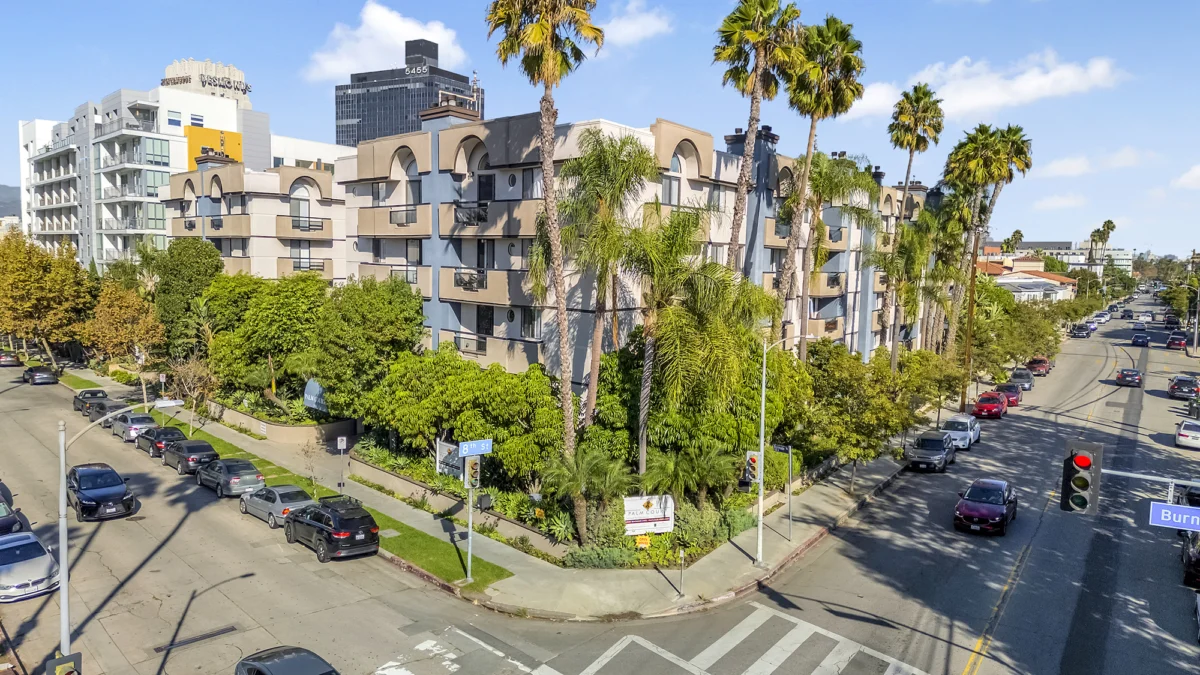
Prime Residential, one of the most prominent multifamily property owners in the Western United States, has finalized the acquisition of the Palm Court Apartments, a 132-unit residential complex located in the heart of Los Angeles’ Miracle Mile neighborhood. The transaction, valued at $51.3 million, marks a significant addition to the firm’s local holdings and underscores the continued institutional interest in high-density, transit-oriented neighborhoods within the Los Angeles basin. The property, situated at 740 South Burnside Avenue, was sold by an LLC tied to Studio City-based Harrison Properties. The sale price reflects a valuation of approximately $388,000 per unit, a figure that highlights the premium placed on well-maintained assets in the Mid-Wilshire corridor.
The deal was facilitated by a team of veteran brokers from Marcus & Millichap. Jeff Louks, Gayle Factor, and Elliot Sabag represented the seller, Harrison Properties, while Matt Ziegler, also of Marcus & Millichap, procured the buyer. According to statements from the brokerage team, the property attracted significant interest due to its location and the recent capital improvements executed by the seller. The Palm Court Apartments underwent extensive upgrades prior to the sale, positioning the asset as a turnkey investment capable of commanding competitive rents in a submarket characterized by high demand and limited supply.
Property Profile and Strategic Location
Constructed in 1988, Palm Court Apartments is a four-story residential structure that offers a diverse unit mix catering to a wide range of demographic profiles. The 132-unit inventory consists of 48 one-bedroom apartments, 72 two-bedroom units, and 12 three-bedroom residences. This distribution allows the property to capture demand from young professionals working in the nearby entertainment and tech sectors, as well as families seeking larger living spaces in a centrally located urban environment.
The amenity package at Palm Court is comprehensive, designed to compete with newer luxury developments in the area. Residents have access to a resort-style pool and spa, a modern fitness center, saunas, and a rooftop sundeck that offers panoramic views of the Los Angeles skyline and the Hollywood Hills. These features, combined with the recent interior and exterior renovations, make the property a standout in the Miracle Mile rental market.
The strategic value of the acquisition is largely driven by the property’s proximity to "Museum Row" on Wilshire Boulevard. This cultural hub includes the Los Angeles County Museum of Art (LACMA), the Academy Museum of Motion Pictures, and the La Brea Tar Pits. Furthermore, the property is located within walking distance of The Grove shopping complex and the Original Farmers Market, two of the city’s premier retail and dining destinations.
Perhaps most importantly for long-term valuation, the Palm Court Apartments are situated near the new Metro D Line (Purple Line) Extension station at Wilshire and Fairfax Avenue. As Los Angeles continues its transition toward a more transit-oriented urban model, properties located within the "transit-rich" zones of the Miracle Mile are expected to see sustained appreciation and lower vacancy rates. The D Line extension will eventually provide a direct subway link between Downtown Los Angeles, the Miracle Mile, Beverly Hills, and Westwood, significantly enhancing the mobility of residents in the area.
Prime Residential and the Park La Brea Connection
The acquisition of Palm Court is a logical extension of Prime Residential’s existing footprint in the Miracle Mile. The firm has owned the landmark Park La Brea community since 1995, located just north of the Palm Court site. Park La Brea is widely recognized as the largest apartment complex west of the Mississippi River, spanning 144 acres and comprising 4,249 rent-controlled units. The community includes 18 high-rise towers and 175 garden-style buildings.
Prime Residential’s long-term stewardship of Park La Brea has made the firm a central player in the Los Angeles housing market. By adding Palm Court to its portfolio, Prime Residential strengthens its economies of scale in the neighborhood, allowing for streamlined management and maintenance operations across its local assets. While Park La Brea is known for its historical significance and vast scale, Palm Court provides a more intimate, modern alternative that complements the firm’s broader regional strategy.
Market Context: Trends and Regulatory Headwinds
The sale of Palm Court comes at a pivotal moment for the Los Angeles multifamily sector. According to the most recent market report from Marcus & Millichap, multifamily investment activity in Los Angeles has shown signs of a rebound, with investment sales increasing by approximately 25 percent during the 12-month period ending in March. Los Angeles continues to be a primary target for institutional capital, accounting for more than 20 percent of all apartment trades across primary U.S. markets during that timeframe.
However, the market remains bifurcated due to local regulatory shifts, most notably Measure ULA, often referred to as the "mansion tax." Enacted in 2023, Measure ULA imposes a 4 percent transfer tax on property sales above $5 million and a 5.5 percent tax on sales exceeding $10 million. The impact of this tax on the high-end commercial market has been profound. Transactions valued at $10 million or more during the recent 12-month period were down 50 percent compared to the year before the measure took effect.
The $51.3 million price tag for Palm Court places the deal firmly within the category of transactions most affected by Measure ULA. The substantial tax burden associated with such sales has led many developers and investors to pause or pivot to other jurisdictions. Nevertheless, the successful closing of the Palm Court deal suggests that for high-quality assets in prime locations, institutional buyers like Prime Residential are still willing to move forward, factoring the tax into their long-term underwriting.
Economic Indicators and Housing Supply
The Los Angeles multifamily market continues to face a complex interplay of high demand and evolving supply dynamics. At the start of 2026, the city’s multifamily vacancy rate held steady at 4.8 percent. While this reflects a healthy level of occupancy, Marcus & Millichap forecasts that the vacancy rate will likely reach 5 percent by the end of the year. This slight uptick is attributed to the delivery of approximately 8,500 new units currently in the construction pipeline.
Despite the influx of new supply, rental rates have remained resilient. Average effective rents in Los Angeles increased by 1.4 percent year-over-year, reaching an average of $2,853 per month. In high-demand submarkets like the Miracle Mile, where barriers to entry for new construction are high due to zoning and land costs, rent growth often outpaces the citywide average.
The Miracle Mile’s appeal is bolstered by its "live-work-play" environment. The neighborhood has historically maintained lower vacancy rates than the broader Los Angeles market due to its central location between the employment centers of Century City, Hollywood, and Downtown. The ongoing revitalization of Wilshire Boulevard and the expansion of the museum district continue to draw high-income renters, ensuring a stable tenant base for assets like Palm Court.
Chronology of the Asset and Transaction
To understand the significance of the sale, one must look at the timeline of the property’s development and its role in the neighborhood’s evolution:
- 1988: Palm Court Apartments is completed, providing modern housing during a period of significant growth for the Mid-Wilshire area.
- 1995: Prime Residential acquires Park La Brea, establishing itself as the dominant residential landlord in the Miracle Mile.
- 2020–2025: Harrison Properties initiates a series of extensive upgrades to the Palm Court complex, focusing on unit interiors and common area amenities to maintain competitiveness against a wave of new luxury "Class A" developments.
- 2023: Measure ULA takes effect in Los Angeles, creating a new fiscal landscape for large-scale real estate transactions.
- March 2026: Market data indicates a 25 percent rise in overall multifamily trades, though the $10M+ segment remains suppressed by tax policy.
- Current Date: Prime Residential closes on the $51.3 million purchase of 740 South Burnside Avenue, marking one of the year’s most significant mid-sized institutional trades in the district.
Implications for the Future of Miracle Mile Real Estate
The acquisition of Palm Court Apartments by Prime Residential serves as a bellwether for the Los Angeles real estate market. It demonstrates that despite the challenges posed by Measure ULA and fluctuating interest rates, there is a "flight to quality" among institutional investors. Prime Residential’s decision to double down on the Miracle Mile indicates a strong belief in the area’s long-term viability, particularly as a transit-oriented hub.
For the seller, Harrison Properties, the exit represents a successful execution of a value-add strategy. By upgrading the 1980s-era building to modern standards, they were able to achieve a premium price point of nearly $400,000 per unit, a strong result for a building of its vintage.
For the neighborhood, the transaction ensures that a major local asset will be managed by a firm with deep roots in the community. As Prime Residential integrates Palm Court into its portfolio, the focus will likely remain on maintaining the property’s high standards to attract the workforce that will soon be utilizing the Metro D Line for their daily commutes.
As the 8,500 new units across Los Angeles come online later this year, the market will continue to watch how existing assets like Palm Court perform. With its combination of recent renovations, a prime location, and an experienced ownership group, Palm Court is well-positioned to weather the projected minor increase in citywide vacancy and continue its role as a cornerstone of the Miracle Mile’s residential landscape.