When Quentin Tarantino’s Once Upon a Time in Hollywood premiered, it captivated audiences not only with its revisionist narrative of 1969 Los Angeles, but deeply through its sartorial shorthand. The double-denim layers, gold-rimmed aviators, scuffed moccasins, and brightly patterned Hawaiian shirts worn by Brad Pitt’s laid-back stuntman, Cliff Booth, ignited a massive wave of Americana menswear enthusiasm that continues to influence contemporary style. Nearly a decade later, the cinematic universe expands with Netflix’s upcoming release, The Further Mis-Adventures of Cliff Booth. Stepping into the director’s chair for this chapter is David Fincher, bringing along his legendary, exacting visual standards and reuniting with one of his most trusted creative collaborators: costume designer Trish Summerville.

The Genesis of a Secret Collaboration
The journey of bringing Cliff Booth’s late-1970s wardrobe to life began with absolute secrecy. Summerville, whose storied partnership with Fincher includes visually distinct works such as The Girl with the Dragon Tattoo, Gone Girl, and Mank, was approached by producer Ceán Chaffin. During an intentionally formal meeting at a local coffee shop, Chaffin extended an offer for an upcoming secretive feature film. Without knowing the plot, the characters, or even the title, Summerville immediately accepted.

"I’m always in for whatever he’s doing," Summerville shares regarding her trust in Fincher. "I don’t know anyone else I would do that with."
It was only after signing on that she received the script and learned she would be revisiting and evolving the world of Brad Pitt’s iconic stuntman. While Once Upon a Time in Hollywood was firmly anchored in the fraught, sun-bleached summer of 1969, The Further Mis-Adventures of Cliff Booth fast-forwards approximately eight years to 1977. This temporal shift required a complete reimagining of the city’s aesthetic landscape, moving away from late-60s counterculture and heading straight into an era defined by Studio 54 excess, punk-rock rebellion, and slick corporate Hollywood glamour.

Navigating the Archives: Research and Methodology
To accurately capture the stylistic transition of late-1970s Los Angeles without falling into polyester-heavy disco cliches, Summerville embarked on an exhaustive research phase. Utilizing Los Angeles’s renowned Western Costume and extensive rental house archives, she scoured period periodicals, behind-the-scenes photography, and mail-order publications. Her research materials spanned high-fashion issues of Vogue and Ebony alongside everyday consumer resources like Sears and JCPenney catalogs. This wide lens allowed her to differentiate between the heightened costumes required for the film’s "movie-within-a-movie" sequences and the grounded, lived-in realities of everyday Californians.

Under Fincher’s famously meticulous direction, every single garment had to serve the narrative seamlessly, avoiding any sense of artificial costuming. This objective required the costume department to build almost every principal garment completely from scratch—a necessity compounded by a grueling 105-to-107-day shooting schedule involving extensive stunt work. In the professional costume community, the guiding maxim remains absolute: "If you have one, you have none." For major characters, multiple duplicates of garments were systematically engineered to endure physical sequences, wardrobe staining, and long production hours.
Evolving Cliff Booth: The Art of Effortless Masculinity

For Brad Pitt’s Cliff Booth, the core challenge lay in updating his silhouette while preserving his inherent, effortless cool. Moving forward from 1969, Summerville subtly shifted Booth’s wardrobe parameters. The actor swapped his earlier moccasins for Roper suede boots, reduced his reliance on heavy layering, and wore his shirts buttoned lower to reflect a man entirely comfortable within his own skin.
A deliberate nod to the original film anchors the new narrative: the movie opens with Booth wearing the exact same Hawaiian shirt from 1969, giving the audience an immediate sense of visual continuity and familiarity. However, as the story progresses, Booth’s wardrobe incorporates new elements influenced both by the script and Pitt’s own collaborative eye. Pitt, who possesses a deep personal appreciation for fashion and design, worked closely with Summerville to develop key looks.

Notable additions include automotive-inspired T-shirts featuring the logo of stunt icon Evel Knievel, reflecting Booth’s natural professional affinity during sequences set at figure-eight race tracks. For the film’s climactic scenes, Summerville’s department manufactured 68 distinct variations of a traditional Filipino barong tagalog shirt, meticulously constructed from natural, embroidered fibers to accommodate the rigorous physical demands placed upon both Pitt and his stunt double. Furthermore, standard-issue Levi’s denim was custom-tailored to establish a specific 1970s cut, ensuring that Booth’s casual attire felt authentic to the period’s weight and structure.
Karen Crosby and the Monochrome Mandate

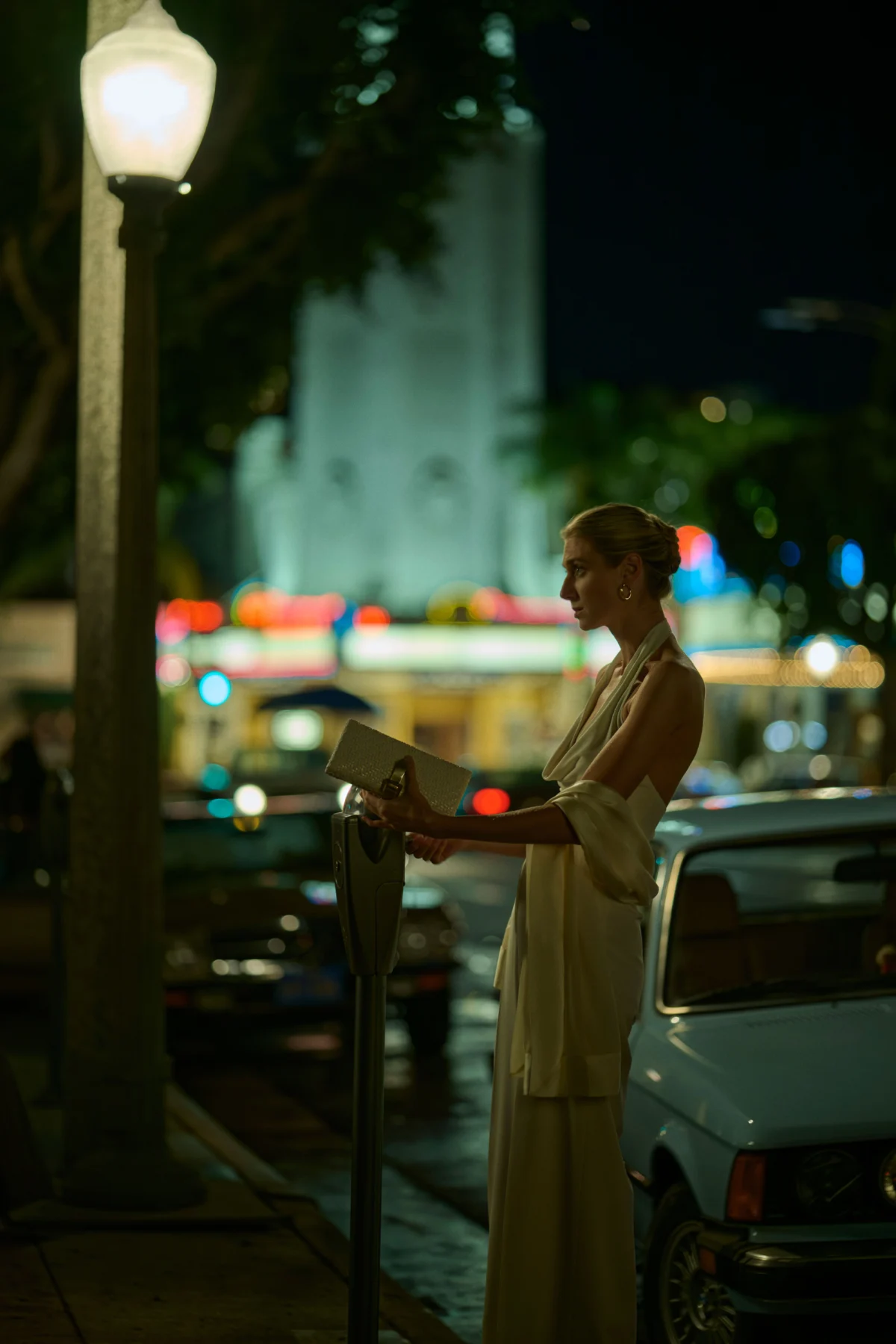
While Booth’s wardrobe retains its rugged practicality, the most striking visual counterpoint belongs to Elizabeth Debicki. Standing six-foot-three, the Australian actor portrays Karen Crosby, an enigmatic and powerful Hollywood studio executive whose crisp aesthetic slices through the seedier underbelly of 1970s Los Angeles crafted by production designer Donald Graham Burt.
Fincher enforced a strict visual mandate for Debicki’s character: she would appear exclusively in varying shades of white. This creative constraint demanded extensive technical color-testing alongside cinematographer Eric Messerschmidt. Because white reads drastically differently under varying lighting conditions, Summerville’s team had to fabricate multiple versions of individual outfits depending on whether scenes were scheduled for exterior sunlight or controlled interior sets.

To anchor Crosby’s character in historical reality while maintaining high cinematic drama, Summerville drew primary inspiration from style icons Lauren Hutton and Cher. Hutton’s classic yet effortless sex appeal—characterized by drapey tops, silk blouses, and sharply tailored high-waisted trousers—provided a blueprint for Crosby’s executive presence. The result is a character whose immaculate tailoring commands the screen, prompting audible gasps from test audiences during key moments, such as her striking passage through the bleachers at a figure-eight racetrack or her regal arrival at a high-profile premiere.
Crafting the Broader Cinematic Landscape

Beyond the principal leads, Summerville’s department populated the background and supporting cast with rich, period-accurate garments that defined the late 1970s zeitgeist. Flash-cut sequences set in Manila feature elaborate brothel settings complete with a functioning Filipino rock band outfitted in towering platform shoes and avant-garde makeup. Other standout moments include a Bordeaux-colored velour one-piece jumpsuit worn by the character Hot Rod, as well as the meticulously maintained tennis whites worn by supporting players, which required constant duplication due to heavy body-makeup transfer during athletic sequences.
The enduring appeal of 1970s fashion, which frequently resurfaces on contemporary runways, stems largely from its unstudied approach to sex appeal. Summerville notes that the decade succeeded aesthetically because individuals achieved style through natural fabric drapes, open silk shirts, thin gold accessories, and non-stretch denim, all of which prioritized personal individuality over fast-fashion uniformity.

Broader Implications for Contemporary Costume Design
The meticulous approach taken by Trish Summerville and David Fincher in The Further Mis-Adventures of Cliff Booth highlights an ongoing shift within prestige streaming cinema. As audiences demand higher visual fidelity, the boundary between feature film costume design and historical preservation continues to blur. By avoiding cheap polyester caricatures and instead constructing authentic garments from archival blueprints, productions of this scale elevate costume design from a mere supportive department to an essential narrative framework. Through precise color theory, rigorous physical tailoring, and deep character integration, the film successfully translates the relaxed ethos of a bygone era into a modern cinematic triumph, ensuring that the legacy of Cliff Booth remains as sharply dressed as ever.