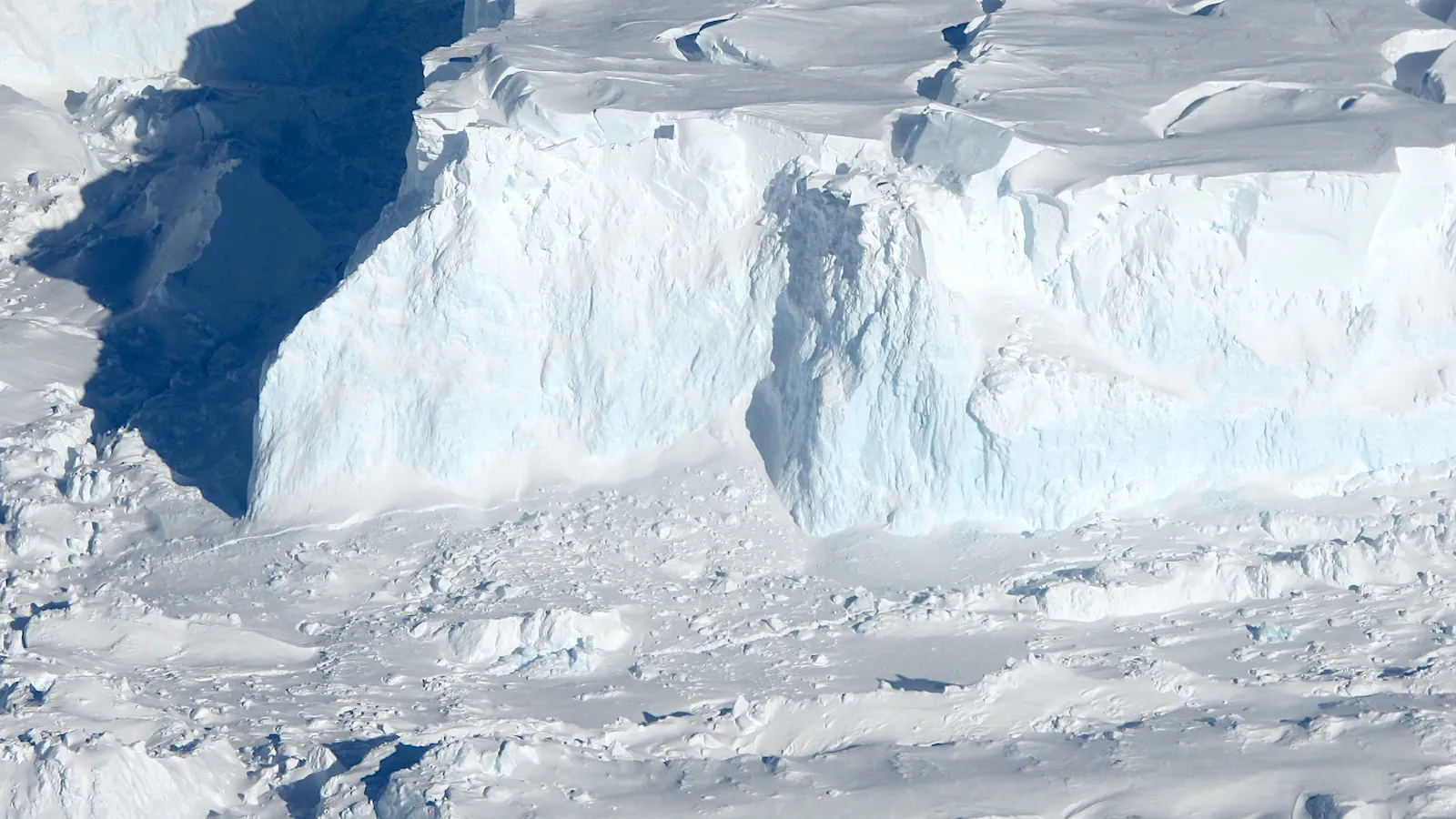
The stability of global coastlines may depend almost entirely on a single, rapidly deteriorating mass of ice at the bottom of the world. Known widely as the Thwaites Glacier, or the "Doomsday Glacier," this gargantuan Antarctic formation—roughly the size of the state of Florida—is melting at unprecedented rates. For years, scientists have understood that Thwaites acts as a critical geological cork, holding back the immense West Antarctic ice sheet. However, recent breakthroughs in climate modeling suggest the situation is far more precarious than previously understood. According to newly published scientific literature, accounting for previously overlooked sub-glacial dynamics reveals that Thwaites could double its projected contribution to global sea level rise by the end of the century, threatening coastal infrastructure, economies, and communities worldwide.
The Anatomy of a Global Threat
To understand the scale of the crisis, glaciologists often look at the unique mechanics of the Thwaites Glacier. Spanning approximately 74,000 square miles, Thwaites is not merely an isolated sheet of ice sliding into the ocean; it is the linchpin of the broader West Antarctic ice system. A vast majority of the ice sheet behind Thwaites rests on a bedrock situated well below sea level.
As the outer edges of Thwaites retreat, they expose deeper inland ice to the warming ocean waters. This dynamic creates a dangerous, self-reinforcing feedback loop known as marine ice sheet instability. When the ice front thins and loses its grip on the seafloor, it floats, reducing the backpressure it exerts on the upstream ice. Consequently, the interior ice flows faster toward the sea, thinning further and accelerating the entire system’s demise.
While satellites have spent decades tracking the rapid retreat and surface fracturing of Thwaites from space, projecting its future behavior has remained a formidable scientific challenge. For years, computer models struggled to accurately simulate the historical retreat captured by satellite imagery, rendering long-term forecasts unreliable and leaving policymakers with a blind spot regarding the exact timeline of potential collapse.
Solving the Sub-Glacial Puzzle
A critical turning point arrived earlier this month with the publication of a study in Nature Communications. Led by Mattia Poinelli, a glaciologist at the University of California, Los Angeles, the research team successfully integrated a major missing variable into ice sheet simulations: the physical processes occurring directly beneath the glacier where it meets the seabed, known as the grounding zone.
Historically, computer models treated the grounding zone as a fixed boundary. However, recent observations have revealed that this zone is highly dynamic, oscillating back and forth with ocean tides. As the ice flexes and bobs with the tides, warm ocean water is pumped deep underneath the glacier. This corrosive intrusion carves out miles-long channels and internal fractures, dramatically accelerating the rate of basal melting.
When Poinelli’s team incorporated tidal flexing and sub-glacial water intrusion into their simulation, the model finally aligned with historical satellite data, successfully recreating decades of observed glacial retreat. The implications of this corrected model are stark. The simulations indicate that Thwaites could become permanently unpinned from its stabilizing seafloor anchors as early as 2038, with a 60 percent probability that this critical threshold will be crossed before the close of the century.
Under a steady climate scenario where global temperatures remain at their current levels, the updated model projects that Thwaites alone will add approximately 3 centimeters of sea level rise by 2100. While 3 centimeters may appear modest at first glance, it represents a doubling of previous projections. Furthermore, over the past three decades, Thwaites has already contributed roughly 10 centimeters of sea level rise, accounting for about 4 percent of the global total—enough to displace coastal communities from the Solomon Islands to Senegal and to severely impact vulnerable shorelines in North Carolina.
The Best-Case Scenario: Too Late for Thwaites?
Even as researchers grapple with accelerated timelines, questions remain regarding how the glacier would respond if global greenhouse gas emissions were drastically curtailed or if future geoengineering efforts successfully cooled the world’s oceans.
To explore this hypothetical, another pivotal study published in Geophysical Research Letters in July utilized advanced computer modeling to test a best-case climate scenario. Led by Rosie Williams, an ice sheet modeler at the British Antarctic Survey, the research team focused on Thwaites and its massive neighbor, the Pine Island Glacier, which currently ranks as the fastest-melting glacier in Antarctica.
Together, Thwaites and Pine Island are responsible for the vast majority of Antarctica’s contribution to global sea level rise. To isolate the glaciers’ structural health, the researchers simulated a scenario where ocean-driven melt was "switched off completely" within the model.
The results revealed a striking dichotomy between two seemingly similar neighbors. In a cooled ocean environment, the Pine Island Glacier demonstrated a remarkable capacity for recovery. Benefiting from a relatively intact outer ice shelf, Pine Island could begin rebuilding its ice mass within a decade, eventually returning to the state it was in 80 years ago.
Thwaites, conversely, showed no such resilience. Even with ocean melting entirely halted, Thwaites would continue to lose ice and drive global sea level rise for at least 150 years. Researchers attribute this disparity to the advanced state of degradation at Thwaites; its eastern half is significantly diminished, and its western sector has fundamentally disintegrated into a chaotic field of floating icebergs. While the absolute speed of ice loss would decrease under a cooled-ocean scenario, the glacier appears to have crossed a tipping point, remaining structurally doomed even under ideal climate recovery conditions.
Implications for Global Adaptation and Policy
The findings from both the University of California, Los Angeles, and the British Antarctic Survey emphasize a nuanced reality for global climate policy. While parts of the Antarctic system may be locked into irreversible retreat, scientists stress that defeatism is unwarranted.
"That doesn’t mean there’s nothing we can do," Williams noted, emphasizing that every fraction of a degree in avoided global warming directly influences the rate of disintegration. Slowing the pace of glacial collapse buys critical time for low-lying coastal cities, island nations, and delta regions to construct physical defenses, relocate vulnerable populations, and overhaul infrastructure.
At the same time, experts caution that current global emission trajectories are not holding steady; they continue to rise, with successive decades consistently breaking temperature records. Consequently, real-world sea level contributions are likely to exceed the baseline figures produced by static models.
As the scientific community refines its understanding of polar dynamics, the Doomsday Glacier serves as an uncompromising barometer of planetary health. The race is no longer simply about preventing the collapse of Thwaites—an outcome increasingly viewed as a geological inevitability—but about managing the cascading consequences for a world whose coasts are reshaped with every melting tide.