The landscape of modern horology is currently undergoing a radical transformation driven by a cohort of independent watchmakers who prioritize technical audacity over tradition. While the heritage conglomerates of Geneva continue to dominate market share, a new wave of artisans is redefining the wrist-worn mechanical aesthetic. From the orbital mechanics of Antwerp to the avant-garde design laboratories of the Swiss Jura, the current climate of independent watchmaking is defined by a synthesis of high-concept engineering and rare, boutique production. This analysis explores the leading names currently setting the pace for collectors and industry observers alike.

The Pioneers: A Historical and Technical Context
The rise of independent watchmaking—often termed the "Indie" movement—can be traced back to the late 1990s and early 2000s, a period marked by a reactionary shift against the mass-production standards of the quartz era. Founders like Denis Flageollet and Felix Baumgartner recognized that the future of the industry lay not in iterative design, but in the total reinvention of the mechanical display.
Chronologically, the movement found its footing with the founding of Urwerk in 1997, followed by the establishment of De Bethune in 2002. These firms established a blueprint for "concept-driven" watchmaking, where the mechanism is not merely housed within a case but acts as a sculptural element of the piece itself. Today, these brands operate in a tier of the market where production is often limited to double-digit annual outputs, necessitating a direct-to-consumer or exclusive-retailer model to manage demand.

De Bethune: Architectural Precision
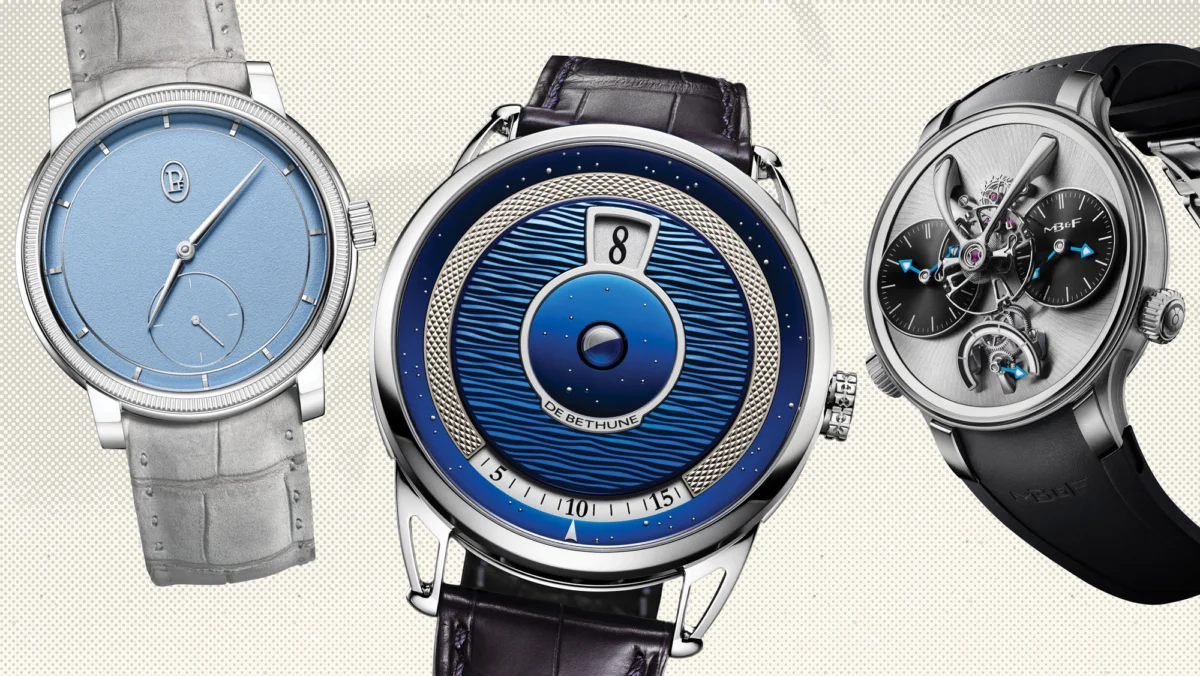
Founded by Denis Flageollet and art collector David Zanetta in 2002, De Bethune serves as a primary example of bridging historical chronometry with futuristic aesthetics. Their signature DB25 Digitale is an exercise in restraint and technical complexity. By separating the hour display from the minutes and housing them on a rotating disc above a spherical, blued-titanium moon-phase function, the brand challenges the traditional layout of the dial. The use of 42mm titanium cases underscores a commitment to lightweight, high-performance materials, appealing to collectors who favor wearable comfort without sacrificing visual drama.
Urwerk: The Mesopotamian Influence
Urwerk’s narrative is inextricably linked to the history of time measurement itself. Established by Felix Baumgartner and Martin Frei in 1997, the brand’s name pays homage to the ancient city of Ur, the cradle of Sumerian timekeeping. The UR-300 Time Quantum exemplifies their sculptural philosophy. By eschewing traditional hands for a T-shaped metal frame where numerical displays rotate, Urwerk treats the watch dial as a living, kinetic interface. This approach has positioned the brand at the forefront of the "avant-garde" movement, garnering cult-like status among tech-forward collectors.

Biver: The Legacy of a Titan
The entry of Jean-Claude Biver into the independent space in 2023 was widely viewed as a watershed moment for the industry. Biver, a man whose career defined the modern luxury watch market, has pivoted to a boutique model with his eponymous brand. The 38mm Biver AB serves as a masterclass in materials science, utilizing solid 18-karat gold dials under a dark gray treatment, encased in a refined brushed-and-polished steel chassis. This piece represents a marriage of "old-world" finishing with the modern sensibilities of a brand that emphasizes rarity and material purity.
Czapek & Cie: The Resurrection of History
The story of Czapek & Cie is one of revivalism. Originally founded by François Czapek in 1845, the brand was dormant for over a century before being resurrected in 2015. Their commitment to legacy is best demonstrated in the Antarctique Tourbillon Victory Green. Originally conceived as a bespoke commission, the 40.5mm timepiece has transitioned into a limited-series production of only 10 pieces. This strategy of moving from custom "on-demand" requests to small-batch manufacturing highlights the brand’s ability to cater to high-net-worth individuals while maintaining the artisanal integrity of the original firm.

Parmigiani Fleurier: The Oscar-Winning Craftsmanship
The 2026 Grand Prix d’Horlogerie de Genève—the industry’s most prestigious awards ceremony—cemented Parmigiani Fleurier’s status as a leader in technical execution. Founder Michel Parmigiani, a master restorer by trade, secured the Chronograph Prize for the Tonda PF Chronographe Mystérieux. This recognition validates the brand’s recent move toward a more integrated, minimalist aesthetic, as seen in the Toric Petite Seconde Platinum Morning Blue. By focusing on the nuances of finishing and movement architecture, Parmigiani Fleurier continues to bridge the gap between traditional restoration and modern, high-complication watchmaking.
MB&F: The Concept House Model
Maximilian Büsser’s MB&F, founded in 2005, operates as a "concept house" rather than a traditional manufacture. By partnering with external horological artisans, Büsser facilitates the creation of pieces that would be impossible under a centralized corporate structure. The LM1 EVO, limited to just 33 pieces, is a testament to this collaborative model. The presence of two separate time displays and a suspended flying balance wheel creates an aesthetic that is as much about kinetic art as it is about timekeeping. This model has effectively democratized high-end watchmaking by bringing together disparate talents under a singular, cohesive vision.

Ressence: The Oil-Filled Revolution
Ressence, established in 2010 by industrial designer Benoît Mintiens, represents a departure from traditional mechanical design. By employing a system of orbiting, rotating discs, Ressence achieves a fluidity of movement that mimics a digital display. The Type 10 DN, weighing a mere 82 grams, utilizes an oil-filled chamber that allows for a unique, distortion-free view of the dial from almost any angle. This innovation showcases how industrial design principles, when applied to watchmaking, can yield entirely new ways of visualizing time.
H. Moser & Cie: The Fumè Aesthetic
Heinrich Moser’s legacy, which dates back to 1828, remains a cornerstone of northern Swiss watchmaking. The Heritage Centre Seconds Espresso Fumè serves as a poignant bridge between the early 20th-century transition from pocket watches to wrist-worn timepieces and contemporary demand for monochromatic, textured dials. The brand’s focus on the "Fumè" dial treatment has become a design hallmark, proving that color and texture can be as vital as movement complications in the modern collector’s market.

Market Implications and Future Trajectory
The proliferation of these independent brands reflects a shift in consumer behavior. Collectors are increasingly seeking brands with a personal narrative, a transparent production process, and a clear connection to the founder’s vision. Data from the 2026 fiscal year suggests that while volume-based luxury brands are facing saturation, independent manufacturers are seeing consistent growth, driven by an appetite for exclusivity and mechanical novelty.
Furthermore, the integration of these brands into established retail environments, such as Material Good in New York or Westime in Beverly Hills, indicates a growing confidence from retailers to stock high-value independent inventory. As these brands continue to push the boundaries of materials—from blued titanium to oil-filled cases—the wider industry is forced to adapt. The implications are clear: the future of horology will not be defined by the scale of the company, but by the intellectual depth of its creations. For the collector, this era offers a rare opportunity to witness the evolution of timekeeping in real-time, backed by a commitment to the enduring value of human craftsmanship.