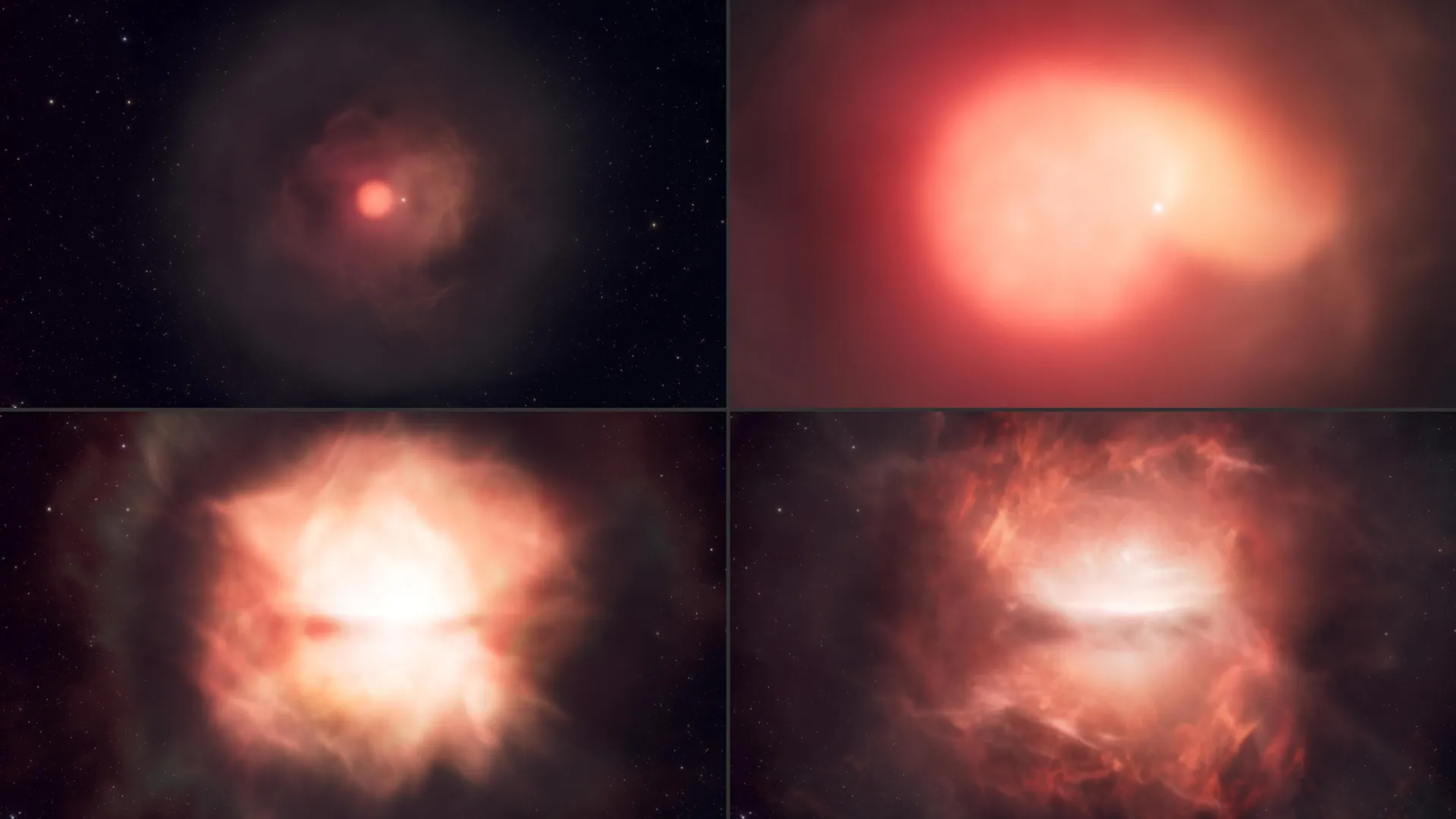
In a landmark achievement for modern astrophysics, an international team of researchers has documented the rare and violent collision of two stars within the Andromeda galaxy. The event, which culminated in the total merger of a Sun-like star with a massive supergiant, provides the first real-time window into a process known as common envelope evolution. Officially designated as AT 2025abao and colloquially dubbed "Bao," the resulting object represents a "rejuvenated" star, offering scientists an unprecedented opportunity to study the lifecycle of binary systems that ultimately shape the evolution of galaxies.
The merger, observed through a sophisticated, multi-observatory effort, serves as a definitive case study in celestial dynamics. By utilizing the unparalleled sensitivity of NASA’s James Webb Space Telescope (JWST) alongside data from ground-based facilities, astronomers have successfully mapped the transition from a stable binary orbit to a cataclysmic unification. This discovery not only resolves long-standing questions regarding how stars interact within shared gas envelopes but also provides critical data for refining predictive models of stellar death and transformation.
The Anatomy of a Celestial Collision
For millennia, the two stars that would eventually become Bao existed in a state of precarious equilibrium. The primary star, identified as "Big Bao," was a colossal supergiant possessing seven times the mass of the Sun, with a radius 350 times greater and a luminosity 18,000 times that of our home star. Orbiting it was "Little Bao," a star roughly 70% the mass of the Sun. For eons, the two maintained a stable binary relationship. However, as the primary star aged and expanded, the orbital dynamics shifted.
The process, termed common envelope evolution, occurred when the primary star’s atmosphere expanded enough to encompass its smaller companion. As Little Bao traveled through this outer layer of gas, it encountered significant frictional drag. This resistance caused the smaller star to lose orbital energy, forcing it into an inward spiral. Unlike previous observations of stellar pairs that took thousands of orbits to complete such a descent, the Bao system underwent this process in a mere seven orbits—a period spanning roughly seven years. The final merger was described by researchers as akin to a bomb detonating within the core of a star, releasing a tremendous burst of energy that signaled the end of the two-star system and the birth of a singular, transformed entity.
A Chronology of Discovery
The identification of AT 2025abao was not the result of a single serendipitous observation, but rather the culmination of years of diligent monitoring across the electromagnetic spectrum.
The first indicators of instability were detected in February 2023, when data from the retired NEOWISE mission revealed anomalous brightness fluctuations in a region of Andromeda previously noted for its steady luminosity. Between 2018 and 2023, the system began to display subtle signs of mass loss, as the smaller companion began stripping material from the primary star’s outer layers.
By September 2024, the Wide-field Infrared Transient Explorer (WINTER) confirmed that the system was expelling significant amounts of dust into the surrounding space. The tempo of the event accelerated in July 2025, when NASA’s SPHEREx mission captured a pivotal transition: the system began to fade in visible light while brightening sharply in the infrared, a classic signature of a star shrouding itself in its own ejected material.
The definitive eruption occurred on October 17, 2025, detected by the Zwicky Transient Facility. The surge in temperature and luminosity prompted an immediate international response. NASA’s Neil Gehrels Swift Observatory and the Gemini North telescope in Hawaii provided essential ground-based support in November 2025. Finally, on December 24, 2025, the James Webb Space Telescope was deployed via a Director’s Discretionary Time program to observe the immediate aftermath, providing the most detailed infrared record of a stellar merger ever captured.
The Scientific Significance of the Bao Merger
The successful observation of AT 2025abao provides a vital data point for understanding the "common envelope" phase, a stage of stellar evolution that remains one of the most significant "missing links" in astrophysics. Common envelope events are theorized to be the precursors to some of the universe’s most extreme phenomena, including the formation of millisecond pulsars, the progenitors of gravitational wave sources, and the precursors to certain types of supernovae.
Viraj Karambelkar, a NASA Hubble Fellow at Columbia University and lead author of the study published in the journal Nature, emphasized the difficulty of capturing such events. "Stellar mergers are notoriously difficult to predict, and even harder to observe in real-time," Karambelkar noted. "Having JWST trained on this system just 47 days after the peak of the eruption gave us a front-row seat to the physics of how these stars shed energy and mass."
The data provided by JWST’s mid-infrared instrumentation was particularly crucial. By analyzing the dust expelled by the giant star, researchers were able to reconstruct the system’s history, looking back at the material ejected over centuries to understand the conditions leading up to the final plunge. The simulations led by Karel Temmink at Radboud University demonstrated that while the smaller star initially seemed capable of escaping the giant’s gravity, the sheer energy dissipation during the final stages of the merger made the collision inevitable.
Broader Implications for Galactic Evolution
The study of AT 2025abao carries profound implications for our understanding of the cosmos. By witnessing this merger in real-time, astronomers have been able to calibrate their computer simulations with empirical evidence, allowing for more accurate predictions regarding the fate of other binary systems.
The findings have sparked a renewed interest in "transient" astronomy—the study of short-lived events that change the appearance of the night sky. With the upcoming surveys to be conducted by NASA’s Nancy Grace Roman Space Telescope, the astronomical community expects an influx of similar discoveries. The Galactic Bulge Time-Domain Survey, in particular, is designed to monitor millions of stars for the exact type of brightness variations that preceded the Bao eruption.
Nadia Blagorodnova, a co-author and associate professor at the University of Barcelona, highlighted the surprise researchers felt regarding the speed of the final event. "We anticipated that the outburst from such an extended stellar system would be a slow, multi-year process," she remarked. "Instead, we watched as it peaked within a week. This shift in our understanding of the timescales involved in stellar death will force a reassessment of how we interpret transient signals from distant galaxies."
Future Outlook and Research Trajectory
As the scientific community continues to analyze the data from AT 2025abao, the focus has shifted toward the long-term evolution of the newly merged star. While the object is currently "rejuvenated" by the influx of mass and energy, its ultimate structure—and whether it will remain stable for millions of years or collapse into a more exotic state—remains a subject of intense investigation.
The successful coordination between disparate observatories, ranging from space-based telescopes like Webb and SPHEREx to ground-based facilities like Gemini North, sets a new standard for collaborative astronomy. This "multi-messenger" style approach ensures that when a transient event occurs, researchers are prepared to capture it across multiple wavelengths, providing a holistic view of the physics at play.
As NASA’s Astrophysics Data Analysis Program continues to support these efforts, the legacy of Bao will likely influence stellar evolution research for decades. By peeling back the layers of dust and radiation surrounding this event, astronomers have not only chronicled the demise of two stars but have also illuminated the mechanisms that drive the ongoing, dynamic transformation of our universe. Whether these events act as the architects of neutron stars or simply as catalysts for stellar longevity, the Bao merger stands as a testament to the power of human observation in deciphering the complex, often violent, lives of the stars that populate the cosmos.