Volkswagen has officially transitioned its Zwickau facility from a singular focus on electric vehicle assembly to a multi-faceted industrial hub that now incorporates an advanced, eight-stage dismantling line. This strategic pivot, designed to recapture value from aging or pre-production vehicles, represents a significant evolution for the German automaker’s flagship electric manufacturing site. By integrating circular economy principles into its core operations, Volkswagen is attempting to offset the mounting costs associated with the transition to electrification while addressing the long-term sustainability of its product lifecycle.
The Evolution of the Zwickau Factory
The Zwickau facility, located in the state of Saxony, has undergone a radical transformation over the past six years. Once a legacy plant for combustion engine vehicles, it became the centerpiece of Volkswagen’s “Electric for All” strategy in 2018. This massive industrial undertaking involved a capital investment of approximately €1.2 billion, aimed at retooling the site for the Modular Electric Drive Matrix (MEB) platform.
The timeline of this transition highlights the speed and intensity of Volkswagen’s shift toward battery-electric vehicles (BEVs):
- 2018: Commencement of the massive €1.2 billion conversion project.
- November 2019: Official launch of production for the ID.3, the first vehicle built on the MEB platform at the site.
- June 2020: The final internal combustion engine (ICE) vehicle rolls off the Zwickau assembly line, marking the end of an era for the factory.
- January 2022: Full transition to electric vehicle production completed with the introduction of the ID.5.
Today, the factory serves as a sophisticated production hub for six different models across the Volkswagen, Audi, and Cupra brands. This manufacturing prowess is supported by extensive automation and a highly skilled workforce that has been retrained specifically for electric vehicle assembly. However, the plant’s future beyond 2031 remains a subject of ongoing internal discussion, making the introduction of the new dismantling line a crucial test case for the facility’s long-term operational viability.
The Mechanics of Industrial Dismantling
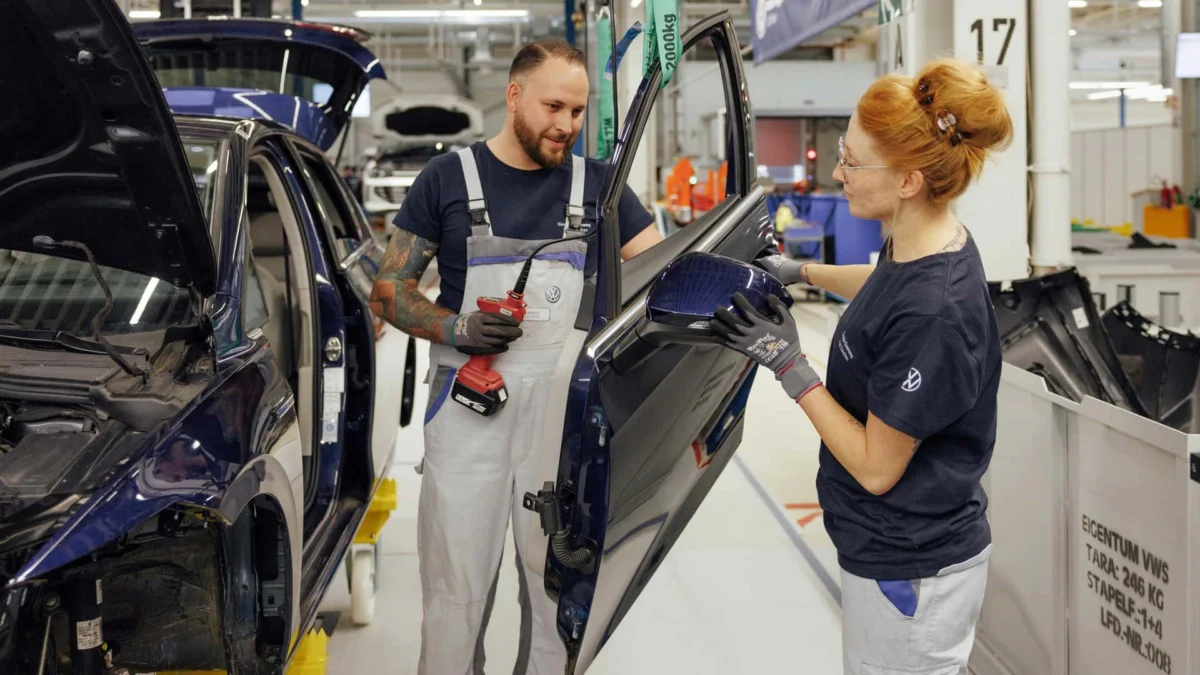
The newly inaugurated dismantling line is not merely a scrap yard; it is a specialized industrial facility designed to systematically deconstruct vehicles. Operating in eight distinct stages, the line is currently configured to handle pre-production models, but the ultimate goal is to process end-of-life (EOL) vehicles that have reached the end of their service.
The construction phase for this facility was notably efficient. By leveraging existing manufacturing infrastructure and repurposing idle equipment, Volkswagen successfully reduced capital expenditures and accelerated the project timeline, completing construction and securing necessary regulatory approvals in just nine months—three months ahead of the original internal schedule.
By 2027, the facility is projected to process approximately 4,100 vehicles annually across two full-time shifts. This operation will be staffed by 100 employees, all of whom have undergone rigorous retraining programs to transition from assembly roles to specialized dismantling roles. This ensures that the human capital invested in the Zwickau plant is preserved, even as the nature of the work changes.
Economic and Circular Economy Implications
Volkswagen’s rationale for the dismantling initiative is twofold: economic optimization and resource conservation. Since July, the company has been actively circulating recovered parts—such as doors, bumpers, electric motors, and transmission components—back into the marketplace. These components are being distributed through the manufacturer’s established service and dealer networks, as well as via independent workshops and secondary parts retailers.
The primary objective is to keep older vehicles on the road for longer periods by providing affordable, high-quality OEM (Original Equipment Manufacturer) parts. This strategy not only serves the consumer by lowering repair costs but also enhances Volkswagen’s brand loyalty by extending the life cycle of its fleet.
Beyond parts recovery, material recycling is a major focus. The systematic separation of plastics, metals, and composite materials during the dismantling process allows for a higher purity of raw materials. According to internal estimates, the high-quality plastic reclaimed from a single vehicle can provide enough recycled material to contribute to the production of up to three new cars. This significantly reduces the carbon footprint associated with sourcing virgin plastics and raw materials.
Financial Context and Strategic Challenges
The launch of the dismantling line occurs against a backdrop of significant financial pressure for Volkswagen. While the company has seen a steady rise in electric vehicle sales, the profit margins on these units remain thinner than those of traditional combustion engine models. The high cost of battery technology and the heavy R&D investment required for the MEB platform have necessitated a more disciplined approach to capital allocation.
This financial strain has already had tangible effects on the company’s product roadmap, most notably the recent decision to pause development on the next-generation electric Golf. The company is currently balancing its long-term commitment to electrification with the immediate need to improve fiscal performance.
The recycling and dismantling business is viewed by analysts as a potential hedge against these thin margins. The project has received a €10.7 million injection from the Saxony government, signaling strong regional support for the initiative. With total investments in the recycling sector planned to reach up to €90 million, the company envisions a future where this division could support up to 1,000 jobs.
However, the success of this model remains to be proven at scale. Volkswagen has yet to disclose specific data regarding profit margins, volume targets for the resale of parts, or the rigorous inspection protocols used to certify used components for secondary sale. The question of whether this line can generate sufficient revenue to become a significant pillar of the Zwickau plant’s economy is one that market observers will be watching closely.
Broadening the Scope: Beyond Electric
While Zwickau is branded as a hub for electric vehicle production, the dismantling line’s utility appears to be brand-agnostic. Visual documentation of the facility suggests that the scope of the dismantling operation is not strictly limited to the brand’s newest EV models. Images released by the company indicate that internal combustion vehicles, including legacy Golf models, are being processed through the line.
This suggests that Volkswagen is adopting a pragmatic approach to revenue generation. By opening the dismantling service to a broader range of models, the company maximizes the utility of its machinery and workforce. This indicates that while the production side of the Zwickau plant is strictly focused on the future of electric mobility, the recovery side is built to address the reality of the existing vehicle population.
Future Outlook and Conclusion
The transformation of the Zwickau factory is a microcosm of the wider automotive industry’s struggle to reconcile the shift to electric mobility with the realities of industrial profitability. The decision to integrate an industrial dismantling line is a proactive move to capture value that is traditionally lost in the scrap cycle.
As the automotive sector faces increasing regulatory pressure to achieve carbon neutrality and improve circularity, the Zwickau model could provide a blueprint for other manufacturers. The ability to reclaim, reuse, and recycle at the factory level creates a closed-loop system that reduces reliance on volatile global supply chains for raw materials.
However, the long-term future of the Zwickau plant remains shrouded in a degree of uncertainty. With no confirmed vehicle production plans beyond 2031, the facility must prove that its new, multifaceted approach—combining high-tech assembly with sophisticated industrial dismantling—can sustain a large-scale workforce in an increasingly competitive global market. For now, Volkswagen is betting that by treating the end of a car’s life as the beginning of a new revenue stream, it can navigate the turbulent transition to an all-electric future while maintaining the stability of its manufacturing heartland.