The Republic of Poland has been plunged into its most severe constitutional crisis in decades following a dramatic escalation of tensions between the center-right government of Prime Minister Donald Tusk and nationalist opposition factions. In a defiant prime-time television address, Tusk committed his administration to pushing through a contentious, sweeping overhaul of the nation’s Constitutional Tribunal. Declaring that "in certain matters, there can be no compromise," the prime minister stood firm against overnight demonstrations, the deployment of riot police to safeguard government buildings, and fierce resistance from opposition-aligned state leadership.
The standoff represents the boiling point of a decade-long ideological war over the separation of powers, the rule of law, and the structure of Poland’s judiciary. As the country prepares for a high-stakes parliamentary election next year, the battle lines have been drawn between Tusk’s broad pro-European coalition and nationalist forces determined to protect their institutional legacy.
A Decade of Paralysis: Background and Context
To understand the current turmoil, one must look back to the eight-year governance of the rightwing Law and Justice (PiS) party, which held power from 2015 until late 2023. During its tenure, PiS engineered radical overhauls across the Polish justice system, transforming independent oversight bodies into partisan instruments. The Constitutional Tribunal—the ultimate arbiter of legislative compliance with Poland’s fundamental charter—was effectively paralyzed after the party stacked the bench with loyalists, altering retirement ages, appointment processes, and administrative control.
These actions triggered an unprecedented standoff with the European Union. Brussels launched multiple infringement procedures and Article 7 proceedings against Warsaw, arguing that the reforms systematically undermined judicial independence and violated EU law. Billions of euros in post-pandemic recovery funds were frozen as a result, placing severe strain on the Polish economy.
When Donald Tusk’s pro-reform coalition swept to power in late 2023 on a promise to restore democratic norms and untangle the PiS judicial architecture, European capitals breathed a sigh of relief. By mid-2024, the European Commission officially moved to end its sanctions procedure against Poland, citing initial legislative steps taken by Tusk’s government to mend the rule of law. However, repairing institutions proved far more complex than anticipated.
The Executive Impasse and the Role of the Presidency
Tusk’s legislative agenda has faced an immovable obstacle: the presidency. Under Poland’s semi-presidential system, the head of state possesses sweeping veto powers capable of blocking government bills unless overridden by an elusive three-fifths parliamentary majority.
The institutional friction reached a boiling point earlier this year when President Karol Nawrocki—a conservative figure aligned with the PiS opposition—flatly refused to swear in five constitutional judges who had been properly vetted and approved by parliament. This refusal left vacancies open, crippled court quorums, and effectively locked the judiciary into a political holding pattern.
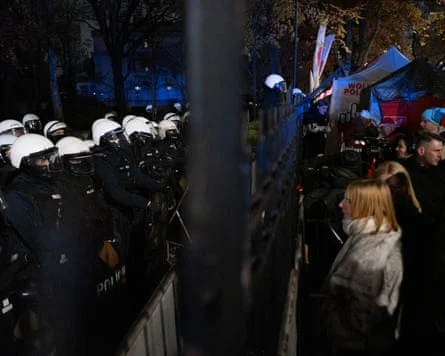
The situation deteriorated from political gridlock to open confrontation when a faction of government-backed judges attempted a bold procedural maneuver. Seeking to break the deadlock, these judges moved to seize administrative control of the tribunal, issuing an immediate suspension of the PiS-appointed chief judge and deputy chief judge. The intervention triggered immediate outrage among conservative circles, leading to impromptu street protests outside the tribunal building in Warsaw and prompting authorities to deploy riot police in tactical gear to prevent physical breaches of the facility.
The Night of Confrontation and Tusk’s Defense
In his Saturday night television address, Tusk pulled no punches, defending the government-backed judicial maneuver as an unavoidable surgical strike to save a broken institution. "There was never any doubt that the court in the form imposed by PiS was not a genuine court," Tusk asserted, noting that numerous European and international tribunals had repeatedly invalidated its rulings.

Drawing a sharp analogy to underscore his point, Tusk likened the outrage of the opposition to "a thief snatching an elderly woman’s handbag, running off, and when he is caught, he screams that he is subjected to violence."
The prime minister went further, framing the domestic struggle within a wider geopolitical context. He argued that the politicians orchestrating resistance to democratic normalization in Poland were finding ideological shelter and support among pro-Russian forces across Europe. To substantiate his claims, Tusk highlighted that former Russian President Dmitry Medvedev had publicly echoed the Polish opposition’s rhetoric, condemning Warsaw’s actions as a "constitutional coup" and persecution of conservatives. "And everything is clear," Tusk told viewers.
Tusk reserved particular condemnation for President Nawrocki, who personally joined the street demonstrations on Friday night and attempted to force his way into the tribunal building to intervene directly. "In a democratic state, no politician can enter a court to issue orders or intimidate judges—not even the president," Tusk declared. "We Poles have succeeded too well in building a strong state to surrender now." He concluded by emphasizing that it is the executive’s constitutional duty to ensure the security and operational continuity of state organs, a duty he vowed to fulfill regardless of the political cost.
The Legal Debate and Cross-Party Fallout
While the government frames its actions as a restorative defense of democracy, legal scholars and human rights watchdogs remain sharply divided over the lawfulness of the administration’s tactics.
The Helsinki Foundation for Human Rights issued a critical statement casting doubt on the legality of the temporary suspensions executed by the government-aligned judges. The foundation warned that utilizing questionable emergency procedures to purge or suspend tribunal members—even those appointed under dubious past regimes—sets a dangerous precedent that "will not contribute" to the genuine, long-term restoration of judicial independence.
Foreign Minister Radosław Sikorski offered a pragmatic, if defensive, assessment of the chaotic scenes on the streets of Warsaw. Acknowledging that the optics of police deployments and street confrontations were "not elegant," Sikorski insisted that inaction was not an option. "The alternative was to concede an unconstitutional transformation of Poland into a presidential republic," he argued.
Meanwhile, efforts at political de-escalation yielded zero results. President Nawrocki hosted a series of cross-party talks on Saturday, which ended without a breakthrough. The opposition reacted with fury to Tusk’s address. Zbigniew Bogucki, a senior aide to President Nawrocki, unleashed a scathing counterattack, labeling the prime minister "a pathological liar who is setting Poland ablaze."
Implications for Poland’s Democratic Future
As the dust settles over the cordoned-off streets of Warsaw, the broader implications of this constitutional crisis are coming into sharp focus. The conflict tests the structural resilience of Poland’s post-communist democracy, exposing the vulnerabilities inherent in a system where executive power, legislative majorities, and presidential vetoes are locked in perpetual antagonism.
With parliamentary elections looming next year, public opinion remains closely divided. The current standoff risks polarizing the electorate further, potentially overshadowing economic concerns and national security priorities. For international observers, particularly within the European Union, the crisis is a stark reminder that democratic backsliding and institutional decay cannot be undone overnight.
Tusk has staked his political legacy on the complete dismantling of the PiS judiciary model. Whether his administration can achieve this through contested procedural maneuvers without permanently compromising the rule of law remains the defining question for Poland’s political future.