
The piercing ring of a 911 call shattered the afternoon quiet in Hyde County, a sprawling, remote expanse of coastal marshlands and agricultural fields in eastern North Carolina. For the county’s emergency response network, this meant navigating an intricate labyrinth of waterways, causeways, and isolated properties spread across a staggering 1,459 square miles of land and water. Yet, rather than dispatching a conventional ground ambulance or waiting for a traditional helicopter to warm up, paramedic Quinn Reece prepared to deploy a radical technological innovation. She climbed into the cockpit of a BlackFly—a single-seat, dual-winged electric vertical takeoff and landing (eVTOL) aircraft equipped with eight distributed propellers and measuring roughly 14 feet in length. Resembling an oversized, high-tech drone, the craft lifted vertically into the sky like a helicopter before transitioning into forward airplane-mode flight.
As Reece sped toward the coordinates at approximately 60 miles per hour, radio communication from the dispatcher relayed conflicting positioning data. The county’s emergency response mobile application had pointed toward an erroneous location. Fortunately, having previously flown over the intricate topography during routine training exercises, Reece possessed immediate geographic intuition. She redirected the nimble aircraft, visually confirmed the actual residence from which the emergency call originated, and instantly transmitted the precise coordinates to backup paramedics traveling by road. Reece touched down, secured the scene, and was actively administering advanced medical interventions a full 20 minutes before the first ground ambulance managed to navigate the rural terrain.
This successful deployment was the exact scenario envisioned by Brook Cox, Hyde County’s emergency medical services chief. Earlier in the year, Cox initiated a pioneering six-month operational trial in partnership with aerospace manufacturer Pivotal. The primary objective was evaluating whether compact eVTOL technology could drastically mitigate response latency in a sparsely populated region where traditional emergency vehicles often struggle against vast geographic distances. Prior to deploying the BlackFly for active 911 dispatches, the local emergency services team executed more than 300 rigorous training and calibration flights, ensuring absolute operational familiarity and adherence to safety protocols.
The Evolution of Advanced Air Mobility and Federal Oversight
While mainstream media discourse regarding electric aviation has largely focused on urban air taxis and futuristic flying cars, regulatory bodies and public agencies are discovering immediate, high-utility applications in specialized sectors. The Federal Aviation Administration (FAA) has actively spearheaded this shift through its eVTOL Integration Pilot Program, a collaborative initiative designed to evaluate emerging aircraft in authentic, operational environments. The regulatory framework views emergency medical services (EMS) as a premier application for eVTOL deployment, particularly in rural and geographically isolated jurisdictions where standard medical infrastructure is chronically stretched thin.
The momentum surrounding advanced air mobility (AAM) has accelerated rapidly across the United States. Concurrently with the Hyde County initiative, major players in the sector have expanded real-world demonstrations. Archer Aviation formally announced comprehensive blueprints for commercial air taxi networks spanning three major Texas metropolitan areas, while Joby Aviation initiated advanced operational demonstrations across Florida. However, rural municipalities are bypassing commercial passenger transport entirely, focusing instead on life-saving civic utilities that capitalize on the unique operational agility of electric aviation.
Chronology of the Hyde County eVTOL Initiative
The integration of electric aviation into Hyde County’s emergency infrastructure represents the culmination of years of technological development, regulatory coordination, and localized testing.
- 2019–2023: Aerospace manufacturers, including Pivotal and Jump Aero, refine single-seat and specialized eVTOL prototypes, targeting rapid emergency response capabilities.
- March 2024: Hyde County EMS Chief Brook Cox officially launches a groundbreaking six-month trial partnership with Pivotal, introducing the BlackFly aircraft to the county’s emergency response strategy.
- Spring to Early Summer 2024: Hyde County paramedics and emergency personnel undergo an intensive training regimen, completing over 300 test flights to master aircraft controls, navigation, and landing protocols.
- December 2024: Pivotal executes a milestone flight demonstration in Los Angeles County, California, launching a BlackFly from a fire station and successfully landing in a private Malibu backyard to prove point-to-point urban and suburban accessibility.
- Mid-2024 to Present: The aircraft transitions from simulation and training into active duty, resulting in successful live-call interventions that shave critical minutes off rural response times.
Bridging the Rural Response Time Gap
In the emergency medical field, the golden standard of care relies on the "eight-minute rule"—the target window within which first responders aim to reach a patient experiencing a life-threatening medical crisis. In stark contrast, national data indicates that rural emergency response times average nearly 15 minutes, driven by vast distances, poor road networks, and limited vehicle availability.
Traditional emergency medical helicopters, while invaluable, carry significant logistical and financial drawbacks. They require extensive pre-flight warm-up sequences, demand specialized multi-person crews, incur massive maintenance costs, and often struggle to land close to residential properties or congested rural spaces.
Carl Dietrich, founder of Jump Aero—a company that has spent seven years developing the JA1 Pulse specifically for emergency response—emphasizes that eVTOLs are not intended to replace ambulances or helicopters entirely. Instead, they introduce an entirely new paradigm of high-speed, immediate-response triage. Unlike turbine-powered aircraft, electric motors suffer no mechanical or financial "penalty" when instantly pushed to maximum power output.
"It’s ideal for rapid response missions because you don’t pay any maintenance penalty for going to full power instantly," Dietrich explains. The JA1 Pulse, engineered for higher performance than the BlackFly, is designed to reach cruising speeds of up to 288 mph, whereas Pivotal’s BlackFly operates efficiently at a modest 63 mph.
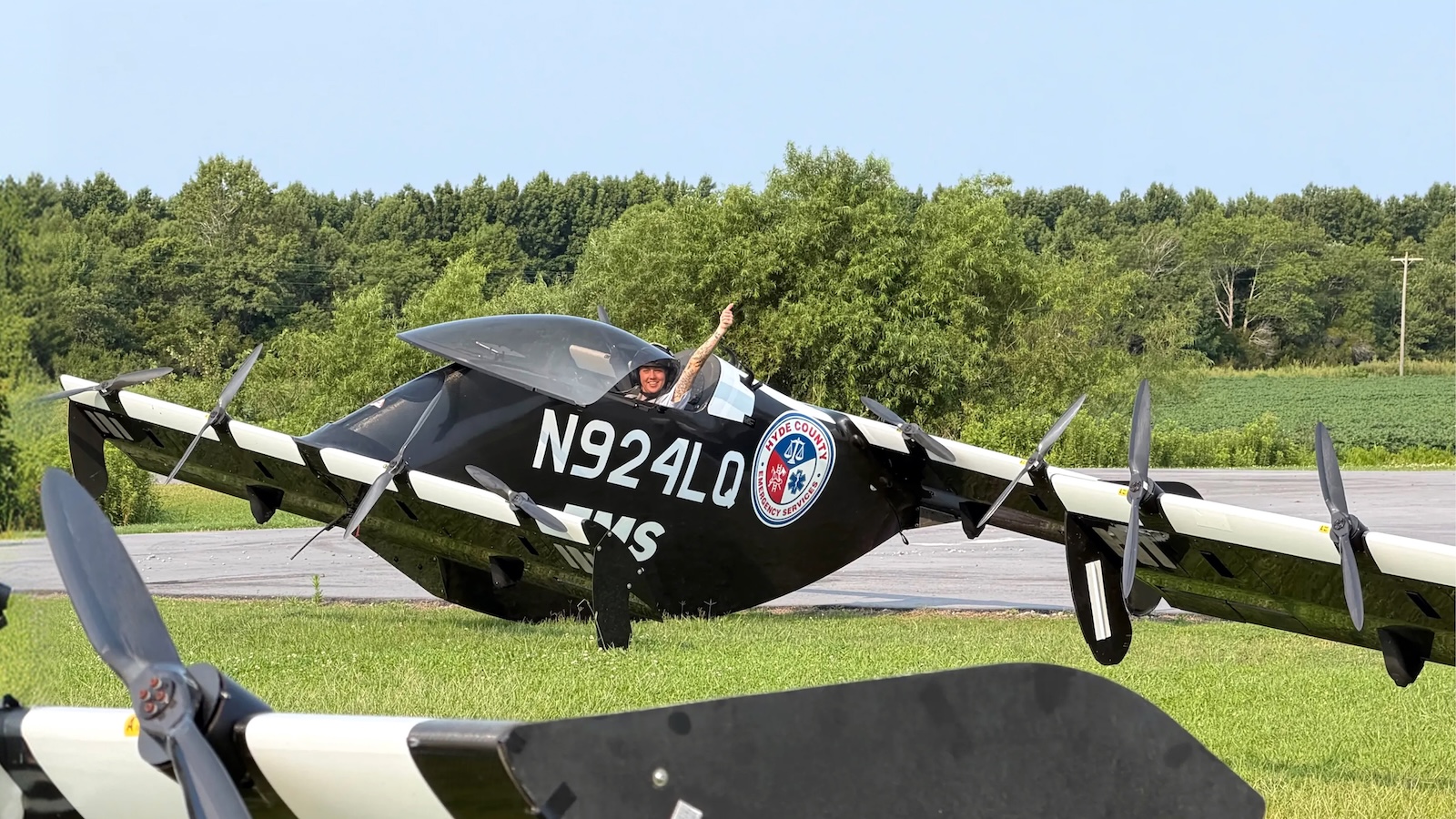
Despite their velocity advantages, current-generation emergency eVTOLs are bound by strict physical limitations regarding battery range and weight capacity. The BlackFly features a 20-mile operational radius on a single charge and a 200-pound payload limit, while the JA1 Pulse extends capabilities to a 70-mile range and a 350-pound payload. Consequently, these aircraft are not designed for patient transport. Their core utility lies in bridging the time gap: rushing a lone medic directly to the patient’s side to stabilize vital signs, clear airways, manage cardiac events, and initiate critical care long before heavy ground transport arrives. During her historic flight, paramedic Reece carried a comprehensive primary response kit, including a cardiac monitor and essential trauma supplies.
Economic Advantages and Regulatory Pathways
Beyond operational efficiency, the economic proposition of compact electric aircraft offers a compelling incentive for cash-strapped local governments. Pivotal’s commercial model retails for approximately $190,000—a stark discount when compared to traditional medical helicopters, which typically command capital expenditures ranging from $500,000 to upwards of $10 million. Furthermore, maintenance and operational expenditures for electric aviation models are projected to run roughly 20 percent cheaper than fossil-fuel-burning counterparts, owing to fewer moving parts and lower energy costs.
Regulatory navigation also presents a smoother trajectory for public agencies than for commercial operators. According to Andrew Mearns, a commercialization consultant at Multicopter Aerospace Consulting, municipal emergency services can frequently operate under the FAA’s public aircraft rules. This classification can exempt public entities from the rigorous, time-consuming commercial pilot credentials required for private air taxi ventures, accelerating community adoption.
April Zhang, director of advanced air mobility at the University of South Florida’s Center for Urban Transportation Research, notes that rural counties provide a frictionless testing ground compared to densely populated metropolitan environments. Finding suitable, unobstructed takeoff and landing zones in urban sprawls remains a complex logistical challenge, whereas rural landscapes offer abundant open space for point-to-point emergency landings. Following Hyde County’s successful proof-of-concept, numerous regional counties are actively evaluating similar integration frameworks.
Expanding Horizons: Stratospheric Environmental Monitoring
While low-altitude eVTOLs are transforming local emergency response, the broader architecture of electric aviation is making profound strides at the opposite end of the vertical spectrum: high above the troposphere. Unmanned stratospheric aircraft are currently undergoing development to operate at altitudes reaching 65,000 feet—roughly double the cruising altitude of commercial airliners.
Equipped with high-efficiency solar power systems, these specialized aircraft can remain continuously aloft for weeks or even months at a time. This endurance profile renders them uniquely suited for long-term ecological surveillance, climate tracking, and disaster mitigation.
Craig Mascarenhas, an aerospace researcher leading engineering efforts for Harvard University’s branch of the Stratospheric Airborne Climate Observing System—in collaboration with Electra.Aero, MIT, and other institutional partners—highlights the vast potential of high-altitude electric flight.
"If you imagine these solar-powered aircraft just circling the L.A. County area, collecting soil moisture, vegetation moisture data, with complex math models and deep learning mapped to that, you can have improved risk profiles better than the models that are currently there," Mascarenhas states. Beyond wildfire detection and real-time perimeter mapping for frontline firefighters, these platforms can track cyclonic storm systems, monitor atmospheric methane leaks across industrial corridors, and measure shifting polar ice dynamics globally.
Environmental Implications and the Path Forward
The overarching narrative of electric aviation is inextricably linked to the global imperative to decarbonize the aerospace sector. However, industry analysts urge a nuanced perspective regarding environmental claims. While transitioning from fossil-fuel-burning helicopters to battery-powered eVTOLs delivers undeniable localized emissions reductions and noise abatement, the carbon calculus shifts when evaluating short-range urban travel. Because vertical flight requires immense energy output to maintain lift without aerodynamic wings, electric aircraft are not inherently more energy-efficient per passenger-mile than electrified ground transit, such as electric buses, trains, or passenger cars.
Nevertheless, in specialized niches where ground transit is physically impractical—such as navigating the marshlands of coastal North Carolina or monitoring receding glaciers in the stratosphere—electric aviation provides an unmatched operational capability.
For manufacturers like Pivotal, the Hyde County deployment serves as an empirical foundation for a much larger commercial vision: revolutionizing short-haul personal and civic transportation. Yet, as the aerospace industry matures, the most immediate and profound impacts of electric flight are being realized not in the crowded skies of metropolitan air taxis, but in the life-saving minutes shaved off a rural 911 dispatch and the silent, solar-powered watch maintained high above the clouds.