New research has unveiled a startling anomaly at the heart of our galaxy, suggesting that the Milky Way is producing stars in a region previously thought to be hostile to such activity. By analyzing the complex dynamics of the Galactic bar—a massive, rotating structure of stars and gas near the galactic center—astronomers have identified a "hidden star factory" that defies the conventional behavior observed in most other barred spiral galaxies. This discovery, led by researchers at the University of Sydney, not only redefines our understanding of stellar birth but also suggests that a major feature long identified as a spiral arm may, in fact, be a component of the central bar itself.
The findings, recently published in the journal Nature Astronomy, represent a significant shift in galactic cartography. For decades, the sheer density of cosmic dust and our vantage point from within the galactic disk have obscured the true nature of the Milky Way’s core. By synthesizing state-of-the-art computer simulations with high-precision observations of masers—microwave-emitting sources that act as signposts for massive star formation—the research team has provided a new, more refined model of the Milky Way’s internal anatomy.
The Dynamics of the Galactic Bar
To understand the magnitude of this discovery, one must consider the classification of the Milky Way as a barred spiral galaxy. Unlike standard spiral galaxies, which possess a central bulge of stars, barred spirals feature a prominent, elongated "bar" structure that rotates like a rigid body, sweeping through the galaxy. This bar is a gravitational engine, acting as a cosmic conveyor belt that shunts gas toward the center.
In the vast majority of barred galaxies studied to date, the rotation of this bar creates powerful, high-velocity shock fronts. Historically, astrophysicists have observed that these shock fronts are so intense that they inhibit the formation of stars, essentially ionizing and heating the surrounding gas to temperatures that prevent it from collapsing into stellar nurseries.
However, the new data suggests that the Milky Way is an outlier. Dr. Hillary Davis, lead author of the study and a recent graduate of the University of Sydney’s School of Physics and the Sydney Institute for Astronomy, notes that the Milky Way’s bar appears to be actively facilitating star formation along these shock fronts. "In most similar galaxies, star formation very commonly occurs along spiral arms," Dr. Davis explained. "What’s extraordinary is seeing this happen in a different region of our Galaxy, where shocks are usually so strong that star formation is often suppressed."
Reevaluating the Norma Spiral Arm
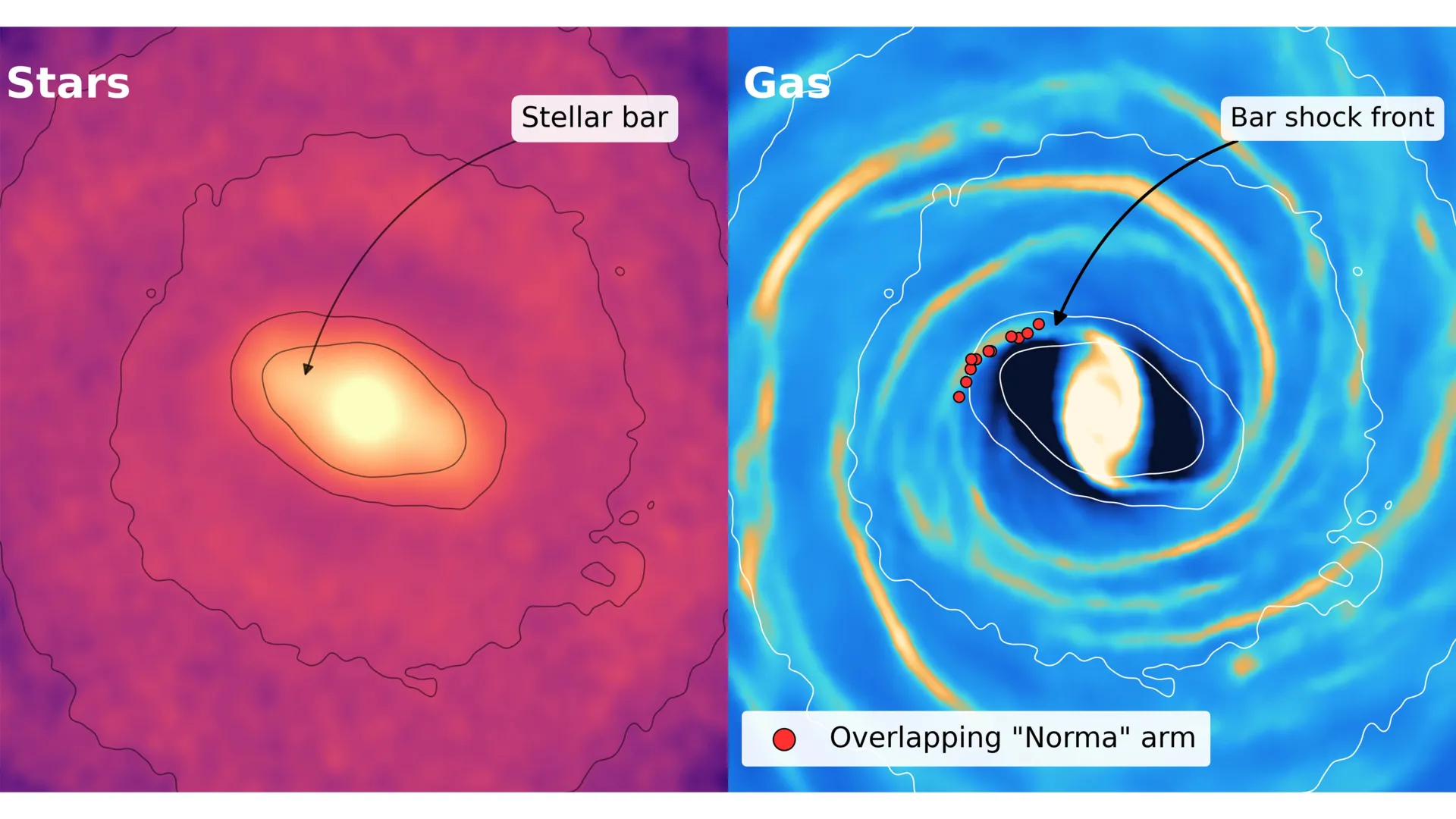
Perhaps the most disruptive element of the study is the challenge it poses to the established map of our galaxy’s spiral arms. For years, astronomers have identified the Norma arm as one of the major spiral features emanating from the galactic center. However, by comparing the spatial distribution of masers—which are naturally occurring, laser-like microwave emissions associated with the birth of massive stars—with the shock fronts predicted by advanced computer simulations, the team found a striking correlation.
The research indicates that the masers previously attributed to the Norma arm align almost perfectly with the shock fronts generated by the leading edge of the Galactic bar. This implies that a segment of what has long been labeled a "spiral arm" may not be a spiral feature at all, but rather a manifestation of the bar’s interaction with surrounding interstellar gas. If this hypothesis holds, it necessitates a fundamental redrawing of the Milky Way’s map, shifting our understanding of how matter is organized within the inner 15,000 light-years of the galaxy.
Chronology of a Galactic Investigation
The road to these findings was paved by a decade of improving computational power and observational resolution. The timeline of this research reflects the broader evolution of galactic astronomy:
- 2010s–2020: Advancements in galactic modeling software allowed researchers to simulate the evolution of barred galaxies over billion-year timescales. These simulations provided the theoretical framework for understanding how gravity, gas, and rotation interact within a bar structure.
- 2021–2023: The research team, utilizing data from international radio telescope arrays, focused on cataloging the precise locations of masers in the inner galaxy. Masers are critical because they are bright enough to be detected through the thick interstellar dust that renders the galactic center opaque to visible light.
- 2024: The publication of the findings in Nature Astronomy provided the first comprehensive evidence linking these maser distributions to the shock fronts of the Milky Way’s bar, establishing the link between the bar’s rotation and local star formation.
Supporting Data and Technical Parameters
The study provides specific metrics that help narrow down the long-debated properties of the Galactic bar. By constraining the bar’s size, angle, and rotation speed, the researchers have offered a more rigid model for future studies. The data suggests the bar extends approximately 4.3 kiloparsecs (roughly 14,000 light-years) from the galactic center.
The use of masers as the primary diagnostic tool is essential to this precision. Because masers are associated with the very earliest stages of massive star formation, they act as "tracers" for the gas compression occurring within the shock fronts. By mapping these tracers against the simulated shock fronts, the team was able to validate the presence of star formation in a region where theoretical models had previously predicted a "dead zone" for stellar birth.
Institutional Perspectives and Scientific Implications
The research has drawn significant interest from the astronomical community, particularly for its implications regarding galactic evolution. While the researchers note that the Milky Way is not the only barred galaxy to show such traits, it is a rare example that demonstrates the complexity of internal galactic dynamics.
"At its heart, star formation is a process we understand from everyday physics," Dr. Davis said. "Forces set matter in motion. In this case, gas is compressed, and that compression can create the conditions for new stars to be born on a massive scale."
The broader impact of these findings is profound. If the Milky Way’s internal structure is different than previously mapped, our understanding of how gas flows through the galaxy—and how that gas is subsequently converted into stars—must be adjusted. This affects everything from models of chemical enrichment in the galaxy to our understanding of how spiral galaxies grow and mature over time.
Funding and Collaborative Effort
This research represents a massive collaborative endeavor, supported by a diverse array of international stakeholders. Funding was provided by the Australian Research Council, the Knut and Alice Wallenberg Foundation, the Swedish Research Council, the Swedish National Space Agency, the LMK Foundation, and eSSENCE (Sweden).
The computational heavy lifting was made possible through National Computing Infrastructure (NCI) Australia, an NCRIS-supported facility, and LUNARC, the Centre for Scientific and Technical Computing at Lund University. The success of this study underscores the importance of public-private partnerships in scientific research, where high-performance computing resources and multinational grant support allow for the analysis of datasets that would have been inaccessible just a decade ago.
Future Directions
As the scientific community continues to digest these results, the focus will likely shift to refining the parameters of the Galactic bar even further. The ambiguity of our position within the disk remains the primary obstacle to definitive galactic mapping. However, with the integration of new data from the European Space Agency’s Gaia mission—which is precisely mapping the positions and movements of over a billion stars—and the continued monitoring of maser activity, researchers are closer than ever to a definitive model of our home galaxy.
The conclusion that the Milky Way’s bar is a dynamic, star-forming environment forces a departure from the "static" view of galactic structures. Instead, the bar is revealed to be a restless, evolving feature that plays an active role in the life cycle of the Milky Way. Whether these findings will lead to the official reclassification of the Norma arm remains to be seen, but the study undoubtedly sets a new benchmark for how we interpret the complex, dusty, and vibrant heart of our galaxy. The Milky Way, it seems, still holds many secrets, and the bar is the key to unlocking the next chapter in our understanding of the universe.