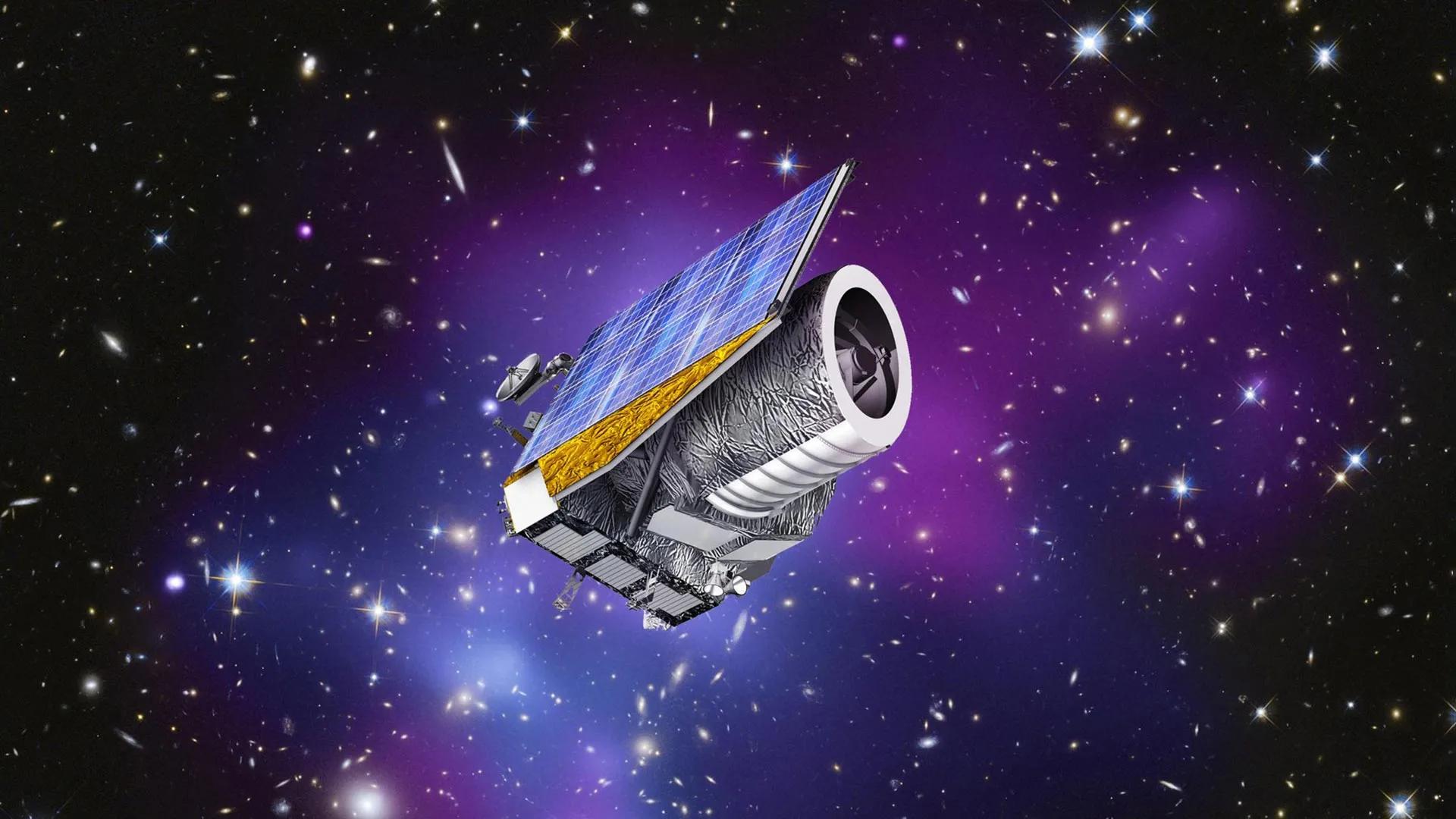
The European Space Agency’s (ESA) Euclid space telescope, an observatory designed to map the dark universe, has inadvertently made a breakthrough contribution to solar system science. Between September 16 and 24, 2026, the telescope captured imagery revealing a previously unknown comet, marking the first time the mission has identified a new member of our solar system. This unexpected detection underscores the versatility of space-based observatories and provides a vital test case for future interplanetary collaboration, specifically regarding the upcoming Comet Interceptor mission.
A Technological "Happy Accident"
Euclid was never intended to be a comet hunter. Its primary directive is to survey billions of galaxies across more than a third of the sky to map the geometry of the dark universe, specifically targeting the influence of dark matter and dark energy on cosmic structure. Because of this, the telescope is optimized for deep-space, high-resolution imaging rather than tracking the rapid, erratic motion of objects within our own solar system.
The discovery was made by Mikko Pöntinen, a PhD student at the University of Helsinki, working in conjunction with the Euclid Consortium’s Solar System Objects Science Working Group. Pöntinen had developed specialized software designed to sift through the massive volume of data produced by Euclid, specifically looking for "streaks"—the characteristic visual signature of a fast-moving object captured during a long exposure.
"I was excited to see my software flag a ‘streak’ smeared across several images," Pöntinen reported. By using predictive modeling, his team was able to locate the object across five separate image sets. Further analysis revealed a distinct, fuzzy coma surrounding the central body, a clear indication that the object was an active comet shedding gas and dust as it interacted with solar radiation.
Chronology of a Celestial Discovery
The identification of the comet, now officially designated C/2026 S1 (Euclid), followed a rigorous validation process that spanned three weeks:
- September 16–24, 2026: Euclid captures the comet in 16 separate exposures while surveying the "Euclid Deep Field North."
- Late September 2026: Researchers cross-reference the moving streak against existing databases of known asteroids and comets. Finding no matches, the team determines the object is a new discovery.
- Early October 2026: The observation data is submitted to the International Astronomical Union’s (IAU) Minor Planet Center (MPC).
- October 8, 2026: The MPC officially validates the discovery, confirming C/2026 S1 (Euclid) as a new celestial body.
Following the formal announcement, ground-based telescopes around the globe were redirected to track the object, allowing astronomers to refine the orbital parameters and confirm its trajectory.
Orbital Characteristics and Distance
C/2026 S1 (Euclid) is currently located approximately 1.3 billion kilometers from Earth—a distance roughly equivalent to the gap between the Sun and the region between Jupiter and Saturn. While its location is within the solar system, its orbit is highly unconventional. Unlike the planets, which move along a relatively flat plane known as the ecliptic, this comet is traveling well outside that plane. It is currently positioned high above the Sun, following a sweeping, elliptical path that will take thousands of years to complete.
This trajectory is common for comets originating from the Oort Cloud, a theoretical shell of icy objects surrounding the solar system. As these ancient remnants of the primordial solar nebula are nudged by gravitational forces, they are sent on long-period journeys toward the inner solar system, where the heat of the Sun causes their frozen components to sublimate, creating the spectacular tails and comas that make them visible to instruments like Euclid.
The Challenge of Searching the Sky
The rarity of this discovery is rooted in Euclid’s operational design. To minimize light pollution and atmospheric noise, Euclid purposefully avoids the plane of the solar system, where the density of dust and debris is highest. This dust reflects sunlight, creating a "zodiacal light" that could interfere with the telescope’s high-precision measurements of distant, faint galaxies.
Furthermore, Euclid employs a "step-and-stare" strategy, which involves imaging a specific patch of the sky once before moving to the next. This methodology is antithetical to traditional comet hunting, which typically requires multiple passes over the same area to observe the movement of an object over time.
"Very few comets are expected to be discovered by Euclid," notes Bruno Altieri, a Euclid Archive Scientist. "It was a happy coincidence that the combination of the comet’s orbit and Euclid’s scanning over those days captured the object in multiple images."
Despite these limitations, identifying solar system objects remains a critical housekeeping task for the Euclid mission. If an object passes through the frame, it must be identified and removed from the final data set to ensure the integrity of the mission’s cosmological measurements. In this instance, what was essentially "noise" for the galaxy researchers became a significant scientific finding for planetary scientists.
Implications for the Comet Interceptor Mission
The discovery serves as a high-value proof-of-concept for the ESA’s upcoming Comet Interceptor mission. The objective of Comet Interceptor is to wait in space until a suitable long-period comet or interstellar object is identified, at which point the mission will deploy to intercept and study the target up close.
While C/2026 S1 (Euclid) is not a candidate for the Comet Interceptor, the rapid communication chain established between the Euclid team and the Minor Planet Center demonstrates that the infrastructure for identifying potential targets is effective. "The process of discovery and alert gives us a real test case for how our two mission teams will coordinate in the future," says Valeria Pettorino, Euclid Project Scientist.
Scientific Significance: Windows to the Past
Comets are essentially "time capsules" from the birth of our solar system 4.6 billion years ago. Because they have spent the vast majority of their existence in the frigid reaches of the Kuiper Belt or the Oort Cloud, they remain largely chemically unchanged.
By studying the composition of the dust and gas ejected by a comet, scientists can infer the chemical makeup of the solar nebula from which the planets formed. This research is vital for understanding the origins of Earth’s water and the delivery of organic molecules—the chemical building blocks of life—to the early terrestrial planets.
Broader Context: Euclid’s Core Mission
While the discovery of C/2026 S1 (Euclid) has captivated the planetary science community, the telescope’s primary goal remains the "Dark Universe" survey. Over its six-year operational window, Euclid will observe the light from billions of galaxies, some as far as 10 billion light-years away. By analyzing the way light from these galaxies is bent by dark matter (gravitational lensing) and measuring the expansion rate of the universe influenced by dark energy, scientists hope to solve some of the most profound mysteries in modern physics.
The fact that this mission is simultaneously producing significant findings in two wildly different fields—cosmology and local solar system science—is a testament to the sophistication of modern space instrumentation. As the data from the Euclid mission continues to flow back to Earth, researchers expect that the automated software developed by Pöntinen and his colleagues will continue to filter out such "interlopers," and in doing so, potentially uncover more of the solar system’s hidden residents.
This discovery underscores that even in a mission designed to look at the farthest reaches of space, the local neighborhood of our own solar system still holds surprises. For the Euclid Consortium, the focus now returns to the deep-field surveys, but the success of the Solar System Objects Science Working Group has established a new, unexpected capability that will benefit astronomical research for years to come.