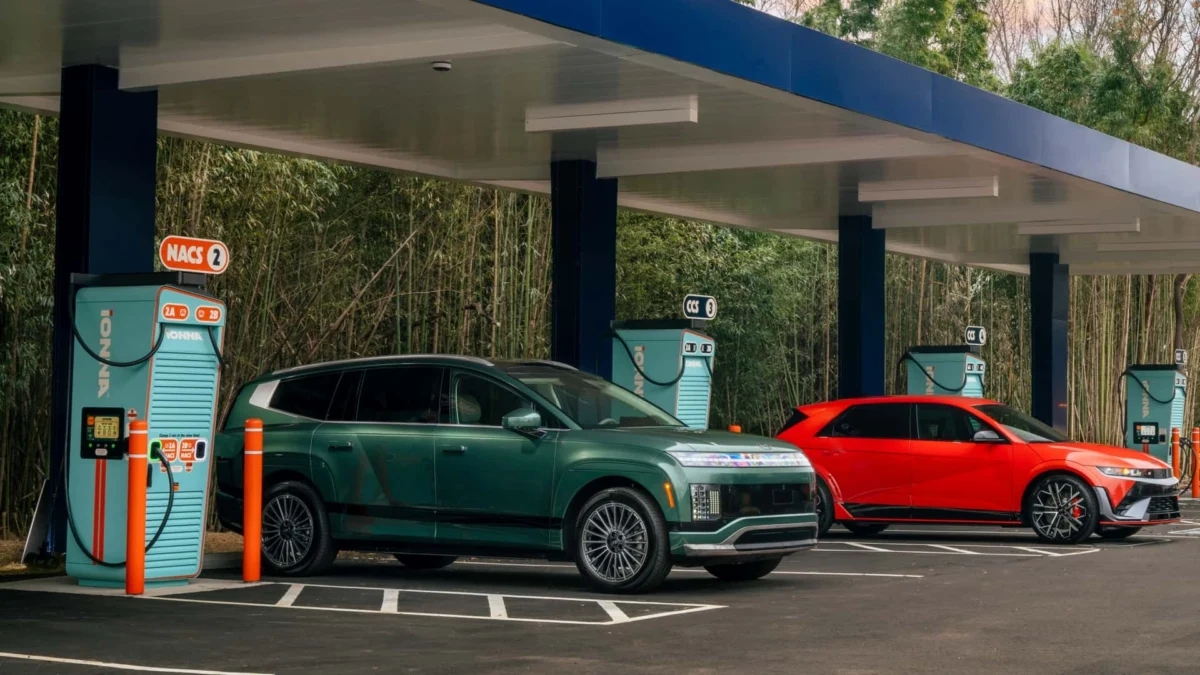
The convenience store and fuel retail giant Circle K has finalized a strategic partnership with Ionna, a high-power charging network consortium, to install hundreds of public fast-charging stations at retail locations throughout the United States. This collaboration, announced on Tuesday, represents a significant expansion of the nation’s electric vehicle (EV) charging infrastructure and signals a deepening integration between traditional roadside retail and the burgeoning electric mobility sector. Under the terms of the agreement, Ionna will deploy its high-performance "Rechargeries" at more than 350 Circle K locations, while also assuming management and modernization duties for Circle K’s existing internal charging network.
This move comes at a critical juncture for the automotive industry. While the breakneck pace of EV sales growth witnessed in the early 2020s has shown signs of stabilization, the demand for reliable, high-speed public infrastructure remains a primary concern for consumers and a priority for federal policymakers. By leveraging Circle K’s extensive geographic footprint, Ionna aims to accelerate its mission of building a premier national charging network that rivals established players like Tesla’s Supercharger network and Electrify America.
The Genesis of Ionna and the Automaker Consortium
Ionna is not a traditional startup but rather a joint venture founded by a powerful coalition of eight major global automakers: BMW Group, General Motors, Honda, Hyundai, Kia, Mercedes-Benz Group, Stellantis NV, and Toyota Motor Corporation. This unprecedented level of cooperation among competitors was prompted by the shared realization that insufficient charging infrastructure serves as the single greatest barrier to mass EV adoption.
The consortium’s primary objective is to deploy at least 30,000 high-powered charging bays across North America by 2030. Unlike many first-generation charging stations that often lacked reliability or integrated amenities, Ionna’s "Rechargeries" are designed to provide a premium user experience. The partnership with Circle K—a subsidiary of the Canadian multinational Alimentation Couche-Tard—provides Ionna with prime real estate along major highways and in densely populated urban centers.
For Circle K, the deal represents an evolution of its business model. The company has already gained significant experience in the EV sector through its operations in Norway, a global leader in electric vehicle penetration. By partnering with Ionna in the U.S., Circle K is applying lessons learned in Scandinavia to the North American market, transitioning from a provider of liquid fuels to a comprehensive energy and convenience hub.
Technical Specifications and Infrastructure Modernization
The technical backbone of the new Circle K-Ionna network focuses on speed and compatibility. Each station will be equipped with 400-kilowatt (kW) DC fast-charging dispensers. These ultra-fast chargers are capable of providing significant range—often 200 miles or more—in as little as 10 to 15 minutes, depending on the vehicle’s battery architecture and state of charge.
A key feature of the Ionna hardware is its dual-standard capability. Every dispenser will support both the Combined Charging System (CCS) and the North American Charging Standard (NACS), the latter being the connector design popularized by Tesla and recently adopted by nearly every major automaker selling vehicles in the U.S. This "universal" approach ensures that virtually any EV on the road today, regardless of brand, can utilize the stations without the need for cumbersome adapters.
Beyond new installations, a pivotal component of this partnership involves the absorption of Circle K’s existing charging assets. According to data from the U.S. Department of Energy’s Alternative Fuels Data Center, Circle K currently operates 378 charging ports across 93 locations. Ionna has committed to "rapidly convert and upgrade" approximately 85 of these existing sites. This modernization effort is expected to improve uptime and user interface consistency, addressing a common complaint among EV drivers regarding the unreliability of older, third-party charging hardware.
The Economic Logic of Retail-Charging Partnerships
The logic driving the partnership between retail giants and charging providers is rooted in consumer behavior and retail economics. In the traditional internal combustion engine (ICE) model, a fueling stop typically lasts between five and seven minutes. During this time, the driver may enter the store for a quick purchase, but the primary focus is the pump.
In contrast, an EV fast-charging session typically lasts between 20 and 40 minutes. This extended "dwell time" creates a massive opportunity for convenience retailers to increase their "basket size"—the total amount spent by a customer per visit. By providing high-speed Wi-Fi, clean restrooms, high-quality coffee, and fresh food options, Circle K can transform a necessary charging stop into a profitable retail experience.

"The opportunity for retailers is clear," industry analysts note. "While gas margins are often thin, the margins on snacks, prepared foods, and beverages are significantly higher. An EV driver waiting 30 minutes is far more likely to spend money inside the store than a gas customer who is back on the road in five minutes."
This synergy has sparked a "land grab" among major retail chains. Ionna has already secured partnerships with other major regional players, including Sheetz and Wawa. Simultaneously, competitors like EVgo have partnered with General Motors to build stations at Pilot and Flying J travel centers, while Mercedes-Benz High Power Charging has focused on high-traffic travel hubs like Buc-ee’s.
Timeline and National Expansion Strategy
The rollout of the Circle K-Ionna stations is expected to begin immediately, with the first wave of upgraded and new sites coming online throughout 2025. This aggressive timeline is part of a broader trend in the U.S. charging industry. Despite a cooling in the rate of EV sales growth following the expiration of certain federal tax credits and high interest rates, the build-out of DC fast chargers reached a record pace in 2024.
Several factors are contributing to this momentum:
- NEVI Funding: The National Electric Vehicle Infrastructure (NEVI) Formula Program, part of the Bipartisan Infrastructure Law, is providing $5 billion to states to create a coast-to-coast network of fast chargers.
- Automaker Commitments: The founding members of Ionna have committed billions in capital to ensure their customers have places to charge, viewing infrastructure as a marketing necessity for their upcoming EV lineups.
- Real Estate Availability: Large-scale chains like Circle K offer "turnkey" locations that already possess the necessary zoning and accessibility for high-traffic use.
Ionna has demonstrated an ability to move quickly, recently making headlines for completing a DC fast-charging site installation in just five days—a process that typically takes months due to permitting and utility interconnection delays. By partnering with a single, large-scale landlord like Circle K, Ionna can streamline the bureaucratic hurdles associated with site acquisition and power grid upgrades.
Addressing the "Charging Desert" and Reliability Concerns
One of the most persistent criticisms of the American EV transition has been the lack of reliable infrastructure outside of major coastal hubs. By targeting 350+ Circle K locations, Ionna is positioning itself to fill gaps in the "charging deserts" of the Midwest and the South. Circle K’s presence in rural and suburban areas is vital for enabling long-distance EV travel and providing charging options for apartment dwellers who may not have access to home charging.
Reliability remains the other half of the equation. Surveys from J.D. Power and other consumer research firms have consistently shown that roughly one in five attempts to use a public charger ends in failure due to software glitches or broken hardware. Ionna’s strategy involves not only deploying high-end hardware but also maintaining a rigorous service standard, backed by the technical expertise of its parent automakers. The integration of charging data directly into the navigation systems of BMW, GM, and Hyundai vehicles will allow drivers to see real-time charger availability and health before they arrive.
Broader Industry Implications
The partnership between Circle K and Ionna is a testament to the maturing of the EV ecosystem. It signifies a shift away from "compliance charging"—stations built simply to meet regulatory requirements—toward a consumer-centric model where charging is a competitive service.
As the 2030 deadline for Ionna’s 30,000-bay goal approaches, the industry will likely see further consolidation. The folding of Circle K’s internal network into Ionna suggests that retailers are increasingly preferring to let specialized networks handle the technical complexities of charging while they focus on their core competency: hospitality and retail.
This deal also places pressure on other convenience store chains and traditional oil companies to accelerate their transition. As more EV drivers gravitate toward locations that offer reliable 400kW charging and premium amenities, stores that offer only gasoline or slow, outdated chargers risk losing a growing and affluent segment of the driving population.
In conclusion, the Circle K and Ionna partnership is more than just a real estate deal; it is a blueprint for the future of the American roadside. By combining the automotive engineering of eight global manufacturers with the retail reach of a convenience store giant, the project aims to normalize electric travel and provide the infrastructure necessary for the next phase of the energy transition. For the American consumer, the result will be a more visible, reliable, and convenient network of chargers that brings the "gas station experience" into the electric age.