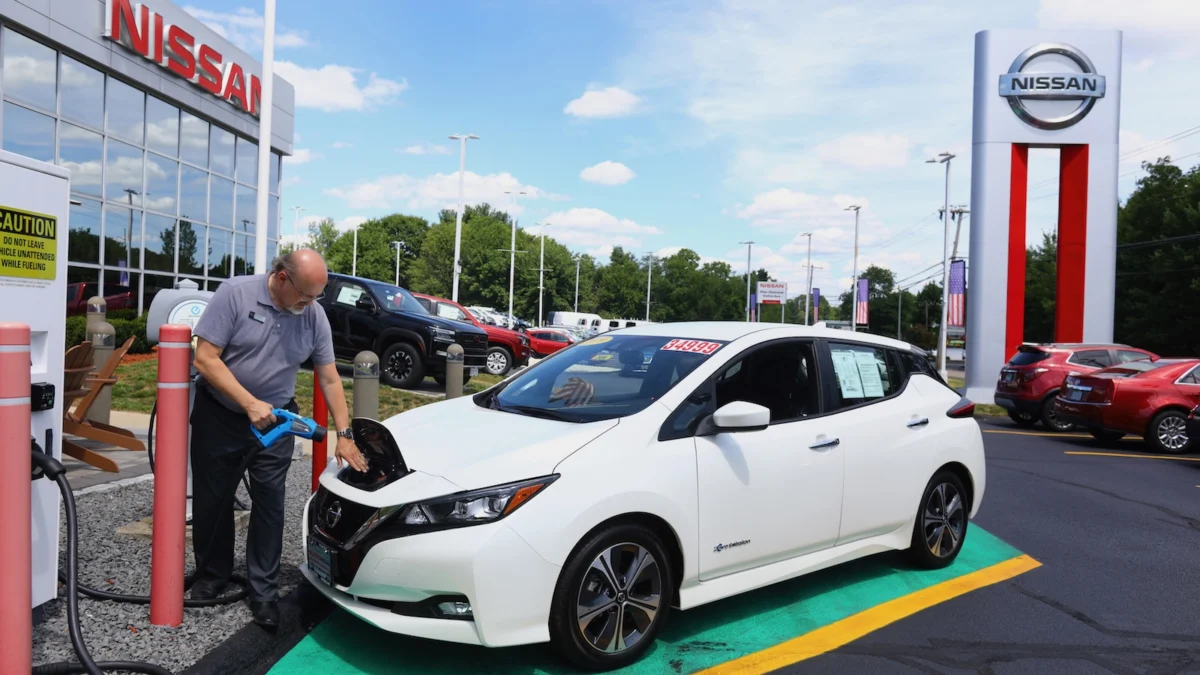
The traditional economic correlation between rising fuel costs and increased demand for electric vehicles appears to have fractured in the United States. Despite a steady climb in gasoline prices throughout the spring, the American automotive market recorded a surprising downturn in new electric vehicle (EV) sales during the month of April. This cooling of the EV sector stands in stark contrast to robust growth in international markets, particularly in Europe and China, suggesting a uniquely American hesitation toward full electrification. Instead of abandoning internal combustion entirely, domestic consumers are increasingly seeking a middle ground, fueling a significant surge in the popularity of hybrid-electric vehicles (HEVs).
Data released by prominent automotive research firms highlights the extent of this divergence. According to Edmunds, sales of new EVs plummeted by approximately 18 percent between March and April. While Cox Automotive offered a more conservative estimate, pegging the decline at closer to 6 percent, the consensus among industry analysts remains clear: the anticipated "pivot point" triggered by expensive gasoline has failed to materialize for the battery-electric segment. This trend is particularly noteworthy given that the national average for regular unleaded gasoline reached $4.56 per gallon in late May, a price point that historically drives consumers toward more efficient transportation options.
The Psychology of Window Shopping versus Purchasing
The disconnect between consumer interest and actual transactions is one of the most striking features of the current market. Ivan Drury, the director of insights at Edmunds, noted that while consumers are actively researching electric options, they are stopping short of signing contracts. "There was a lot of window shopping," Drury observed, pointing to high traffic on digital platforms for electrified vehicle listings. "It did not translate to tire-kicking and purchases."
This behavior suggests that while the American public is conceptually interested in moving away from gasoline, the practical realities of EV ownership—most notably the initial financial outlay—continue to serve as a formidable deterrent. For many, the curiosity regarding Tesla, Rivian, or Ford’s Lightning models is being stifled by the "sticker shock" of the transaction price, leading them to reconsider traditional internal combustion engines (ICE) or the increasingly accessible hybrid market.
The Financial Barrier: Analyzing the Price Gap and ROI
The primary obstacle remains the "cost hurdle." According to Cox Automotive, the average transaction price for a new electric vehicle in April was $6,214 higher than its internal combustion counterpart. While proponents of EVs often point to lower long-term operating costs, including reduced maintenance and the avoidance of the gas pump, the math for the average consumer is becoming increasingly complex.
Stephanie Brinley, a principal automotive analyst at S&P Global Mobility, emphasizes that the payback period for an EV is often too long for the average buyer to justify. "You don’t know how long it’s going to take to get that back," Brinley stated. At current fuel prices, the calculus is daunting. For a buyer to recoup a $6,000 price premium based solely on fuel savings—assuming a gasoline-powered car that achieves 30 miles per gallon and a gas price of $4.56—they would need to drive more than 40,000 miles.
While savings on routine maintenance, such as oil changes and brake wear, can shorten this timeline, other hidden costs often extend it. These include higher insurance premiums for EVs, which are often more expensive to repair after collisions, and the significant upfront cost of installing a Level 2 home charging station, which can range from $500 to over $2,000 depending on the home’s electrical infrastructure. Furthermore, if fuel prices were to stabilize or drop, the economic advantage of the EV would shrink even further, making the investment feel even riskier to a middle-class household.
The Rise of the Hybrid: A Simpler Calculus
As full EVs struggle to gain mainstream momentum, hybrid vehicles are experiencing what experts call a "hybrid moment." Unlike battery-electric vehicles, hybrids do not require a change in consumer behavior; there is no "range anxiety" and no need to install specialized charging equipment. Hybrids utilize smaller batteries and electric motors to assist the internal combustion engine, improving fuel economy by 25 to 45 percent through regenerative braking and electric-assist at low speeds.
The simplicity of this value proposition is reflected in the sales figures. Edmunds data shows that hybrid sales have jumped 20 percent year-over-year and nearly 50 percent since February. This surge coincides with the onset of heightened geopolitical tensions in the Middle East, which historically signals to consumers that gas prices are likely to remain volatile.
Automakers have been quick to capitalize on this shift. Toyota, a long-time proponent of hybrid technology, has moved aggressively to phase out gas-only versions of its most popular models. The 2025 Toyota Camry, a staple of the American sedan market, is now sold exclusively as a hybrid. The RAV4, currently the best-selling SUV in America, has followed a similar trajectory, with its hybrid variants seeing record demand. Similarly, the Honda CR-V Hybrid has become a cornerstone of Honda’s domestic strategy, offering 37 mpg compared to the 29 mpg of the standard gasoline model.
Used EVs and the Secondary Market
While the new EV market faces headwinds, the used EV segment provides a rare bright spot. Sales of pre-owned electric vehicles rose by 3 percent from March to April. More importantly, the price premium for a used EV over a used internal combustion vehicle has narrowed significantly, sitting at just $1,096 in April.
Stephanie Valdez Streaty, director of industry insights at Cox Automotive, noted that used EVs are "selling efficiently," often spending fewer days on dealer lots than their gasoline counterparts. The influx of EVs coming off two- and three-year leases is expected to create a "glut" of inventory throughout the remainder of the year. This increase in supply is likely to drive prices down further, potentially making used EVs the primary entry point for price-sensitive consumers who want to transition away from gasoline but cannot afford the premium of a new model.
Geopolitical Context and the Global Divergence
The current stagnation in the U.S. EV market is particularly unusual when viewed through a global lens. In Europe, EV sales leaped in April as the conflict involving Iran and threats to the Strait of Hormuz pushed petrol prices to new highs. In China, the world’s largest auto market, EV exports and domestic sales set new records in April, supported by heavy government subsidies and a robust public charging infrastructure.
The Strait of Hormuz remains a critical chokepoint for global oil supplies. With Iran maintaining its influence over the region and the looming American summer travel season—typically the period of highest demand—analysts predict that gas prices will continue to climb. In most parts of the world, this would be a guaranteed catalyst for EV adoption. However, in the United States, the "edge-case people"—those already predisposed to buying an EV—are the only ones making the leap.
"Dramatic pump readings might nudge them because they were already in that direction," said Brinley. "But what we’re unlikely to see is a shift in current [internal combustion car] owners just fundamentally making that change simply because of gas prices."
Timeline of the 2024 Market Shift
The current market dynamics are the result of a series of events that began in early 2024:
- January-February 2024: Cold snaps across the U.S. highlighted challenges with EV battery performance and charging speeds in low temperatures, leading to a wave of negative press and consumer hesitation.
- February 2024: Escalating tensions in the Middle East began to impact global oil futures, leading to a steady rise in U.S. pump prices.
- March 2024: Several major automakers, including Ford and GM, announced they would scale back EV production targets in favor of increasing hybrid production to meet shifting consumer demand.
- April 2024: New EV sales recorded a sharp decline (between 6% and 18%), while hybrid sales reached a 50% growth milestone since the start of the year.
- May 2024: National average gas prices hit $4.56, but EV transaction prices remained high, cementing the hybrid as the preferred "efficiency" choice for the American mainstream.
Implications for the Automotive Industry
The data from April suggests a significant recalibration of the "Green Revolution" in the United States. While the federal government continues to push for a transition to electric power through the Inflation Reduction Act and stricter EPA emissions standards, the consumer is signaling a preference for an incremental rather than a radical change.
For automakers, this shift poses a strategic challenge. Companies that bet heavily and exclusively on a rapid EV transition may find themselves with excess inventory and underutilized manufacturing capacity. Conversely, those like Toyota and Honda, who maintained a diversified portfolio including hybrids and plug-in hybrids (PHEVs), are currently well-positioned to capture the "middle-of-the-road" consumer.
The long-term implication is that the "EV chasm"—the gap between early adopters and the mass market—may be wider and deeper in the U.S. than previously estimated. Until the upfront price gap is closed and the public charging infrastructure becomes as ubiquitous and reliable as the neighborhood gas station, the hybrid vehicle appears set to remain the dominant bridge to the future of American motoring. The "hybrid moment" is not just a temporary reaction to high gas prices; it is a reflection of a consumer base that values practicality and immediate affordability over the long-term promise of a fully electric fleet.