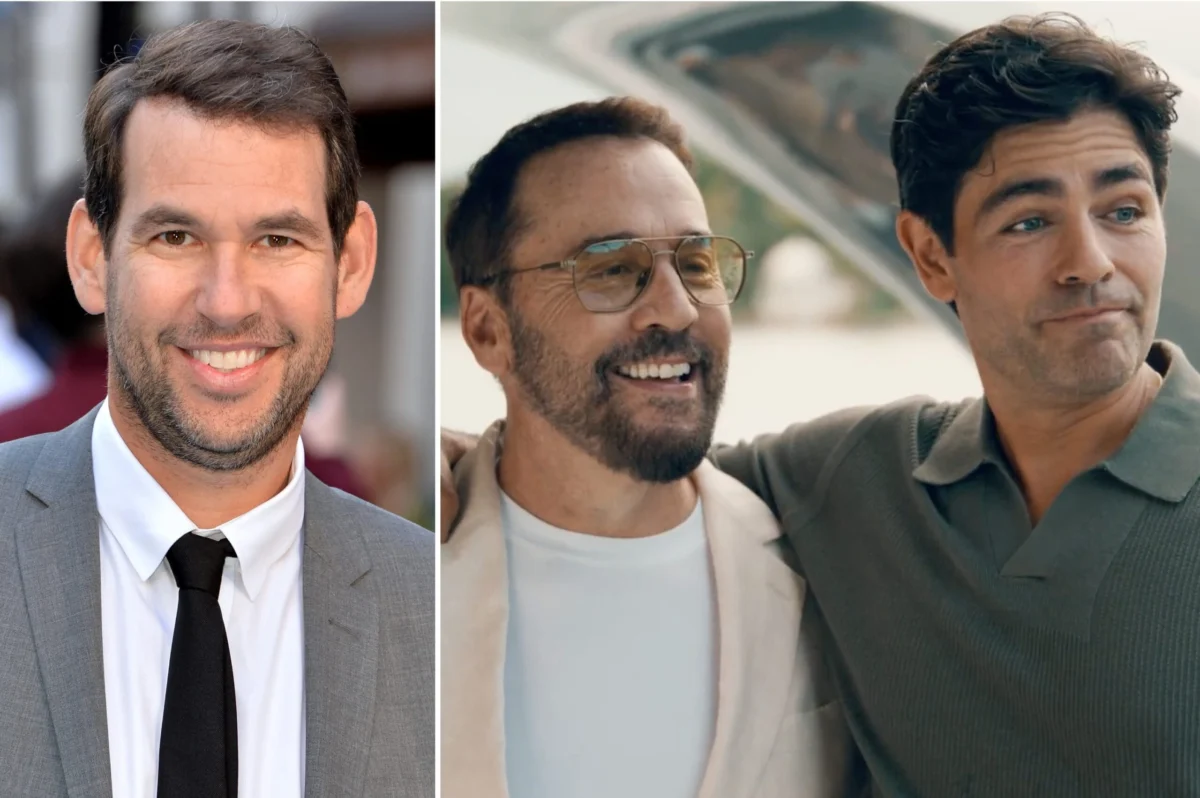
The intersection of classic television nostalgia and modern brand marketing has sparked a fierce industry debate following the release of a promotional campaign for Jake Paul’s gambling platform, Betr. Doug Ellin, the creator of the iconic HBO comedy series Entourage, has publicly lashed out against a newly debuted three-minute commercial that reunites former series stars Jeremy Piven and Adrian Grenier. Ellin did not mince words, characterizing the high-profile digital advertisement as a cheap, derivative emulation of the critically acclaimed television show that defined an era of Hollywood satire.
The commercial in question, which dropped online to immediate viral attention, features Piven and Grenier interacting in a setting that heavily mirrors the luxury-soaked, insider-Hollywood aesthetic of Entourage. While the actors are technically framed as playing exaggerated versions of themselves rather than their legendary television counterparts—super agent Ari Gold and movie star Vincent Chase—the narrative beats tell a different story. Piven’s character navigates a lavish mansion party before tracking down Grenier aboard a yacht to pitch him a lucrative new cinematic project. The dynamic, the pacing, and the sharply delivered dialogue are unmistakably designed to evoke memories of the HBO hit series, which ran for eight successful seasons from 2004 to 2011, followed by a feature-length film continuation in 2015.
The Genesis of the Controversy and Social Media Backlash
The on-screen reunion first came to light when media outlets reported on the Betr 2.0 marketing campaign. Within hours of its release, Ellin was inundated with digital correspondence from fans and industry peers. According to the showrunner, he received approximately 400 messages regarding the commercial, prompting him to address the matter publicly through a series of impassioned video messages and social media posts on platforms including Instagram and X (formerly Twitter).
Ellin’s primary grievance is not centered on financial compensation or missing out on a paycheck, but rather on the perceived degradation of the creative writing process. He expressed deep frustration that the meticulous effort poured into crafting the original scripts, character arcs, and systemic world-building of Entourage was seemingly reduced to a fast-food-style marketing ploy.
"Many people worked really hard to make our show as good as it was," Ellin stated on Instagram, capturing the sentiment of a frustrated auteur. "When I see cheap, shitty imitations that try to pass for what we did, it makes me puke." He elaborated further on the emotional toll of television writing, noting that he and his team of writers suffered over every single syllable and word to establish the distinct cadence of the show, only to see it utilized in what he deemed a piece of embarrassing emulation.
Targeting Jeremy Piven and Industry Dynamics
As the public war of words escalated, Ellin’s critique extended directly toward Jeremy Piven, who won three consecutive Emmy Awards for his career-defining portrayal of the volatile, fast-talking talent agent Ari Gold. Ellin revealed a layer of behind-the-scenes tension, claiming that Piven had actively distanced himself from the Entourage franchise in the years following its conclusion, seeking to build distance between himself and the character that made him a household name.
"I not only wrote, we found these people. We cast these people," Ellin remarked regarding the formation of the ensemble cast. He recounted having to actively persuade Piven to take on the role initially because the actor was reportedly hesitant to commit to the television project. According to Ellin, once the series ended, Piven showed little interest in discussing the show or keeping its legacy alive due to other professional pursuits. However, the creator suggested that financial incentives ultimately motivated the actor to step back into familiar territory for the Betr commercial.
Despite his direct criticisms of Piven’s participation, Ellin maintained that he harbors no personal bitterness regarding actors securing lucrative endorsement deals. "I want everyone to get paid, get rich. Just fucking do your own shit. That’s all," he clarified, emphasizing that the issue lies in the artistic appropriation of the show’s specific comedic and dramatic ecosystem rather than the actors’ right to earn a living.
Betr’s Official Response and Viral Success
Representatives for Betr defended the creative direction of the commercial, maintaining that the campaign achieved its intended marketing objectives. In an official statement addressing the controversy, a company spokesperson emphasized the positive reception the advertisement received from the broader viewing public.
"We were excited to bring Jeremy and Adrian back together, appearing as themselves. Creating that kind of unexpected cultural moment with two amazing actors was exactly what we wanted for Betr 2.0," the company stated. Highlighting the immediate digital impact of the campaign, the spokesperson noted that the spot generated nearly 10 million organic social views within its first 24 hours online.
Betr further leaned into the organic publicity generated by Ellin’s public outcry, expressing gratitude for the creator’s unwitting role in driving conversation around the launch. "We’re really proud of how the spot came together, and the response has been overwhelmingly positive… We had a lot of fun making it, they had a lot of fun making it, and people seem to be having a lot of fun watching it. We appreciate Doug watching the ad and helping promote it. Betr 2.0 is available now."
Escalation Across Digital Platforms
The digital discourse did not slow down after the initial statements. Taking his grievances to X, Ellin continued to voice his discontent, doubling down on his characterization of the ad as unoriginal and derivative. Replying to digital inquiries from followers, he dismissed the notion of an upcoming Entourage revival with pointed sarcasm, suggesting that if fans wanted a reboot, Piven should take the reins to write and direct it himself.
Ellin’s resistance to an Entourage revival is not new, though the topic has perpetually hovered over the creative team for over a decade. While members of the cast and occasional studio inquiries have historically stoked rumors of a potential reboot or spinoff, Ellin has consistently poured cold water on these ideas in recent years. Earlier in the month, speaking on the Joe Vulpis Podcast, he noted that a continuation of the series is highly unlikely and that he refuses to invest intellectual capital into revival concepts unless a guaranteed financial backing is established upfront.
The Legacy of Entourage and Subsequent Creative Endeavors
The friction surrounding the Betr commercial highlights the complex ownership and emotional attachment creators hold toward their intellectual property in an era dominated by nostalgia-driven advertising. Entourage, which drew heavily on the real-life experiences of executive producer Mark Wahlberg navigating the Hollywood landscape as a rising movie star, remains a significant cultural touchstone of the mid-2000s cable television boom. It pioneered a specific brand of fast-paced, male-centric industry satire that has rarely been successfully replicated.
Since the conclusion of the series and the 2015 feature film, Ellin has attempted to recapture lightning in a bottle with subsequent projects. The closest he came to a spiritual successor was the 2002 pilot titled Ramble On. That dramedy pilot followed established entertainment veterans attempting to reinvent their careers, featuring Entourage alumni Kevin Connolly and Kevin Dillon alongside high-profile star Charlie Sheen. Despite releasing a promotional trailer for the project, Ellin was ultimately unable to secure a formal distribution deal with a network or streaming platform, leaving Ramble On in development limbo.
Currently, Ellin maintains a connection to his most famous creation through the Victory podcast, which he co-hosts alongside Entourage star Kevin Dillon. The podcast regularly deconstructs past episodes of the HBO series, offering behind-the-scenes insights and commentary for longtime fans.
Broader Industry Implications
The public clash between a prominent television creator and a major modern betting brand underscores a growing tension within the modern entertainment and advertising landscape. As traditional television viewership continues to fragment and streaming platforms alter the economics of residuals and intellectual property ownership, advertisers increasingly turn to familiar pop-culture archetypes and nostalgic actor pairings to capture consumer attention.
For creators who spent years defining specific fictional universes, seeing those signature dynamics utilized in commercial spots without creative oversight or approval can trigger fierce pushback. While corporate entities measure success through metrics such as organic social views, engagement rates, and platform sign-ups—as evidenced by Betr’s celebration of their marketing metrics—creators like Ellin view the trend through the lens of artistic integrity and the protection of original writing.
As the digital dust settles on the Betr 2.0 campaign, the episode serves as a striking reminder of the enduring power of television nostalgia, as well as the deep personal stakes involved when the commercial world intersects with the legacies of beloved classic television properties.