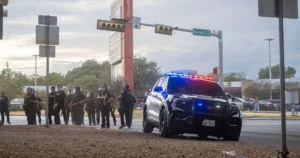
In a landmark and unanimous decision delivered on Thursday, the California Supreme Court ruled that Riverside County Sheriff Chad Bianco acted unlawfully by ordering his deputies to seize more than 650,000 ballots associated with a high-stakes state special election. The high court’s justices determined that the sheriff not only violated state election statutes dictating the exclusive custody of voted ballots but also unlawfully flouted direct supervisory directives issued by California Attorney General Rob Bonta.
The ruling brings a definitive legal halt to a months-long confrontation between local law enforcement and state officials over the administration of elections, the constitutional authority of the state attorney general, and the boundaries of criminal investigations into voting processes. Under the court’s orders, Sheriff Bianco must immediately cease his inquiry into alleged election irregularities and return the confiscated ballots to county custody, barred from any further handling of the election materials outside of compliance mandates.
Main Facts and Court Rulings
The unanimous verdict addressed two consolidated legal actions brought against Sheriff Bianco following his department’s unprecedented confiscation of ballots. According to the text of the ruling, Bianco’s actions directly contravened California elections code, which mandates that voted ballots remain strictly within the physical and administrative custody of designated county elections officials.
The justices firmly rejected arguments presented by the sheriff’s legal team, writing that the defense failed to provide a compelling basis to interpret section 15551 in a manner inconsistent with its plain statutory text. Furthermore, the court upheld the constitutional authority of the attorney general under Article V, Section 13 of the California Constitution, which establishes the attorney general as the chief law officer of the state with direct supervisory powers over every district attorney and sheriff regarding the execution of their official duties.
In light of these findings, the court ordered the immediate return of all seized materials to the Riverside County Registrar of Voters and enjoined Bianco from conducting further investigative measures into the special election.
Background Context and Chronology of the Seizure
The roots of the controversy stretch back to the special election concerning Proposition 50, a major redistricting measure that shifted five of California’s Republican U.S. House seats into configurations significantly more favorable to Democrats ahead of the midterm elections. Following the certification of the vote, local groups raised questions regarding minor statistical variances, alleging a discrepancy involving roughly 45,800 votes reported to the California Secretary of State.
Seizing upon these local complaints, Sheriff Bianco—who launched an unsuccessful bid for the California governorship in the primaries—mobilized the Riverside County Sheriff’s Department to confiscate over 611,000 ballots from the special election. The materials were subsequently transported and stored in an undisclosed location, triggering widespread alarm among voting rights advocates, state officials, and local representatives.
County elections officials swiftly pushed back against the sheriff’s narrative, clarifying that the actual mathematical discrepancy between machine counts and the final certified tally submitted to the state amounted to a mere 100 votes, rather than the tens of thousands claimed by the sheriff’s office. Despite these clarifications, Bianco defended the operation as a legitimate "fact-finding mission" aimed at uncovering potential election fraud and institutional corruption.
The timeline of the legal battle escalated rapidly through the spring and summer of 2026:
- Early 2026: Riverside County deputies seize more than 650,000 ballots following complaints regarding Proposition 50 vote counts.
- March 2026: Following intense legal pressure and lawsuits filed by the California Attorney General’s Office and UCLA’s Voting Rights Project, Bianco announces a temporary pause to his investigation.
- April 2026: The California Supreme Court issues a formal preliminary order formally halting the sheriff’s probe.
- August 2026: The state high court hears oral arguments from both the Attorney General’s Office and Sheriff Bianco’s legal representatives.
- September 24, 2026: The California Supreme Court hands down its final, unanimous ruling against Bianco, ordering the return of the ballots and reaffirming the attorney general’s supervisory powers.
Official Responses and Public Statements
The high court’s decision drew starkly polarized reactions from state officials, legal experts, and the sheriff himself.
Attorney General Rob Bonta praised the ruling as a crucial defense of the rule of law and the integrity of California’s electoral infrastructure. "I’m grateful that our State Supreme Court reaffirmed my authority as Attorney General to supervise county sheriffs," Bonta stated. "I take my responsibility to exercise that authority in the public interest seriously. This was an extraordinary situation that required extraordinary action."
Conversely, Sheriff Bianco launched a sharp critique of the judicial outcome, utilizing an advertisement for his upcoming 2028 reelection campaign to condemn the ruling. Bianco asserted that the decision granted the Attorney General’s Office "unchecked power over any investigation in the state of California" and argued that it established a dangerous precedent whereby local law enforcement is subjugated to Sacramento rather than local constituents.
"I will obey the writs. I will not obey the message behind them — that local law enforcement works for Sacramento, not for the people who elected us," Bianco wrote in his campaign release. In prior podcast and media appearances, including an October 2025 interview on the Ben Maynard Program, Bianco had frequently echoed broader skepticism regarding mail-in voting systems, asserting that mail-in ballots are inherently vulnerable to manipulation.
Governor Gavin Newsom weighed in heavily on the controversy, linking the court’s decision to broader legislative efforts to safeguard the state’s democratic institutions. The ruling arrived just days after Governor Newsom signed a comprehensive package of statutory bills designed explicitly to shield California elections from outside interference and preempt unauthorized law enforcement seizures of ballots.
"Today’s ruling affirms that in California we will defend democracy — using every branch of government," Newsom wrote following the announcement. "And the new laws I signed just last week add new protections so attacks like this cannot happen again. People deserve to know their ballot is counted and secure, and in California we will do everything we can to protect that constitutional right — this year, and beyond."
Broader Implications and Analysis
Legal analysts note that the Supreme Court’s unanimous decision carries profound implications for the separation of powers and the jurisdictional limits of county sheriffs within the state of California. By firmly cementing the supervisory reach of the attorney general over local law enforcement in matters of statewide public interest, the court has effectively foreclosed unilateral interventions by local agencies into state-level electoral administration.
Furthermore, the case underscores the growing intersection between local law enforcement, partisan politics, and election administration. With sheriffs increasingly asserting independent authorities over public safety and governance, constitutional scholars suggest this ruling provides a definitive judicial ceiling on how far local officials can intrude into domains traditionally managed by specialized administrative and electoral bodies.
As Riverside County officials work to reintegrate the recovered ballots into official administrative archives, the fallout from the case is expected to resonate across upcoming legislative cycles, shaping how California defends its electoral processes against emerging political and legal challenges.