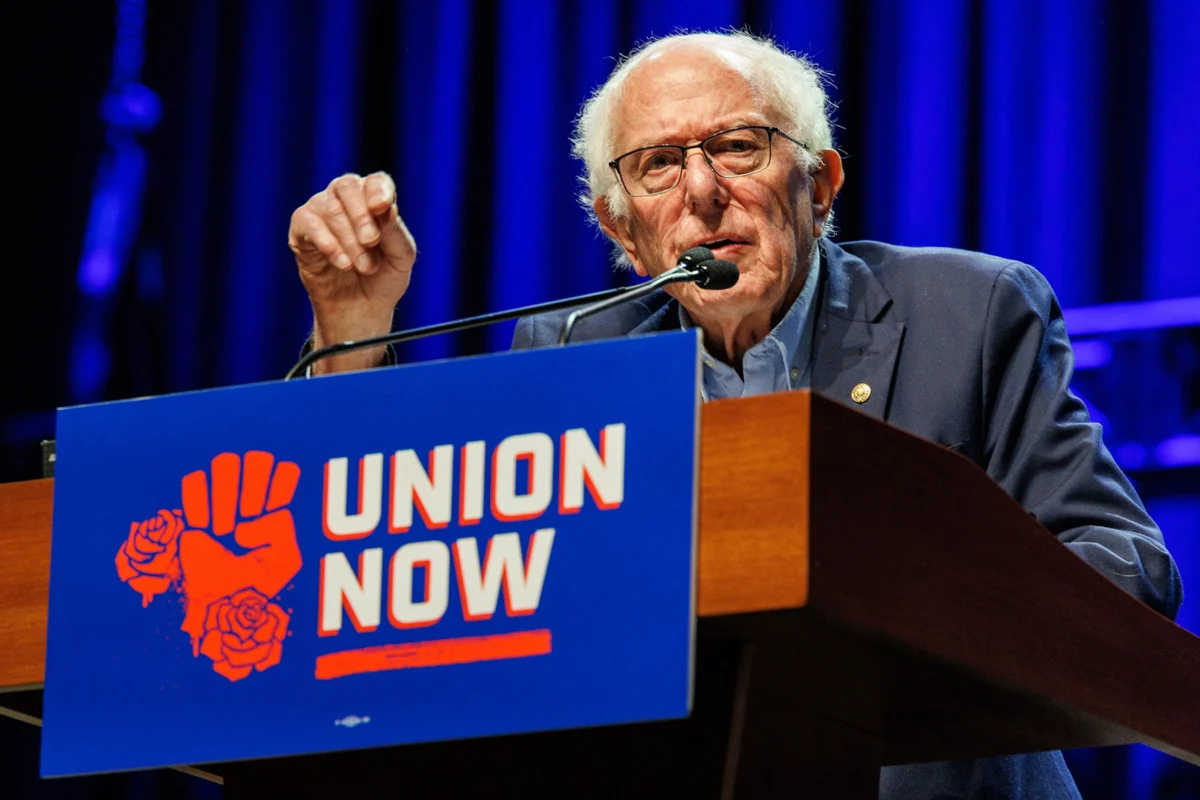
A new organization aimed at bolstering the labor movement, Union Now, launched this past Sunday afternoon, drawing over 100 attendees to a New York City venue. The event, which featured prominent figures in progressive politics and organized labor, underscored both the historical significance of unions and the challenges they face in the contemporary economic landscape, particularly in the face of rapid technological advancement.
The rally, held at a location that required attendees to wait in line, was initiated by Sara Nelson, president of the Association of Flight Attendants-CWA, to support workers engaged in contract negotiations. Among the notable figures present were Randi Weingarten, president of the American Federation of Teachers, New York City Mayor Zohran Mamdani, and Senator Bernie Sanders, a leading voice in the Democratic Party’s left wing. The event opened with a performance by singer-songwriter Josh Ritter, whose rendition of Woody Guthrie’s "This Land Is Your Land," joined by Nelson, evoked a sense of nostalgia for a period when labor and progressive movements held greater sway in national policy.
This retrospective sentiment was juxtaposed with a stark acknowledgment of the labor movement’s diminished influence. Over the past four decades, U.S. unionization rates have experienced a significant decline, plummeting from over 20% to a current level slightly above 10%. This period has coincided with a substantial increase in income inequality, the offshoring of millions of manufacturing jobs, and a political landscape increasingly shaped by the interests of affluent individuals and corporations. Data from the Bureau of Labor Statistics consistently shows this downward trend in union density since the early 1980s, a period marked by significant shifts in economic policy and corporate strategies.
Speakers at the Union Now rally addressed the perceived threats posed by artificial intelligence (AI) and Silicon Valley leaders, whom they characterized as emblematic of an elite-driven political agenda. Both Mayor Mamdani and Senator Sanders specifically highlighted AI and robotics as significant challenges to the future of the working class. Conversations with attendees revealed a palpable sense of concern and even anger regarding the rapid development of AI and automation. One member of a local carpenters’ union articulated a common sentiment: "Neither party has successfully laid out a pro-worker path forward for AI, which he felt would hit like a ‘freight train’ in the coming years." The palpable frustration was further evident when a man in the audience shouted, "Fuck Sam Altman," to widespread applause, referencing the CEO of OpenAI, a prominent figure in AI development.
The rise of automation presents a complex challenge for organized labor as it endeavors to regain its former strength. While policymakers across the political spectrum express a desire to reshore manufacturing – a traditional stronghold for unions – there is a growing concern that many of these repatriated jobs will be highly automated. Evidence from international manufacturing hubs, such as the "lights-out" factories in China that require minimal human intervention, supports this apprehension. This looming threat, coupled with widespread fears of job displacement across various sectors, has amplified calls from labor leaders for greater influence in shaping policy.
Organizations like Union Now aim to provide critical support in this evolving landscape. In an era where unionization rates continue to fall and, as noted by the Economic Policy Institute, former administrations have sought to dismantle workplace protections, Union Now’s mission is to connect unions and workers with essential resources. Sara Nelson articulated her vision for the organization in a post-event interview: "If we can help them have the time and not have to be able to pick up another shift, or work a second job, and they can focus on the organizing, they can win." This initiative seeks to empower workers by alleviating the immediate economic pressures that often hinder organizing efforts.
Nelson’s vision aligns with a broader shift in American politics, where the consequences of declining union power and rising inequality are becoming increasingly apparent. A growing segment of the electorate is seeking an alternative political framework that re-centers labor and working people as central actors in national discourse. This perspective has long been championed by Senator Bernie Sanders, who has dedicated decades to advocating for the working class. At 84 years old, Sanders has witnessed firsthand the zenith of organized labor’s influence and its subsequent decline, providing him with a unique historical perspective on the current challenges.
In an interview following the rally, Senator Sanders elaborated on the factors contributing to the decline of unions, the implications of automation, and his outlook on the future of labor.
The Decline of Unionization: Trade Policy and Corporate Opposition
Rolling Stone: We’re here today to celebrate and advocate for organized labor and unions, but the reality is that over the last 40 years, rates of unionization in the U.S. have plummeted. What’s driving that decline, and do you think it can be turned around?
Bernie Sanders: I absolutely think it can be turned around. The decline has occurred for a number of reasons. We’ve had trade policies in this country—NAFTA, Permanent Normal Trade Relations with China—that resulted in many thousands of factories being shut down, where workers hadn’t been represented by unions. Millions of decent-paying jobs, many union jobs, were lost. Union membership declines when jobs are lost and union workers die.
Secondly, we have seen, in an unprecedented way, incredible anti-union and union-busting activity on the part of corporate America. I am now the ranking member of the Health, Education, Labor, and Pensions Committee, and almost every week I’m on the phone with workers around the country who are trying to organize, trying to get a contract, and the kind of horrible things that the companies are doing to try to make it impossible for them to have a union. These companies break the law every day; they do it with impunity. There are no norms to kind of punish them, which is why we need to bring about strong legislation that makes it possible for workers to form unions without their companies and their bosses acting illegally against them.
AI and Automation: The Next Industrial Revolution
Rolling Stone: There’s been a lot of talk today on the threat of AI and automation. When we’re talking about bringing back manufacturing jobs to the U.S., do you see, as many have said, that a lot of these jobs may be ultimately replaced by robots?
Bernie Sanders: I’ve been spending a lot of time on AI. On Thursday, as a matter of fact, we’re going to be doing an event in Washington with many labor leaders. The focus is going to be on AI and robotics, what it will mean to the working class, and how we effectively bring it back. So it’s an issue I’m working very, very hard on.
Everybody must understand that this is not just another kind of economic transformation. This is the most consequential, by far, industrial revolution in the history of the world. It makes the revolution, the transformation from agriculture to industry, look very slow and tepid compared to what we’re seeing right now.
The question is, who will AI and robotics benefit? Will they simply benefit the billionaires who are investing huge amounts of money in it, whose job it is, whose goal it is, to throw workers out on the street and reduce labor costs? Or will that technology be used to benefit and improve the standard of living of all people? That is the struggle of the moment.
Rolling Stone: You don’t see job losses as inevitable?
Bernie Sanders: Well, what I see is that the struggle right now is who benefits from AI and robotics. So, if you’re a worker and we have robots that can help out, and your work week can be reduced from 40 hours a week to 20 hours a week with no loss in pay, is that a bad thing? I don’t think so. So the question is, who benefits? And we’ve got to make sure that it’s working people that benefit, not just Mr. Musk and Mr. Bezos and the other guys.
Unions and Democracy
Rolling Stone: Do you see building up unions as important for democracy?
Bernie Sanders: Absolutely. Democracy is under assault right now from a number of directions. Clearly, Trump is an authoritarian and does not believe in democracy. I don’t think anyone has any doubts about that. But it’s not just Trump. We’re also looking at a corrupt campaign finance system where billionaires are spending unlimited amounts of money to buy the candidates they want. So, we need a strong, organized political force to demand that this country be a vibrant democracy—one person, one vote—where the needs of working people are heard, not an oligarchy where the rich and powerful control our government. And the strongest possible way, the strongest force to help us achieve that goal is the trade union movement.
Addressing Economic Challenges: Beyond Deregulation
Rolling Stone: There’s a growing part of the Democratic Party that’s looking at the midterms and the future and sees a different path forward, focusing on things like supply constraints, reducing regulation, making building more affordable. On one end, I think that there is a lot of synergy with what you’re advocating for, but then there are many who embrace that sort of ‘abundance’ ideology that are skeptical of unions, arguing that they raise prices.
Bernie Sanders: I was a mayor for eight years. I work in the United States Senate. Bureaucracy is real. It slows things down, often unnecessarily. And we’ve got to deal with that. We’ve got to make government efficient and productive. No question about that. With a dedicated, well-paid, well-motivated workforce, that’s the goal.
This idea that just doing away with regulations is going to address the crisis that the working class of this country faces today is an absurd idea. That’s not the case. We need a political movement led by the working class, led by the trade unions, that is going to fight for an agenda that speaks to the needs of all. And that means healthcare for all, raising the minimum wage to a living wage, building the millions of units of affordable housing that we need.
The current economic climate, marked by rising inflation and stagnant wages for many, presents a complex policy challenge. While some advocate for deregulation as a means to stimulate economic growth and reduce costs, labor advocates like Sanders argue that such measures often disproportionately benefit corporations at the expense of workers. The debate over the role of unions in potentially influencing prices, particularly in sectors with strong union presence, is ongoing. However, from Sanders’ perspective, the focus should remain on ensuring that technological advancements and economic policies serve the broader population, not just a select few. The initiative by Union Now signifies a proactive effort by labor leaders to navigate these multifaceted challenges and to strategically rebuild the movement’s influence in an era of profound economic and technological transformation. The organization’s success will likely depend on its ability to adapt to these changes and effectively mobilize workers in a rapidly evolving global economy.