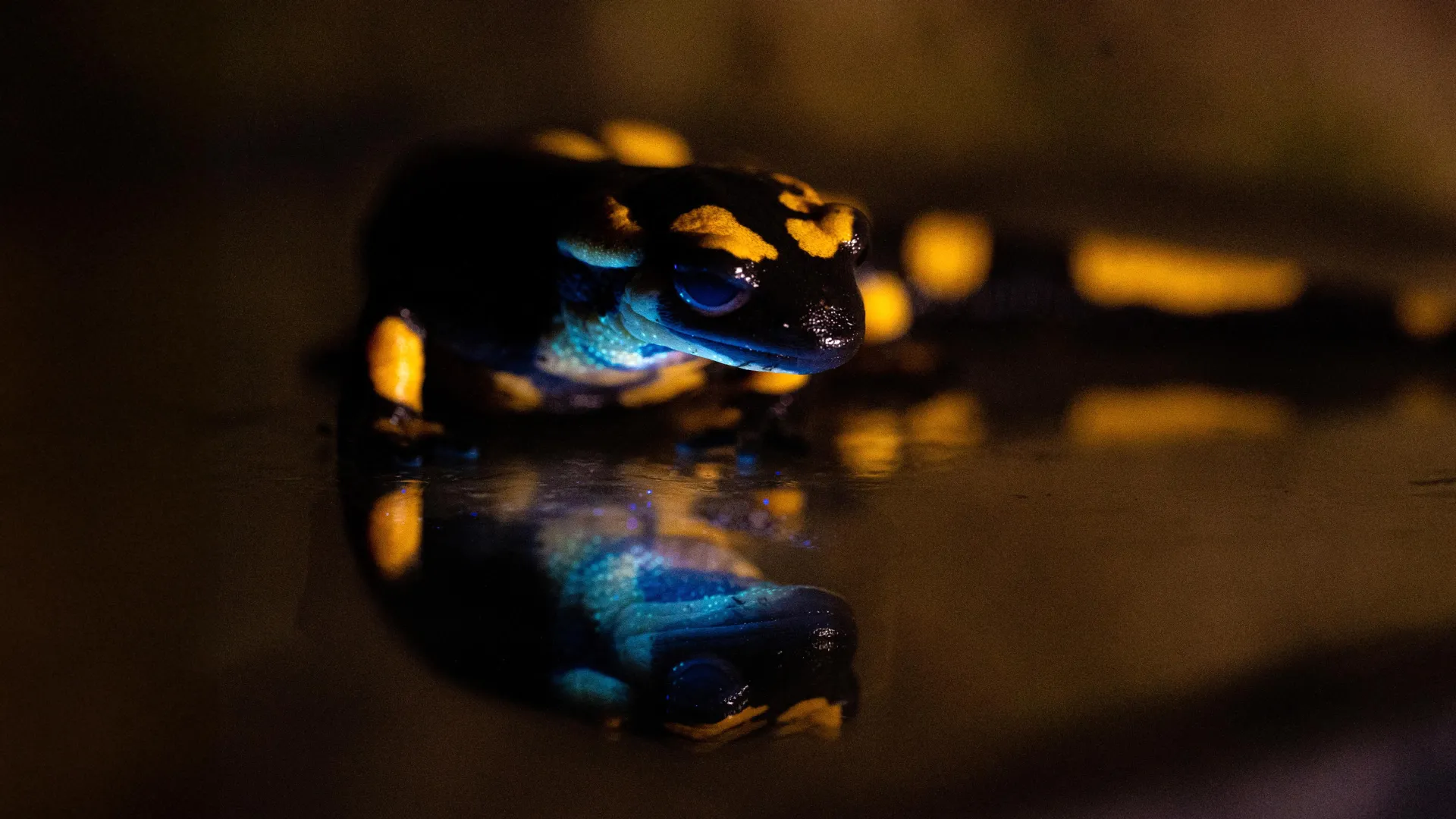
The fire salamander (Salamandra salamandra), a creature long celebrated in European folklore and meticulously documented by naturalists for centuries, has recently unveiled a biological secret that remained hidden in plain sight. Despite the species being one of the most recognizable amphibians on the continent, characterized by its high-contrast black and yellow warning coloration, modern research has confirmed that these animals possess the capacity for biofluorescence. When exposed to ultraviolet (UV) light, the salamanders emit a striking green and cyan glow, a phenomenon that has prompted a re-evaluation of how these vulnerable creatures interact with their environment and their predators.
This discovery, spearheaded by an international team of researchers including experts from the Museum of Natural Sciences in Barcelona and the Max Planck Institute for Chemical Ecology, marks a significant milestone in herpetological studies. It challenges the long-held assumption that biofluorescence is primarily a marine phenomenon, pushing the boundaries of what is known about terrestrial vertebrate biology.
A Chronology of Discovery and Scientific Context
For decades, the study of the fire salamander focused heavily on its toxic defenses. The species is well-known for its ability to secrete samandarines—potent steroidal alkaloids that act as a chemical shield against predators. Because these secretions have been the subject of intensive chemical analysis for more than 100 years, the recent discovery of biofluorescence was entirely unexpected.
The timeline of this research began with the systematic observation of amphibian behavior under non-standard lighting conditions. While bioluminescence—the ability of an organism to produce its own light through chemical reactions, such as in fireflies—has been well-documented, biofluorescence functions differently. It requires an external light source, typically UV radiation, which the animal’s skin absorbs and subsequently re-emits at longer, visible wavelengths.
In recent years, the scientific community has moved away from the belief that terrestrial biofluorescence is a rare anomaly. Early records of fluorescent traits in scorpions paved the way for more rigorous testing in other land-dwelling animals. When researchers applied these modern detection methods to the fire salamander, they found that the glow was most intense on the yellow patches of the animal’s skin, as well as within the glandular secretions themselves. Remarkably, these secretions retain their fluorescent properties for over 24 hours after being expelled, suggesting that the glow is not merely a transient byproduct of living tissue but a stable chemical characteristic.
Data and Biological Mechanisms
The mechanism behind this light emission involves specific compounds within the skin and the granular glands. When ultraviolet light—which is outside the human visible spectrum—strikes the salamander, the molecules within the skin absorb this energy and shift the wavelength, resulting in the vivid green and cyan light observed by the researchers.
One of the most critical aspects of this finding is the duration of the fluorescence in the secreted toxins. If the mucus produced by the salamander remains luminescent long after it has been deposited on a leaf or a patch of forest floor, it implies that the light might serve as a long-term signal.
While the exact chemical identity of the fluorescent molecule remains elusive, the research team is currently conducting mass spectrometry and chromatography to isolate the compound. The preliminary data indicates that this is a previously unidentified molecule, distinct from the known samandarines. The successful identification of this compound is considered the "holy grail" of the ongoing study, as it will determine whether the fluorescence is an accidental byproduct of metabolic pathways or an evolutionarily selected trait designed for a specific purpose.
Expert Perspectives on the Phenomenon
The discovery has drawn reactions from across the scientific spectrum, emphasizing the necessity of using new tools to examine familiar organisms. Bernat Burriel of the Museum of Natural Sciences in Barcelona highlighted the humility that such findings instill in the scientific community. "It is fascinating that such a well-studied species still harbors unknown phenomena like this," Burriel stated. "It reminds us that even the most familiar organisms can hide secrets that are only revealed when they are observed with new tools."
Martin Kaltenpoth, director of the Department of Insect Symbiosis at the Max Planck Institute for Chemical Ecology, echoed these sentiments, focusing on the functional potential of the glow. "Fluorescence meets several criteria that suggest a communicative function," Kaltenpoth noted. "It could help salamanders detect each other in nocturnal or particularly dense environments, or act as an additional defense signal."
The research team, which includes contributors from the Institute of Subtropical Biology and the Catalan Society of Herpetology, views this as a collaborative triumph. The study has been integrated into a broader, pioneering amphibian conservation project in Catalonia, supported by the Barcelona Zoo Foundation, which seeks to protect the species from the increasing threats of habitat fragmentation and climate-induced environmental stress.
Implications for Survival and Conservation
The presence of biofluorescence in fire salamanders raises two primary hypotheses regarding its evolutionary advantage: social signaling and aposematism.
1. Social Signaling and Nocturnal Interaction:
Fire salamanders are primarily nocturnal or crepuscular, active in environments where light is limited to the lunar and starlight spectrums. Research into lunar light suggests that the moon reflects a higher proportion of UV and violet wavelengths compared to the sun. Under these specific conditions, the biofluorescence of the salamander would be heightened, potentially acting as a visual beacon for other salamanders. This could assist in mate recognition or the establishment of territory in the dense, damp forests that the species calls home.
2. Aposematism and Predator Deterrence:
Aposematism is the defensive mechanism where a prey species advertises its toxicity through warning colors. The fire salamander’s black and yellow pattern is a textbook example of this. If the yellow markings are further enhanced by fluorescence, it may make the salamander appear more dangerous or easier to identify for potential predators, even in low-light conditions. By "lighting up" under UV, the salamander may be signaling its toxicity more effectively, thereby reducing the likelihood of a lethal encounter with a predator.
Broader Impact on Conservation Efforts
The fire salamander is currently classified as "vulnerable" on the IUCN Red List of Threatened Species. As habitat destruction, climate change, and the spread of pathogens like Batrachochytrium salamandrivorans (a deadly chytrid fungus) continue to decimate amphibian populations globally, understanding the basic biology of these animals becomes a matter of urgency.
The discovery of biofluorescence is not merely a biological curiosity; it serves as a baseline for better understanding the sensory world of the salamander. If this species relies on fluorescent cues for mating or safety, conservationists must consider how light pollution—an often-overlooked threat to nocturnal wildlife—might disrupt these vital signals. Artificial light at night (ALAN) can wash out natural UV cues, potentially rendering a salamander’s "social network" invisible or disrupting its defensive signaling.
Furthermore, this study demonstrates the power of modern imaging technology in conservation science. By applying non-invasive, high-tech monitoring tools, researchers can gain insights into the lives of threatened species without disturbing their delicate habitats. This research provides a new framework for evaluating the health of amphibian populations, suggesting that our understanding of their ecological needs is far from complete.
Conclusion
The revelation that the fire salamander glows under ultraviolet light serves as a powerful reminder of the complexity of the natural world. It underscores that even the most "familiar" species are subject to mysteries that can shift our understanding of evolutionary biology and ecological interaction. As the researchers continue their quest to identify the specific molecule responsible for this radiance, the broader scientific community is reminded of the importance of continuous, technology-driven observation. For the fire salamander, this new chapter in its scientific biography may ultimately provide the necessary data to better protect it from the threats that currently loom over its European forest habitats. The glow, it seems, is not just a biological quirk—it is a window into the survival strategies of one of Europe’s most iconic amphibians.