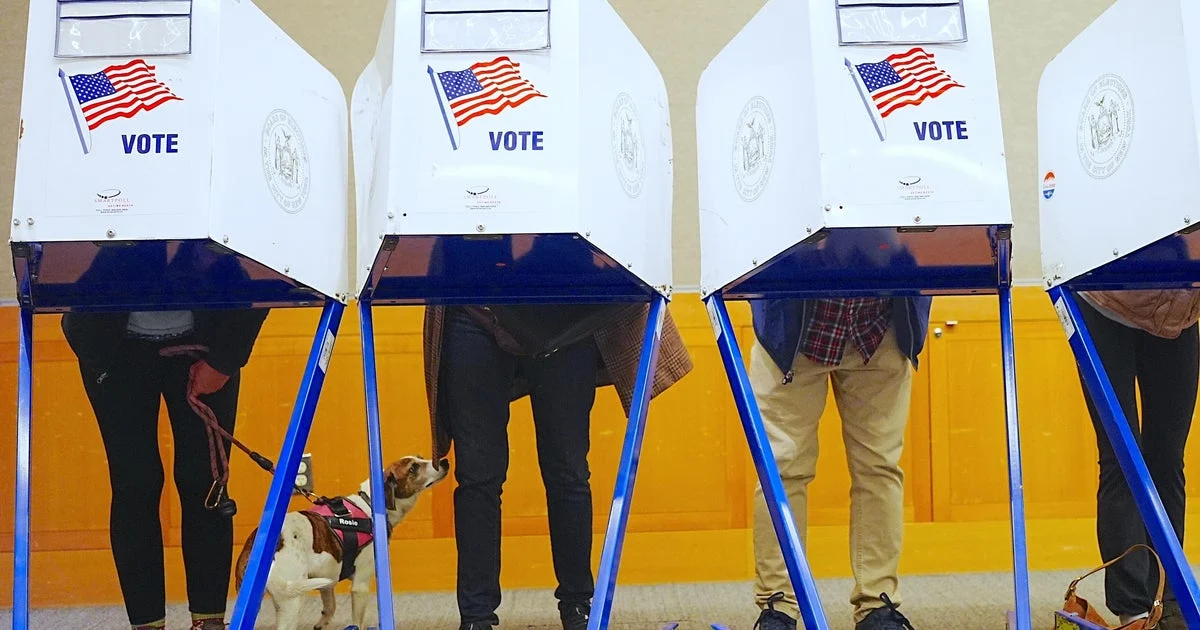
Early voting is officially underway across the United States for the 2026 midterm elections, with Election Day scheduled for Tuesday, November 3, 2026. As the nation approaches this critical electoral milestone, voters face a sprawling ballot that will decide the balance of power in Washington, shape key state-level policies, and determine the legislative trajectory for the final two years of President Donald Trump’s administration. Every single seat in the United States House of Representatives—all 435 of them—is up for contention. Furthermore, voters in 35 states will participate in U.S. Senate races, 36 states will hold gubernatorial elections, and more than 150 ballot measures are scattered across 40 states.
Despite the profound stakes involved, midterm elections historically face a persistent challenge: voter turnout significantly lags behind presidential election cycles. Political scientists and election officials are working overtime to combat this enthusiasm gap, emphasizing that midterms offer some of the most direct avenues for citizens to influence federal and local policy. With razor-thin margins expected in numerous contests across the country, experts note that individual ballots carry extraordinary weight during midterm cycles.
The Landscape of the 2026 Midterms: A Historic Turning Point
Midterm elections have traditionally served as a referendum on the sitting president. Historical data underscores this trend: the president’s political party has lost congressional seats in 37 out of the past 41 midterm elections. As the nation navigates the back half of Donald Trump’s presidency, the 2026 midterms present a familiar yet volatile dynamic.
Control of both chambers of Congress is hanging in the balance, and the arithmetic in Washington could not be tighter. In the House of Representatives, Republicans currently maintain a razor-thin majority. Democrats require a net gain of just three seats to wrestle control of the chamber. Meanwhile, the Senate map presents its own high-stakes battles, where Democrats need a net gain of four seats to flip the upper house.
The implications of these congressional shifts extend far beyond partisan bragging rights. The legislative branch acts as either a critical check on executive power or an enabler of the administration’s agenda. The party that ultimately controls Capitol Hill will hold the pen on major policy debates, including whether to approve critical funding for the ongoing Iran War, how to structure federal regulation for artificial intelligence (AI), and how to address pressing economic anxieties voiced by everyday Americans.
Voter Sentiment: Disillusionment Meets Civic Duty
While the policy implications are vast, public opinion data reflects a complex backdrop of voter fatigue and skepticism. A recent CBS News/YouGov poll revealed that a majority of voters harbor doubts about whether either major political party has a coherent, effective plan to improve their financial well-being. Many respondents indicated they do not believe their personal economic situations will improve regardless of which party controls the electorate.
This widespread skepticism has pushed some citizens to consider sitting the election out entirely. Mandy Sieren, a farmer in Kansas, voiced a sentiment shared by a segment of the electorate weary of partisan bickering. "I just don’t trust anybody at this point enough to vote for them, Republican [or] Democrat," Sieren said. "I think they’re all crooked."
Conversely, other voters view participation as an uncompromisable civic obligation. Brody Saner, a college student also in Kansas, expressed a contrasting viewpoint rooted in action. "If there’s something you’re not happy with, go out and vote. Do your part to change it," Saner said. Tracy Preisser, another Kansas voter, echoed this fundamental principle, stating simply, "Your vote is your voice."
Political scientists emphasize that navigating these competing emotions is a central challenge of modern campaigns. Donald Green, a prominent political scientist at Columbia University who has spent three decades studying voting behavior, acknowledges that voters frequently experience dissatisfaction with both major parties. However, Green argues that the core of the democratic process rests on making an informed choice between available candidates.
"Although they might be dissatisfied with both parties, typically it comes down to the candidates themselves, and [voters] have to make an informed choice one way or the other," Green noted.
Why Your Vote Carries More Weight in Midterms
By virtually every statistical metric, midterm elections are the moments when an individual ballot wields its maximum potential power. The primary driver of this phenomenon is turnout. During the 2022 midterm elections, approximately 46% of eligible voters cast ballots nationwide. In stark contrast, presidential election years—such as 2024—frequently see turnout surge closer to 65%.
Because fewer people participate in midterm cycles, the mathematical weight of each individual vote increases exponentially. Furthermore, congressional and local races are frequently decided by razor-thin margins. History provides numerous examples of elections swinging by a handful of votes:
- During the 2022 midterms, Republican Representative Lauren Boebert narrowly defended her seat in Colorado by a margin of just 546 votes.
- In the 2024 general election, Democrat Adam Gray secured victory in California’s hotly contested 13th Congressional District by a microscopic margin of just 187 votes.
- Looking back to 2020, Republican Mariannette Miller-Meeks won her fiercely contested Iowa House race by a mere six votes.
Political experts anticipate that the 2026 midterms will feature a similar roster of nail-biting contests where a few dozen or hundred votes could completely flip a district, altering the balance of power in Washington.
Beyond the raw mathematics of an individual ballot, Professor Green points out that voting operates as a collective signal. Politicians and political strategists pay meticulous attention to demographic turnout patterns.
"It may be surprising to them how attentive politicians are… to which groups vote at high rates and which groups don’t," Green explained. He notes that this dynamic explains why elected officials frequently cater disproportionately to older demographics, who turn out reliably at high rates. Conversely, policy issues that directly affect young voters and low-income communities—groups that historically vote less frequently—are frequently sidelined or devalued in legislative debates.
The Stakes Beyond Washington: Statehouses, Governors, and Local Issues
While congressional battles capture the lion’s share of national media attention, the 2026 midterms feature critical down-ballot races that directly dictate daily life. More than 30 states are electing governors this cycle, with highly competitive races stretching from Georgia to Ohio.
State executives hold immense administrative authority, particularly regarding emerging technological and environmental infrastructure. For instance, governors play a pivotal role in the ongoing expansion of data centers nationwide. State leaders hold the power to approve moratoriums, grant or deny lucrative tax breaks, and appoint utility commissioners who dictate energy policy. Across 13 states, voters will encounter 41 specific ballot initiatives directly addressing the regulation, zoning, and environmental impact of data centers.
Furthermore, local elections and down-ballot choices dictate property taxes, local healthcare costs, public school funding, and the composition of municipal and state courts. These localized decisions often produce the most immediate, tangible impacts on a citizen’s standard of living.
A Legacy of Civic Engagement and the Ongoing Fight for Access
For many Americans, the act of voting represents more than a logistical civic duty—it is the continuation of a hard-fought historical struggle. In New York City, poll worker Sandra Strother approaches the 2026 midterms with a deeply personal perspective shaped by family history. Strother recalls that her uncle was killed in Alabama during the 1950s simply because he attempted to exercise his fundamental right to vote as an African American.
"That’s my great motivator," Strother said, explaining why she dedicates her time not only to casting her own ballot but to ensuring that every eligible citizen can navigate the voting process smoothly and safely. Her story reflects the broader narrative of American democracy, where access to the ballot box has been secured through decades of activism, sacrifice, and resilience.
Chronology of the 2026 Election Cycle
- Early 2026: Primaries and state-level candidate filing deadlines take place across the country, setting the official matchups for the November general election.
- Late Summer to Early Fall 2026: Campaigns intensify television and digital advertising blitzes, focusing heavily on economic concerns, foreign policy developments such as the Iran War, and federal AI regulations.
- October 2026: Early voting opens in jurisdictions nationwide, allowing millions of citizens to cast their ballots ahead of Election Day.
- November 3, 2026: Election Day. Polling places open nationwide, and the final tally begins to determine the control of the House, the Senate, and state governor’s mansions.
Fact-Based Analysis of Implications
As the 2026 midterms unfold, the broader implications for the United States will depend heavily on which party captures legislative momentum. If Democrats manage to secure the necessary net gains to flip either the House or the Senate, President Trump’s final two years in office will likely be characterized by intense legislative gridlock, aggressive congressional investigations, and heightened partisan confrontation. Conversely, if Republicans successfully defend or expand their majorities, the administration will possess a clear pathway to advance its remaining policy priorities, judiciary appointments, and regulatory rollbacks without formidable congressional interference.
Ultimately, election experts and civil rights advocates agree that the overarching outcome of the 2026 midterms will not merely be determined by party platforms, but by who ultimately decides to show up at the ballot box. With control of the federal government hanging by a thread, the cumulative weight of millions of individual decisions will soon define the next chapter of American governance.