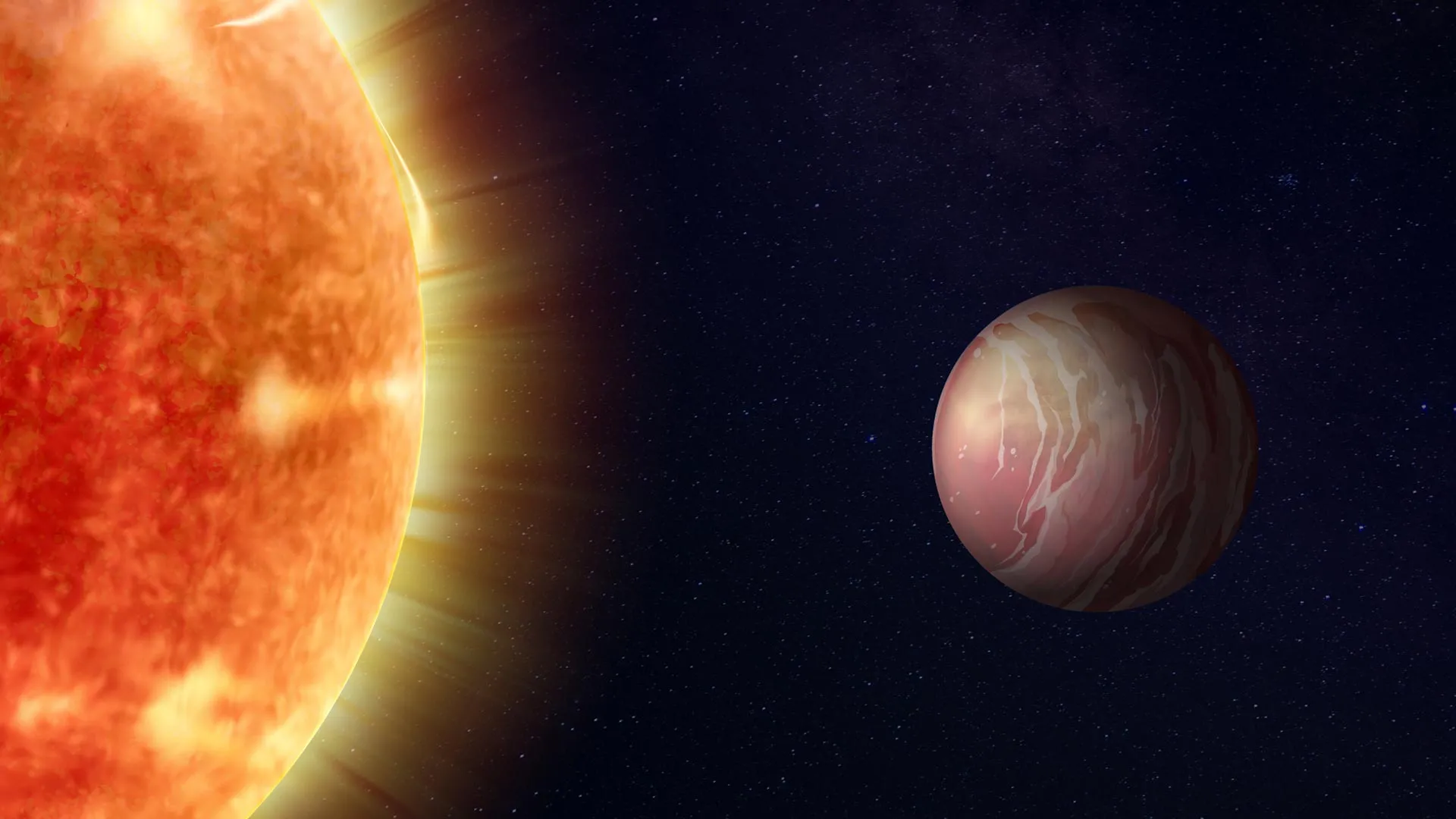
In a discovery that challenges fundamental models of planetary evolution, an international research team has identified a resilient atmosphere surrounding TOI-561 b, a "super-Earth" exoplanet located 280 light-years from our solar system. The findings, published in The Astronomical Journal, reveal that this hellish, lava-covered world is shrouded in a reflective, high-altitude layer of silicate clouds that acts as a planetary sunscreen, allowing it to retain an atmosphere that conventional astrophysics suggests should have been stripped away billions of years ago.
The research, led by Professor Lisa Dang of the University of Waterloo and Dr. Anjali Piette of the University of Birmingham, utilized the unparalleled sensitivity of the James Webb Space Telescope (JWST) to conduct a 37-hour observation period. During this window, the team captured nearly four complete orbits of the planet around its host star, providing a comprehensive data set that forced a re-evaluation of how rocky, highly irradiated planets interact with their own gaseous envelopes.
The Anomaly of TOI-561 b
TOI-561 b is a world of extremes. Classified as a rocky exoplanet orbiting in close proximity to its star, its surface is believed to be a global ocean of molten rock. Under standard planetary formation and evolution theories, a planet orbiting so close to its star would be subjected to intense stellar wind and radiation, which typically erodes any primordial atmosphere within a few hundred million years.
However, the JWST data indicated a distinct lack of expected surface temperatures. Initial measurements suggested the planet was significantly cooler than a dark, airless, rocky body should be. This discrepancy led researchers to hypothesize that the planet was either remarkably efficient at transporting heat to its dark nightside or that it possessed a reflective mechanism capable of bouncing incident starlight back into space. The subsequent analysis confirmed that the planet reflects approximately 75% of the starlight it receives—an albedo rivaling that of Venus—suggesting the presence of a thick, protective gaseous layer.
Chronology of Discovery and Observation
The investigation into TOI-561 b has unfolded in several stages over the past few years, culminating in the recent JWST observations.
- Initial Detection: TOI-561 b was first identified through transit photometry, revealing its existence and proximity to its star. Initial estimates categorized it as a "super-Earth" with a density suggesting a rocky composition.
- Thermal Profiling: Earlier ground-based and space-based surveys hinted at thermal irregularities. Astronomers noted that the dayside brightness temperatures were lower than expected, setting the stage for the current hypothesis regarding an atmosphere.
- The JWST Phase Curve Analysis: In the most recent campaign, the research team used the JWST to monitor the planet’s brightness and heat fluctuations throughout its orbital phase. By analyzing the "phase curve"—the variation in light as the planet rotates and orbits—the team was able to distinguish between thermal emission from the surface and light reflected by cloud cover.
- Atmospheric Modeling: Following the observation, the team ran complex climate simulations. These models confirmed that silicate minerals, specifically silicon dioxide (SiO2) and magnesium silicate (MgSiO3), could condense into high-altitude clouds under the planet’s extreme heat, creating the observed "sunscreen" effect.
The Mechanism of Persistence: A Volcanic Life-Support System
The most significant scientific hurdle presented by these findings is the question of longevity. If a planet is constantly losing its atmosphere to space, how does it maintain a stable, dense layer for billions of years?
Dr. Anjali Piette suggests that the planet’s surface might be the key. "Our discovery challenges current theories. We would expect a heavily irradiated rocky planet like TOI-561 b to have lost its atmosphere billions of years ago," Piette stated. One leading theory is that the molten lava surface acts as a planet-wide, continuous volcanic source. As the interior of the planet undergoes geological activity, it may be venting gases into the atmosphere at a rate that offsets the atmospheric escape caused by stellar radiation.
If the atmosphere is indeed composed of carbon dioxide or sulfur dioxide, it would mirror the extreme conditions found on Venus or the volcanically active moon of Jupiter, Io. However, the scale of TOI-561 b implies a much more dynamic process, where the molten mantle serves as a persistent reservoir, effectively "recharging" the atmosphere as it is depleted.
Technical Implications and Comparative Planetary Science
The use of phase curve analysis in this study represents a milestone in exoplanetary characterization. By measuring the redistribution of heat from the permanently illuminated dayside to the nightside, researchers have confirmed that an atmosphere is actively moving energy across the planet. In a vacuum, the temperature difference between the day and night sides would be extreme; the fact that the nightside is warmer than expected serves as definitive evidence that the atmosphere is circulating heat efficiently.
This discovery holds profound implications for the field of exoplanetary science:
- Revising Habitability Models: While TOI-561 b is certainly not habitable, understanding how it retains an atmosphere despite intense radiation helps scientists define the boundaries of what makes a planet "alive" in geological terms.
- Refining Atmospheric Composition: The next phase of research will focus on identifying the specific gases involved. Using longer-wavelength spectroscopy, the JWST will attempt to "fingerprint" the chemicals in the atmosphere. Identifying sulfur dioxide, for instance, would confirm the hypothesis that the planet is essentially an extreme, volcanic world.
- The "Lava World" Category: This study helps solidify a new category of exoplanets: the "active-atmosphere lava world." These planets are proving to be far more complex than previously assumed, acting as laboratories for extreme chemistry and high-temperature physics.
Official Responses and Future Research Directions
The project, spearheaded by the University of Waterloo in collaboration with the University of Birmingham, has prompted interest across the global astronomical community. Professor Lisa Dang emphasized the collaborative nature of the findings, noting that the combination of observational data and computational modeling was essential to resolving the mystery.
"The next big question we will seek to answer is whether TOI-561 b’s atmosphere resembles Venus or an extreme version of Io," Dang remarked. "Observing the planet at longer wavelengths with JWST could give us insights and help explain how a planet this hot has held on to an atmosphere for billions of years."
The broader scientific community is now looking toward future JWST cycles to provide more granular detail. While the current evidence is strong, confirming the exact chemical makeup of the clouds and the rate of volcanic outgassing will require multiple observation cycles. If the volcanic replenishment theory is confirmed, it would suggest that many other "lost" or "bare" rocky planets might actually possess thin, ephemeral atmospheres that have gone undetected due to the limitations of previous-generation telescopes.
Conclusion
The case of TOI-561 b serves as a stark reminder of the diversity of planetary environments within our galaxy. The ability of a world to "sunscreen" itself with mineral clouds, while simultaneously venting its own molten core to maintain an atmospheric shield, reveals a level of planetary resilience that was previously relegated to the realm of theoretical speculation. As the JWST continues its mission, the study of TOI-561 b will likely serve as the benchmark for how we identify and analyze the volatile, high-energy worlds that dominate the rocky landscape of the Milky Way. Whether these planets represent a final, violent stage of planetary evolution or a stable, long-lived class of worlds remains the primary focus of the next decade of astronomical inquiry.