Before KPMG began actively marketing its groundbreaking AI-deployment model to a wide array of enterprise clients, it undertook a pivotal engagement: selling it to OpenAI itself. This revelation forms the bedrock of a newly announced strategic alliance, elevating KPMG to the prestigious status of an OpenAI Elite Partner, the highest tier within OpenAI’s burgeoning partner network. The collaboration began with the frontier AI laboratory engaging KPMG to construct an internal Supply Chain & Fulfillment Orchestration platform. In essence, OpenAI commissioned the global consulting firm to engineer precisely the kind of AI-native workflow system that KPMG now intends to roll out broadly across the corporate landscape. This foundational "client-zero" deployment is not merely a testament to KPMG’s capabilities but serves as the concrete proof point for its ambitious market strategy, marking a significant evolution in how AI solutions are conceptualized, built, and delivered at scale.
The Genesis of an Elite Partnership: OpenAI as "Client-Zero"
The formal announcement today solidifies a relationship forged in the crucible of practical application. OpenAI, a pioneer in artificial intelligence research and development, effectively became KPMG’s first client for a sophisticated AI-powered enterprise solution. This was not a theoretical exercise but a direct challenge to design and deploy an internal Supply Chain & Fulfillment Orchestration platform, a critical component for any organization, especially one operating at the cutting edge of technology. By successfully building an AI-native workflow system for OpenAI’s own operational needs, KPMG demonstrated the viability and efficacy of its approach. This internal success story is now the cornerstone of their joint go-to-market strategy, positioning KPMG to offer a thoroughly vetted, real-world tested AI-deployment model to the global enterprise sector.
Colleen Kapase, Vice President of Strategic Global Partnerships and Ecosystems at OpenAI, underscored the exclusivity and significance of KPMG’s new designation. She affirmed to Fortune that Elite Partner status is not granted lightly, reserved only for a "limited group of global partners" possessing the requisite reach, scale, and delivery capabilities essential for facilitating worldwide enterprise AI adoption. This selective approach highlights OpenAI’s commitment to working with partners who can not only understand its technology but also translate it into tangible, large-scale business value across diverse industries and geographies.
Echoing this sentiment, Chad Seiler, KPMG’s U.S. industry leader for technology, media, and telecommunications, articulated the shift in the AI adoption paradigm. In an interview, Seiler declared, "We’re beyond experimentation. This is about large-scale enterprise deployment." His statement reflects a maturation in the enterprise AI market, moving past initial pilot programs and proof-of-concepts towards robust, integrated solutions that fundamentally transform core business operations. The "client-zero" experience with OpenAI provides KPMG with invaluable insights and a compelling narrative to convince other large organizations that AI integration is no longer a futuristic concept but a present-day imperative, ready for broad implementation.
Redefining Enterprise Interaction: The "Headless" Software Paradigm
At the core of KPMG’s offering is a profound re-imagination of enterprise software interaction, predicated on a bold prediction for the future of work. Traditionally, employees engage with enterprise systems through intricate applications, navigating complex graphical user interfaces (GUIs), logging into disparate systems, and clicking through a multitude of modules and screens. Seiler contends that this prevalent mode of interaction is rapidly approaching its obsolescence.
KPMG’s vision pivots around the concept of "headless" enterprise software. Seiler elaborated, "When we say headless, we’re really talking about decoupling the experience of work from the underlying systems and screens and modules while keeping those systems in place as a system of record." This decoupling does not imply the wholesale replacement of existing enterprise resource planning (ERP) or customer relationship management (CRM) systems. Instead, these established, mission-critical systems will continue to function as robust "systems of record," providing the foundational data and processes. The transformation lies in the user’s interaction layer.
In this evolving model, employees will no longer be burdened with learning the intricate "geography" of various software applications. Instead, they will simply "describe what they want done." AI agents, powered by advanced large language models (LLMs) like those from OpenAI, will interpret the user’s intent, seamlessly coordinate actions across multiple backend systems, and execute the required tasks. Crucially, these intelligent agents will also be programmed to identify situations demanding human judgment, escalating complex decisions or ambiguous requests to human operators. This shift promises to dramatically enhance efficiency, reduce cognitive load on employees, and unlock new levels of productivity by allowing humans to focus on higher-value, strategic tasks rather than mundane operational navigation.
The ultimate trajectory of this headless paradigm, according to Seiler, leans heavily towards voice interaction. "Over time, you’re going to be talking more than you’re typing," he predicted. This envisions a future where professionals engage in natural language conversations with their enterprise systems. "Instead of just interacting with your ERP system or your CRM system in a traditional way with clumsy UIs that are limited in what they can do, you’re kind of unleashed and you can have literally conversations with your systems and take actions with it and take actions not only within that system, but connect that to other data sets and other systems all through an intelligent agentic layer." This represents a profound shift from command-line interfaces and button-clicking to intuitive, conversational AI, blurring the lines between human and machine interaction.
A KPMG blog post published earlier, co-authored by Swami Chandrasekaran and Matteo Colombo, formally articulates this impending transformation: "Tried and true SaaS isn’t going away. Its user interface is evolving. More precisely, a new work surface is emerging." This reinforces the idea that the foundational technology remains, but the way users engage with it undergoes a radical, AI-driven metamorphosis. The underlying databases and enterprise applications, while indispensable, recede into the background, becoming invisible infrastructure. A new layer of AI agents takes center stage, acting as intelligent intermediaries that translate human intent into machine execution across the enterprise ecosystem.
The "Decide, Execute, Deliver" Sandwich and the Evolving Nature of Work
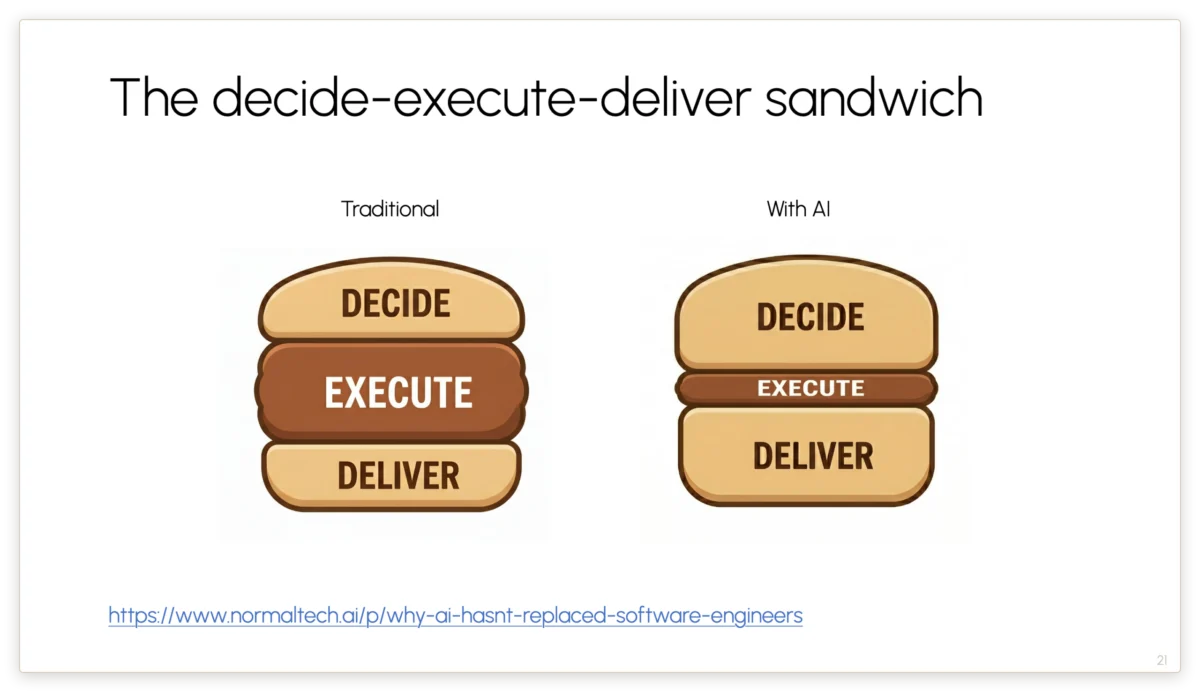
To conceptualize the impact of AI on work processes, the discussion ventured into the "sandwich" framework proposed by Princeton’s Arvind Narayanan, whose "AI as Normal Technology" research dissects work into three distinct layers: a "decide" layer at the top, an "execute" layer in the middle, and a "deliver" layer at the bottom. Narayanan terms this the "decide, execute, deliver sandwich." His original thesis posits that AI primarily compresses only the "execute" layer, which he argues typically constituted no more than a third of the total work. The "decide" and "deliver" layers – encompassing judgment, strategy, and accountability – are believed to resist compression and may even expand as the "execute" layer shrinks.
Seiler readily acknowledged the resonance of Narayanan’s framework with KPMG’s observations in its deployments, noting that the visual representation indeed resembled a "skinny hamburger patty." However, he introduced a crucial nuance: the accelerated pace enabled by AI itself generates new burdens at the "deliver" layer. This newfound speed necessitates increased verification, oversight, and a different kind of overhead that wasn’t explicitly captured in Narayanan’s initial thesis – namely, more "talking about work" rather than simply doing it. Seiler explained, "The worker spends less time learning the geography of the software and more time focusing on the outcomes they’re trying to achieve." In his interpretation, the "decide" bun doesn’t merely hold steady as the "execute" patty diminishes; it can actively expand, absorbing the coordination and strategic work that previously resided within the middle layer. This suggests a reallocation of human effort towards higher-order cognitive functions and oversight.
Narayanan, when reached for comment, concurred that software engineers have historically dedicated a substantial portion of their time to writing specifications and product requirements documents, activities that align with the "bun" section of his metaphor. He further argued that while judgment and accountability inherently resist compression, AI’s rapid advancements are simultaneously "increasing the ambition and complexity of projects." This implies that the "ceiling" of judgment and accountability dynamically elevates, even as AI lifts the "floor" of routine execution, creating a continuous demand for human discernment and strategic thinking.
Narayanan also highlighted a potential pitfall of this agentic future: "lock-in." He warned that as AI agents become "the main queryable repository of all…tacit knowledge," organizations risk developing a deep dependence and "stickiness." This scenario effectively renders the AI agent an indispensable "coworker that you can’t fire without every team losing workflows and know-how." This raises critical questions about data ownership, vendor lock-in, and the long-term strategic implications of deeply embedding AI into core operational knowledge bases.

The Broader Landscape of Enterprise AI Adoption
The strategic alliance between KPMG and OpenAI unfolds against a backdrop of explosive growth and transformative potential within the global artificial intelligence market. The advent of generative AI has ignited an unprecedented rush among enterprises to integrate these powerful capabilities into their operations, seeking to gain competitive advantages, enhance efficiency, and innovate new services.
Market data underscores this urgency. According to projections from various research firms like Gartner and IDC, the global AI market is expected to surge past hundreds of billions of dollars in the coming years, with enterprise AI spending forming a substantial segment. Companies are investing heavily in AI for diverse applications, from automating customer service and optimizing supply chains to accelerating R&D and personalizing customer experiences. The global management consulting market, valued at over $300 billion, is increasingly pivoting towards AI implementation, recognizing the complex challenges and immense opportunities it presents for their clients. KPMG, as one of the "Big Four" professional services networks, is strategically positioning itself at the forefront of this shift.
However, the journey to enterprise AI adoption is fraught with complexities. Organizations grapple with a myriad of challenges, including ensuring robust data governance and security, seamless integration with legacy systems, addressing the significant talent gap in AI expertise, navigating ethical considerations, and managing the cultural shifts required for successful AI integration. It is precisely these multifaceted challenges that amplify the value proposition of consulting firms like KPMG. Their deep industry knowledge, experience in large-scale transformations, and ability to bridge the gap between cutting-edge technology and practical business application become invaluable.
KPMG’s internal journey with AI provides a chronological context to its current offering. The firm has been actively integrating OpenAI capabilities into its own operations since 2023, notably through its internal AI tool, aIQ Chat. This internal adoption by KPMG’s Advisory and internal teams, including identifying Codex-related use cases, served as an essential proving ground, building institutional knowledge and demonstrating the practicality of AI-enabled capabilities before taking them to external clients. This "eat your own dog food" approach lends credibility to their current market strategy.
KPMG’s Strategic Differentiator in a Commoditizing AI Landscape
In a world where the underlying AI technology, specifically foundational models, is rapidly becoming commoditized, Seiler articulated KPMG’s enduring value proposition. He argued that the consulting firm’s true differentiator lies not merely in its technological prowess but in its "decades of client-specific institutional knowledge that no frontier model has." He elaborated on this crucial advantage: "We know their business models, their people, their culture, their systems, their data, their politics, their silos, in an intimate way at scale that some of these frontier models don’t." This deep, nuanced understanding of client ecosystems—often built over years of engagements—allows KPMG to effectively tailor, integrate, and deploy AI solutions in a manner that generic models, however powerful, cannot achieve on their own.
Colleen Kapase of OpenAI affirmed this, noting that KPMG brings "deep enterprise transformation experience," particularly across highly regulated industries, the public sector, and cybersecurity. In these sectors, issues of governance, compliance, and secure implementation expertise are not merely beneficial but absolutely critical. She highlighted specific areas of partnership, including public-sector modernization and KPMG’s "Daybreak Cyber" product, in addition to the pivotal "client-zero" work within OpenAI itself. Kapase also clarified that OpenAI is committed to broad access across its ecosystem, assuring that KPMG is not receiving exclusive access to unreleased OpenAI capabilities, but rather leveraging the widely available and future-proofed tools.
Seiler, for his part, characterized the OpenAI alliance as additive rather than exclusive. KPMG maintains parallel strategic partnerships with other leading frontier AI labs, including Anthropic. This multi-partner approach reflects a pragmatic understanding of the enterprise market, where large clients are unlikely to standardize on a single AI provider. "We don’t think we’re going to see a lot of cases where we’re going to have one client that’s completely just using one frontier model to run everything," Seiler stated. He acknowledged that many clients are already diversifying their AI portfolios, utilizing cheaper alternatives—including open-source models, some originating from China—for narrower tasks. This strategy serves as both a cost-efficiency measure and a resilience hedge against over-reliance on a single vendor.
Kapase addressed the rise of open-source models by emphasizing OpenAI’s continuous focus on "helping customers get greater value from OpenAI." She cited advancements like GPT-5.6, which delivers enhanced intelligence per token and stronger performance per dollar, and "Sol," which demonstrates 54% greater token efficiency on agentic coding tasks. These improvements underscore OpenAI’s commitment to maintaining a competitive edge through continuous innovation in performance and cost-effectiveness.
Ultimately, what distinguishes the OpenAI deal in Seiler’s view is its "go-to-market dimension." He articulated the difference: "It’s one thing to work with the labs, and then it’s another thing to also work with them and go to market with them." The "client-zero" deployment for OpenAI itself serves as the ultimate proof point. If KPMG could successfully build and implement this sophisticated AI-native platform for the very pioneer of generative AI, the pitch to virtually any other enterprise client becomes immeasurably more compelling and credible.
Implications and the Long Road Ahead for AI Transformation
The partnership between KPMG and OpenAI carries significant implications across the technology and business landscapes. For the consulting industry, it reinforces the critical role of firms like KPMG in guiding complex AI transformations. As AI technology becomes more accessible, the value shifts from simply providing the tech to strategically integrating it, managing organizational change, ensuring governance, and extracting measurable business value. This positions management consultants as indispensable navigators through the complexities of AI adoption, moving beyond purely technological discussions to strategic business decisions.
For enterprise software, this alliance signals a profound disruption to traditional SaaS models, heralding a future dominated by conversational interfaces and intelligent agents. The focus will increasingly shift from user interface design to intuitive, natural language interaction, fundamentally altering how employees engage with their digital tools. For OpenAI, partnering with a global professional services powerhouse like KPMG significantly strengthens its enterprise foothold, providing a trusted channel to deploy its advanced AI capabilities across a vast and diverse client base.
The timeline for this transformation, however, is not one of instant disruption. Arvind Narayanan frames organizational adaptation to AI as a "decades-long process," drawing parallels to the gradual electrification of factories rather than an overnight revolution. KPMG implicitly hedges in a similar direction, cautioning against wholesale reinvention. Their blog post advises that "the most successful organizations will be deliberate about where they reinvent—and where they do not," acknowledging that "the same workflows that have been in place for years may continue to be the best fit." This pragmatic approach recognizes the inertia and established efficiencies within large organizations.
Narayanan further notes that while he doesn’t believe AI presents an immediate existential threat of "superintelligence by 2027," it nonetheless represents "more urgent a shock than most organizations are used to dealing with." This paradox highlights the need for a measured yet proactive approach to AI integration—acknowledging its long-term transformative power while managing the immediate challenges of adoption. In essence, reinventing the "sandwich" of work is a marathon, not a sprint.
KPMG concludes its strategic positioning with a statement that resonates less like a technology announcement and more like a core management consulting memo, which is precisely the point. The firm asserts that agentic AI adoption is "a portfolio of business decisions to be made, not a technology migration." For a firm whose fundamental value proposition has always revolved around assisting large organizations in making complex, carefully considered decisions, this is not a hedge against technological change but rather a powerful reaffirmation of its core identity and indispensable role in the unfolding AI era. The partnership with OpenAI, proven through the "client-zero" experience, demonstrates KPMG’s readiness to lead enterprises through this next great wave of technological evolution.