A critical inflection point in the global energy transition has arrived, marked by an urgent push towards renewable energy sources. At the forefront of this shift is solar power, with installations scaling at an unprecedented rate worldwide. However, this monumental build-out faces significant headwinds, primarily a persistent labor market challenge. Today, Gritt, an innovative startup founded by two Carnegie Mellon-trained roboticists, announced its emergence from stealth with a substantial $26 million Series A funding round, signaling a potential paradigm shift in how solar infrastructure is deployed. The company aims to address the industry’s labor bottleneck by deploying intelligent, AI-powered robotic systems capable of operating in the complex, unstructured environments of construction sites, thereby accelerating the path to energy independence and mitigating climate change.
Addressing a Critical Global Challenge: The Solar Energy Imperative
The global imperative to transition to clean energy sources has never been more pronounced. Climate change exigencies, coupled with geopolitical drives for energy independence, are propelling solar energy to the forefront of national and international agendas. According to the International Energy Agency (IEA), solar PV is set to become the largest source of electricity generation globally by 2050 under a net-zero emissions scenario, requiring massive, sustained deployment. Projections from the Solar Energy Industries Association (SEIA) indicate that the U.S. alone needs to install hundreds of gigawatts of new solar capacity in the coming decades to meet ambitious climate targets, such as the Biden administration’s goal of a carbon pollution-free power sector by 2035. This growth translates into an estimated installation of tens of millions of solar panels annually.
However, the rapid expansion of solar infrastructure is frequently hampered by a fundamental constraint: the availability of skilled labor. The construction industry globally, and particularly in specialized fields like renewable energy installation, faces a chronic shortage of workers. Data from the Associated General Contractors of America (AGC) consistently highlights that a significant percentage of construction firms struggle to find qualified craft workers, including electricians, equipment operators, and general laborers. Solar panel installation is physically demanding, involving the repetitive lifting and precise positioning of heavy, fragile panels, often in challenging outdoor conditions. A standard solar panel can weigh between 40 to 60 pounds, with larger utility-scale panels exceeding 75 pounds, requiring substantial manual effort and posing significant risks of injury from strains, falls, and equipment accidents. This arduous nature, coupled with the often-remote locations of large-scale solar farms, makes attracting and retaining labor a formidable challenge, directly impacting project timelines and costs. The traditional approach to industrial robotics, designed for controlled factory environments, has historically struggled to adapt to the dynamic, unpredictable, and often chaotic conditions of outdoor construction sites, leaving this critical labor gap largely unaddressed.
Gritt’s Innovative Approach: AI for Unstructured Environments
Gritt’s strategy directly confronts this long-standing challenge by leveraging the latest advancements in artificial intelligence. Historically, industrial robots have been confined to highly structured, predictable factory settings where tasks are repetitive and environmental variables are tightly controlled. The unstructured nature of construction sites – with varying terrain, changing weather, dynamic obstacles, and diverse materials – has rendered conventional robotics largely ineffective. However, the advent of advanced AI models, particularly in areas like computer vision, deep reinforcement learning, and large language models, has begun to change this equation. These new AI capabilities enable machines to perceive, understand, and adapt to complex environments in ways previously impossible.
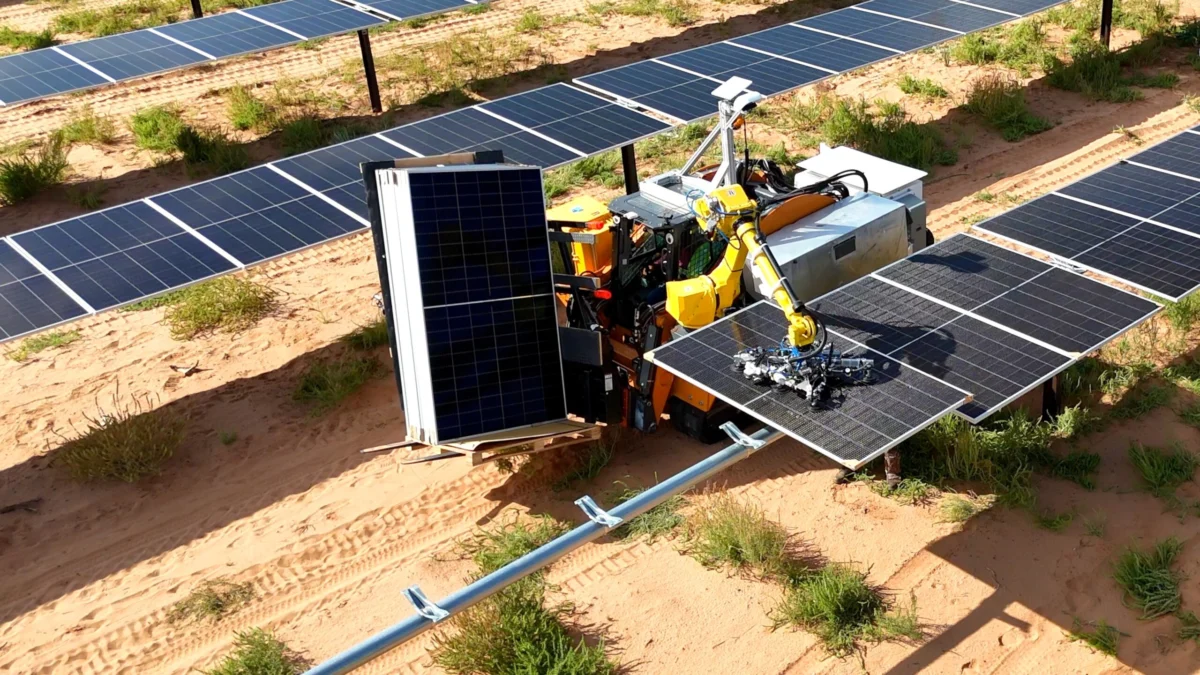
At the core of Gritt’s innovation is an intelligent software system designed to imbue off-the-shelf industrial hardware with the adaptability required for construction work. Unlike many competitors who opt to build proprietary robots from the ground up, Gritt’s approach is hardware-agnostic. The company currently utilizes readily available equipment such as rented skidders (heavy construction vehicles) and robotic arms from established manufacturers like Kawasaki. This strategic choice offers several distinct advantages: it reduces upfront capital expenditure, accelerates development cycles, simplifies maintenance and parts procurement, and allows for greater scalability by tapping into existing global supply chains for industrial machinery. The genius lies in Gritt’s proprietary AI models, which serve as the "brain" controlling these machines, enabling them to perform complex, precision tasks in unpredictable outdoor settings.
Founders Puneet Puri (CEO) and Vishal Dugar (CTO), both experts from Carnegie Mellon’s renowned robotics program, articulated their vision for Gritt as an entity designed to "help civilization build infrastructure faster." Puri emphasized the necessity of "an intelligence which can work in the outdoor, chaotic environments of these construction sites, and it has to be generalizable enough that it can work in these varied environments." This emphasis on generalizability is key; it means the underlying AI framework can be rapidly adapted to new tasks and different site conditions, a significant departure from the bespoke, task-specific programming that characterized earlier generations of industrial automation.
Precision and Performance in the Field
Gritt’s initial application focuses on one of the most labor-intensive and injury-prone aspects of solar farm construction: the handling and installation of large glass solar panels. The company’s systems are currently deployed to perform the critical steps of unloading these panels from delivery trucks, safely transporting them across varied terrain to the metal racking structures, and then positioning them with sub-millimeter accuracy onto the frames. This precision is paramount not only for ensuring the structural integrity and optimal performance of the solar array but also for preparing the panels for final fastening by human workers.
The impact of Gritt’s systems on operational efficiency is substantial and has been quantitatively demonstrated. Puri reported that a typical eight-person crew, relying solely on manual labor, can install approximately 800 solar panels per day. In stark contrast, the same crew, when augmented by Gritt’s AI-powered systems, can achieve an installation rate of 3,000 to 4,000 panels daily. This represents a staggering 375% to 500% increase in productivity, dramatically shortening project timelines and reducing overall labor costs per installed watt.
Beyond speed, the technology offers significant improvements in worker safety and working conditions. A Gritt customer, who requested anonymity for competitive reasons but expressed strong enthusiasm, highlighted the system’s ability to reduce injuries. By automating the repeated lifting of 100-pound panels overhead, Gritt’s robots eliminate a primary source of musculoskeletal injuries, strains, and fatigue among human workers. Furthermore, the customer noted that the system makes it significantly easier to undertake projects in remote locations, where attracting and housing a large human workforce is logistically and financially challenging. This allows developers to unlock new sites that might otherwise be economically unfeasible, further accelerating renewable energy deployment.
Fueling Growth: Investment and Market Traction
Gritt’s potential to revolutionize solar construction has attracted significant investor confidence, leading to a total funding of $34 million to date. The recent $26 million Series A round was led by Obvious Ventures, a firm known for its investments in companies addressing systemic global challenges, with participation from Union Square Ventures and Active Impact Investment. This follows an earlier seed round backed by First Round Capital, Climactic, Congruent Ventures, and VSC Ventures. The swift succession of funding rounds underscores the perceived urgency and scalability of Gritt’s solution within the burgeoning clean energy sector.
Andrew Beebe, a partner at Obvious Ventures who led the Series A, articulated the investment thesis: "These guys are in the second camp [of entrepreneurs who know how to get into dirty, dull, and dangerous jobs and scale them like mad], and that’s a special kind of entrepreneur that has the technical chops, the AI, and the machine vision skills to make it work." This sentiment highlights the dual appeal of Gritt – combining deep technological innovation with a pragmatic understanding of real-world industrial challenges and the drive for rapid deployment. The Series A funding will be crucial for Gritt to scale its operations, expand its engineering and deployment teams, and accelerate the development of new robotic functionalities.
The company has already demonstrated remarkable market traction. Gritt is currently contracted to assist in the installation of 2.8 gigawatts (GW) of solar panels over the next 18 months, a substantial volume that speaks to the immediate demand for its solutions. Its customer base includes three of the top ten power construction companies in the United States, indicating that its technology is being adopted by major players in the energy infrastructure sector. Looking ahead, Gritt aims to operate 48 of its intelligent systems within the next six months, marking an aggressive scale-up strategy designed to meet the escalating demands of the solar industry.
The Competitive Landscape and Strategic Differentiation
The nascent field of construction robotics, particularly for solar installation, is drawing increasing attention, leading to the emergence of several competitors. Companies like Luminous Robotics, Cosmic, and China’s Trinabot are also developing robotic solutions for panel installation. However, a key differentiator for Gritt lies in its strategic approach to hardware. While many competitors are focused on building their own bespoke robotic hardware from scratch, Gritt has deliberately chosen to develop an advanced AI software layer that can control off-the-shelf industrial equipment.
This "hardware-agnostic" strategy presents a distinct competitive advantage. Developing custom robotic hardware is an incredibly capital-intensive, time-consuming, and complex undertaking, requiring significant investment in design, manufacturing, and maintenance infrastructure. By leveraging existing, proven industrial machinery, Gritt can significantly reduce its research and development costs, accelerate its time to market, and achieve a leaner cost structure. This approach also allows for greater flexibility and scalability. As new, more advanced industrial hardware becomes available, Gritt’s AI can potentially be integrated with minimal modifications, ensuring that its solutions remain at the cutting edge without the need for constant, costly hardware redesigns. The ability to rent rather than purchase specialized equipment further reduces financial barriers to entry and operational overhead for its customers.
While competitors building proprietary hardware might achieve highly optimized, integrated systems for specific tasks, Gritt’s focus on generalizable AI operating across diverse platforms could enable faster deployment, broader application, and more rapid iteration of capabilities. This difference in strategy could significantly shape the pace of growth and the cost-effectiveness of solutions as demand for robotic construction technologies continues to surge.
Beyond Solar Panels: Gritt’s Vision for Construction Robotics
Gritt’s ambitions extend far beyond merely installing solar panels. The company views its current application as a foundational step toward a broader transformation of the construction industry. Immediate plans include adding new manipulation tasks to its systems, such as fastening the solar panels to the frames, drilling posts for racking, and even building the racking structures themselves. These advancements will further reduce the manual labor required on site, moving towards more comprehensive automation of the installation process.
Longer term, Gritt aims to expand into other common, labor-intensive construction tasks that share characteristics of being "dirty, dull, and dangerous." A prime example cited is rebar tying, a crucial step in concrete construction where steel reinforcing bars are meticulously tied together before concrete is poured. This task is highly repetitive, physically demanding, and often performed in awkward positions. The generalizable nature of Gritt’s AI models is crucial to this expansion. Puri noted that "making a system for one solution was still possible to some extent five years ago," but modern AI allows for the same underlying pipeline to be reused and improved across varied tasks. He offered a compelling example: training the system to stack cinder blocks initially took weeks, but a similar demonstration involving rebar tying was achieved in just a single day using the same core software. This exponential increase in learning speed highlights the power of generalizable AI to rapidly adapt to new applications.
The "Physical AI Layer" and Future of Construction Management
Perhaps the most ambitious aspect of Gritt’s vision is to evolve its systems into a "physical AI layer" that not only performs dextrous, labor-intensive tasks but also enhances site management and decision-making. By integrating a suite of sensors – cameras, LiDAR, GPS, and other environmental monitors – with its intelligent systems, Gritt envisions its robots becoming pervasive, intelligent observers of the construction site.
This integrated intelligence could unlock capabilities far beyond mere automation. For instance, the system could continuously monitor site conditions, noticing an open trench as a storm approaches and automatically alerting workers to cover it before rain damages components or creates safety hazards. It could track inventory in real-time, flagging missing materials before they cause project delays. It could also monitor construction progress, identify potential bottlenecks, and provide data-driven insights to project managers, transforming reactive problem-solving into proactive management.
Puri articulated this expansive vision: "Gritt becomes now this layer of physical AI, which is doing this dextrous, labor-intensive task, plus it can help you take decisions on the site." This concept aligns with the broader industry trend towards "Construction 4.0" and smart construction, where data, automation, and AI are integrated to create safer, more efficient, and more predictable project outcomes. Gritt’s systems could provide unprecedented visibility and control over complex construction operations, driving efficiencies that extend beyond mere task automation into holistic project optimization.
Broader Implications: Reshaping Labor, Economics, and Climate Action
The rise of companies like Gritt carries profound implications across economic, labor, and environmental fronts. Economically, by dramatically increasing productivity and reducing labor-related costs and risks, Gritt’s technology could significantly lower the overall cost of solar installation. This cost reduction would make solar power even more competitive with traditional energy sources, stimulating further investment and accelerating its deployment. Faster project completion times also mean quicker returns on investment for developers and utilities, further incentivizing renewable energy projects.
From a labor perspective, the introduction of robotics in construction often sparks concerns about job displacement. However, Gritt’s approach, by focusing on "dirty, dull, and dangerous" tasks, aims to transform, rather than simply eliminate, human roles. Workers will shift from physically strenuous activities to supervisory, maintenance, and higher-skilled technical roles involving robot operation, programming, and data analysis. This creates opportunities for upskilling the existing workforce, fostering safer working environments, and attracting new talent to the renewable energy sector by offering more appealing, technology-driven careers. The long-term vision of Gritt as a "physical AI layer" also suggests the creation of entirely new job categories related to AI management, data analytics, and intelligent site supervision.
Environmentally, Gritt’s technology offers a direct and powerful contribution to global climate action. By accelerating the pace and reducing the cost of solar panel installation, it directly enables faster deployment of clean energy infrastructure. This rapid build-out is essential for meeting aggressive carbon reduction targets and transitioning away from fossil fuels, thereby mitigating the most severe impacts of climate change. The ability to deploy solar farms more efficiently, even in remote or challenging terrains, means more renewable energy capacity can come online sooner, making a tangible difference in the race against global warming.
In conclusion, Gritt’s emergence from stealth with significant funding and demonstrable traction marks a pivotal moment for the solar energy industry and the broader construction sector. By ingeniously applying cutting-edge AI to off-the-shelf hardware, the company is not only addressing critical labor shortages but also paving the way for a more efficient, safer, and data-driven approach to building the infrastructure of the future. As Gritt scales its operations and expands its robotic capabilities, it stands poised to be a key catalyst in accelerating the global transition to a sustainable energy future, proving that intelligence, when applied strategically, can overcome even the most daunting real-world challenges.