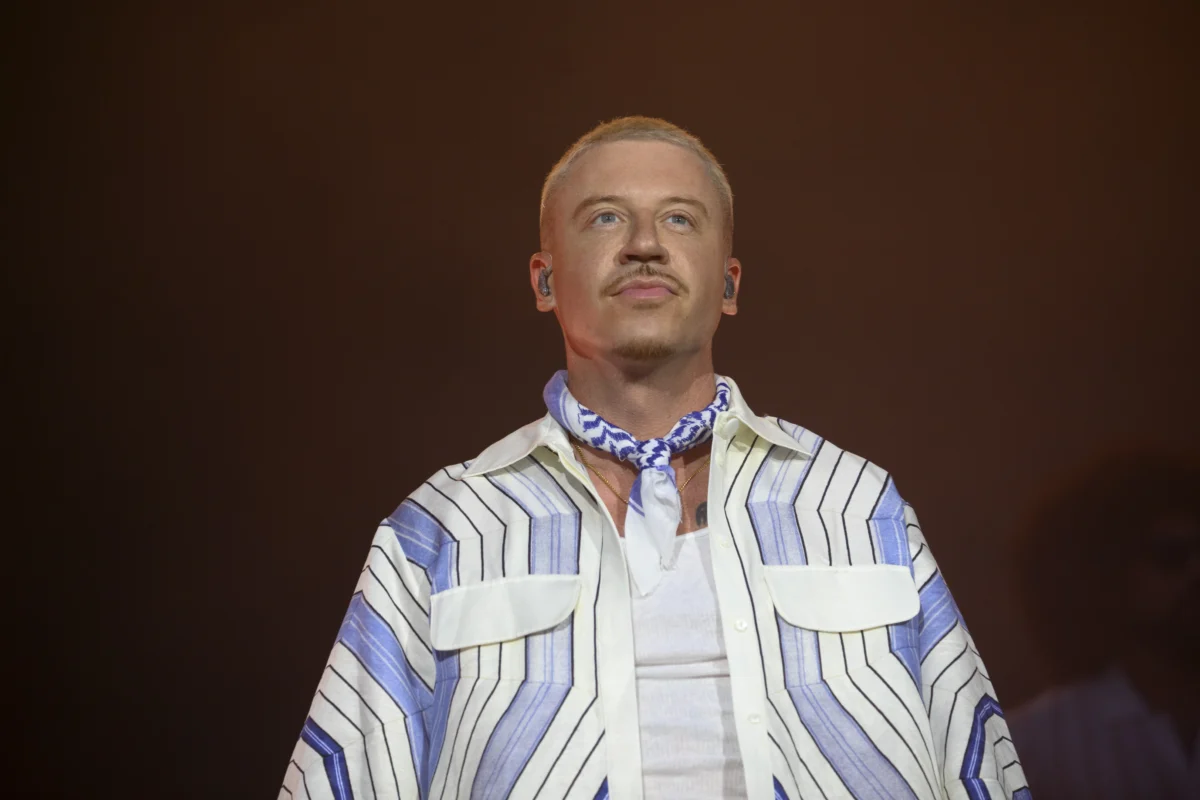
The intersection of global politics, live entertainment, and artistic expression reached a significant milestone in Dublin, Ireland, as Grammy Award-winning rapper Macklemore took the stage to kick off a dedicated three-show solidarity tour. The performance marked his first major live dates since a controversial sequence of events that began in September, when he was removed from Ed Sheeran’s high-profile "Loop" stadium tour across the United States. Dedicating the evening to themes of "love and liberation," Macklemore utilized his platform to address the geopolitical crisis in Gaza and the West Bank, while cementing his commitment to humanitarian advocacy through music.
The concert in the Irish capital featured surprise guest appearances by acclaimed artist Hozier and hip-hop group Kneecap, drawing immense crowds and setting a defiant tone for the rest of the trek. The itinerary includes subsequent stops in Paris and London, with all ticket proceeds directed toward charitable organizations providing aid to Palestine. Furthermore, the rapper has committed his entire $1 million salary earned from the initial legs of the Ed Sheeran tour to Palestinian relief efforts.
The Genesis of the Controversy: MetJersey Speeches and Immediate Fallback
The roots of the current tour trace back to September 4 and 5, during Ed Sheeran’s concert dates at MetLife Stadium in East Rutherford, New Jersey. Performing as a supporting act, Macklemore addressed the sold-out stadium crowd, declaring "Free Palestine" and delivering brief political remarks.
"A big part of the reason why I wanted to do this tour in the first place is so I could stand up in stadiums like this and say two words that are very near and dear to my heart: ‘Free Palestine,’" Macklemore told the audience during the September 4 performance. "I want those words to be loud and clear, so that people all the way in Gaza to the occupied West Bank know that we have not forgotten about them."
During his September 5 appearance, the rapper reiterated the phrase while clarifying that his political stance was not intended as a criticism of Jewish people. Despite this addendum, the speeches immediately polarized audiences, sparking viral debate across social media platforms. High-profile figures weighed in on the controversy, including pop star Pink, whose social media activity regarding the comments drew widespread scrutiny. Concurrently, advocacy groups, most notably the Israeli American Council (IAC), issued formal petitions demanding Macklemore’s removal from the remainder of the tour.
Critics argued that the stadium stage was an inappropriate venue for geopolitical partisanship. In a statement released at the time, representatives for the IAC asserted: "This was an Ed Sheeran concert — not a political rally, not a protest, and not an activist event. The issue is not whether Macklemore has the right to hold political views. The question is where the line should be drawn when an opening act uses a global concert platform to advance a one-sided political agenda."
Fallout and Tour Disruptions Across the United States
The backlash quickly translated into logistical complications for the tour’s promoters. On September 14, just over a week after the New Jersey shows, Messina Touring Group—the promoter behind Sheeran’s U.S. itinerary—announced that Macklemore had been dropped from all remaining dates.
The promoter cited venue pressures as the primary catalyst for the decision, stating they had been formally "notified by venues that they will not allow a concert to take place with Macklemore on the lineup, which would result in the cancellation of the tour and impact hundreds of thousands of fans."
The decision prompted a cascading wave of solidarity boycotts within the music industry. Several other supporting acts on the Sheeran bill, including Finneas, Lukas Graham, and Aaron Rowe, announced their withdrawal from the tour. In addition, the majority of Sheeran’s backing band members stepped down in protest of the promoter’s decision to drop the rapper.
Complications deepened further when Macklemore publicly claimed that Robert Kraft, owner of Gillette Stadium in Massachusetts, had refused to allow him to perform at the venue and allegedly lobbied other stadium operators to enact similar bans. In response to the escalating public relations crisis, Kraft announced a joint initiative alongside Ed Sheeran, pledging $2 million in charitable donations toward humanitarian aid in the Middle East.
Ed Sheeran’s Silence, Backlash, and Subsequent Statement
As the controversy intensified, primary headliner Ed Sheeran faced intense public pressure to clarify his position. On September 12, Sheeran released a comprehensive statement addressing the situation, emphasizing that the decision to remove Macklemore was made by the promoters rather than himself, while defending his longstanding policy of avoiding political commentary during public performances.
"Just because I choose not to speak publicly, it doesn’t mean I don’t have them [political views], and it doesn’t mean I don’t care. Nor does it mean I don’t support causes in my own, personal way," Sheeran wrote. "There is a reason I do not use my professional platform for politics — my audience includes young people, often children, of all backgrounds. Those who come to my shows do not expect a political forum. I respect Macklemore’s strength of purpose to stand up and shout for what he believes. However, there is room for multiple approaches to the same end: peace. I choose to use my fame and platform to be a place of safety and sanctuary, to maintain diplomacy and keep conversations open, not closed."
However, Sheeran’s stance generated a new wave of criticism from fans and commentators who viewed the neutrality as complicity or cowardice in the face of a severe humanitarian crisis. Facing mounting pressure and shifting public sentiment, Sheeran altered his approach just days later. During a concert in Philadelphia on September 19, the British pop star addressed the conflict directly from the stage.
"What happened in Israel and at the Nova Music Festival on Oct. 7 was horrific and compounded centuries of Jewish pain," Sheeran told the Philadelphia audience. "What is happening in Gaza is catastrophic and unjustifiable, and disproportionate. Our hearts can be broken by the scale of devastation and loss of civilians’ lives, children’s lives, and the systemic injustice we’re seeing unfold in the West Bank cannot be overlooked."
Macklemore’s Dublin Address and Artistic Resistance
Addressing the six-week interval between his dismissal from the Sheeran tour and his triumphant return to the stage in Dublin, Macklemore reflected on the cultural weight of his chosen phrase. Standing before the Irish audience, he defended the linguistic simplicity of his message against its detractors.
"Six weeks ago, it was two words. Two words is all that it took. Two words that are rooted in love and liberation," Macklemore stated. "Not against anybody, not divisive. Not a call for hatred. But a call to recognize our shared humanity. Free Palestine. I said free Palestine! The same thing that I want for all of us, freedom, dignity, the right to exist without fear. Being able to raise our children in the homes that we grew up in, not having to prove our humanity to the rest of the world."
He continued by critiquing the systemic pushback against pro-Palestinian rhetoric in Western cultural spheres: "And yet, those words, those two words, right, those two words are so threatening to some people. They would rather silence those two words than confront what they actually mean. Because freedom that requires another person’s oppression is not freedom at all. I said freedom that requires another person’s oppression is not freedom at all."
The rapper pointed to the continuous stream of documentation emerging from the conflict zones as justification for his vocal stance. "And while the world debates those words, we see the videos, we see the footage, we see parents pulling their children out of the rubble. Families erased. Devastation beyond our imagination. And somehow, those words have become more controversial than the suffering that made them necessary."
He concluded his remarks by framing music as an enduring vehicle for social and political dissent. "That is why we are here tonight. That is why we are here, because throughout history, music has given people a place to resist, to come together as a collective, to share our grief, to share our stories, to move from the heart, to mobilize people with the frequency of love. The heartbeat in our drum that makes us feel alive, that makes us feel connected."
Broader Implications for Live Entertainment and Activism
The clash over Macklemore’s stage remarks highlights a growing tension within the modern music industry regarding the boundaries of artist expression, corporate event management, and geopolitical accountability. As major stadium tours rely on multi-million dollar sponsorships, complex insurance frameworks, and diverse venue partnerships, promoters increasingly view overt political statements as financial and operational liabilities.
Conversely, a vocal segment of the artistic community and concert-going public maintains that performers have a moral imperative to address global crises, particularly when funded through international tours or platformed by major commercial entities. The willingness of supporting acts like Finneas and various backing musicians to walk away from a lucrative stadium tour underscores a generational shift among artists who are increasingly willing to prioritize political solidarity over commercial stability.
Following his performance at Colorado’s Red Rocks Amphitheatre on October 22, Macklemore’s current European dates in Paris and London signal that independent curation and charity-driven concert models may offer viable alternatives for artists facing industry blacklisting. As the geopolitical landscape in the Middle East continues to evoke intense global polarization, the intersection of pop culture and political advocacy remains a high-stakes arena where artistic freedom and corporate risk management continuously collide.