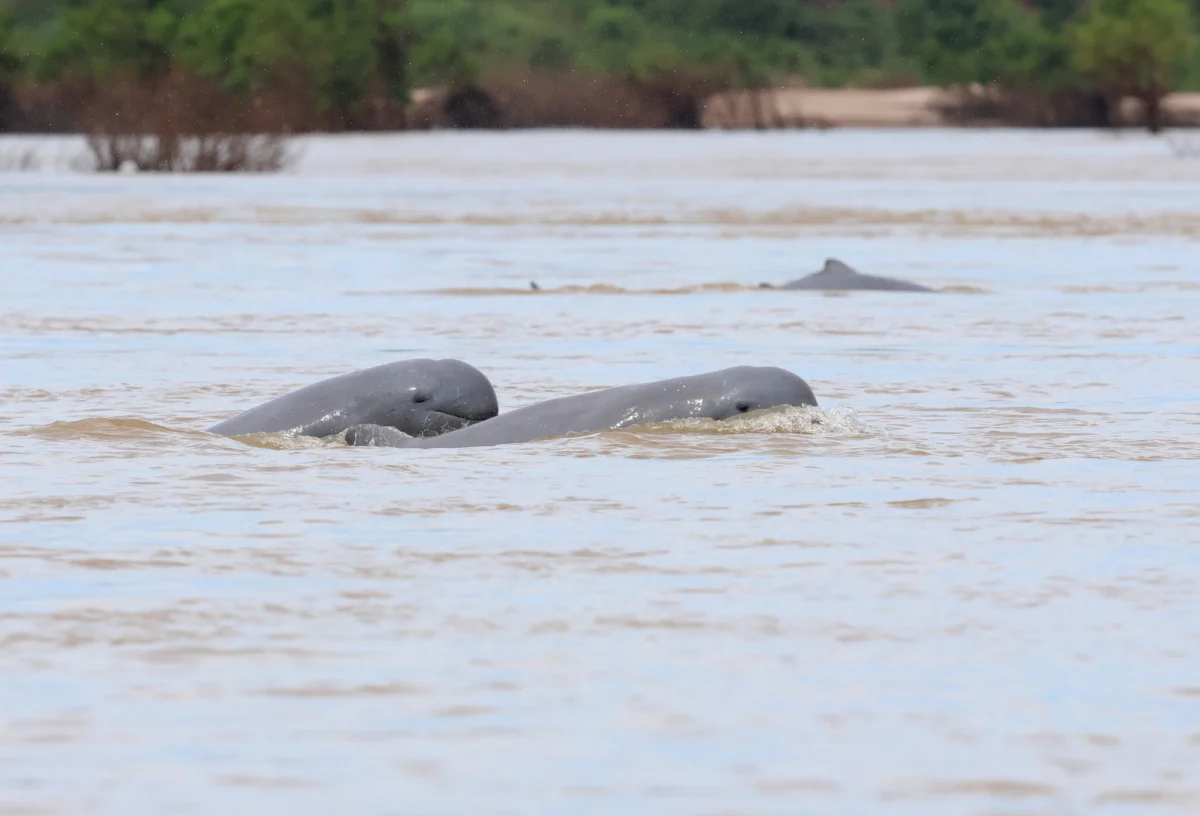
At nine in the morning, the heat on the Mekong River in Cambodia’s Kratie province is already stifling, yet for Heang Koeurn, this is the most vital hour of the day. He kills the motor of his small wooden boat, allowing the vessel to drift silently into the Kampi pool. For 11 years, Koeurn has performed this same routine, leaning forward with his elbows pressed against his knees, eyes fixed on the shifting, murky currents of the Mekong. He is waiting for a glimpse of a gray, rounded head breaking the surface—a signature of the Irrawaddy dolphin (Orcaella brevirostris), the river’s last remaining cetacean. Finally, a dorsal fin crests, and a few meters away, a group of foreign tourists reacts with hushed excitement, pointing toward the ripple. For these locals, the dolphin is more than a tourist attraction; it is a sacred symbol of the river’s health and an ancestral spirit of the Mekong. Yet, this species stands on a precarious precipice, caught between the encroaching pressures of industrial development and the desperate, often illegal, struggle for survival by those who live along the river’s banks.

A Demographic Collapse
The history of the Irrawaddy dolphin in the Mekong is one of steady, alarming decline. Once thriving throughout the Mekong Delta, the Tonle Sap Lake, and the vast network of the river’s tributaries, the population has been decimated by human activity over the last three decades. In the late 1990s, scientists estimated that approximately 200 of these freshwater mammals inhabited the Cambodian stretch of the river. Today, that number has plummeted to just over 100 individuals.
The primary drivers of this collapse are multifaceted. Historically, direct hunting and the capture of dolphins for the entertainment industry played a role, but the modern threats are more insidious. Habitat degradation, the proliferation of hydroelectric dams, and the widespread use of gillnets—large, invisible curtains of nylon mesh—have created a gauntlet that the dolphins struggle to navigate. Because these dolphins share the same deep-water pools that serve as prime fishing grounds, accidental bycatch has become the leading cause of mortality. Calves, which are naturally curious and slower than adults, are particularly vulnerable, often perishing after becoming entangled in nets or when their mothers are trapped, leaving them unable to survive on their own.

The Chronology of Conservation Efforts
The fight to preserve the species has been marked by a series of legislative and community-based interventions, though progress remains uneven.
- 2012: Recognizing the rapid decline, the Cambodian government established a 180-kilometer (112-mile) protected core habitat zone stretching through Kratie and Stung Treng provinces. Simultaneously, the fisheries department mobilized 72 river guards to patrol these zones, specifically tasked with removing illegal fishing gear.
- 2014: The Fisheries Administration (FiA) and WWF-Cambodia launched a comprehensive initiative to reconcile the needs of local fishing communities with conservation goals, offering alternative livelihoods to reduce dependence on wild-caught fish.
- 2022: A tragic milestone occurred when the last known Irrawaddy dolphin in the transboundary Anlong Chheu Teal pool, a male known as the "lonely dolphin," was found dead after becoming entangled in fishing gear. This effectively signaled the local extinction of the species in that section of the Mekong.
- 2025: The Ministry of Land Management formally designated the remaining core habitat zones as state land, providing a stronger legal framework for protection against encroachment and development.
The Dam-Induced Ecological Crisis
While illegal fishing is the most immediate threat to individual dolphins, the long-term viability of the species is inextricably linked to the hydrology of the Mekong. The river is currently home to more than 160 operational dams on its mainstream and tributaries, including 13 on the main stem. The Don Sahong Dam in southern Laos, located less than two kilometers from the Cambodian border, is a prime example of the environmental shift.

Operational since 2020, the Don Sahong Dam sits at a critical gateway for regional fish migration. While researchers note that the dams do not necessarily kill dolphins directly, they fundamentally alter the river’s rhythm. By changing flow patterns and obstructing the migration of fish species, the dams degrade the river’s biodiversity. As the fish stocks that dolphins depend on for food dwindle, the dolphins are forced to forage in less suitable areas, increasing their exposure to human conflict. Climate change further compounds these hydrological fluctuations, leaving the river’s ecosystem in a state of constant, stressful flux.
Law Enforcement and the Reality on the River
The enforcement of conservation laws is a dangerous and underfunded endeavor. At the Kampi river guard station, the reality is stark: a collection of faded maps and broken equipment. Patrollers like Kem Sophat and Veang Tino describe a job defined by physical risk and financial hardship. Illegal fishers, often facing their own economic desperation, have been known to carry weapons and respond with violence when confronted.

The financial burden is equally heavy. Many guards earn a meager $5 to $7.50 per day, often covering the costs of their own fuel and meals to maintain patrols. Despite these obstacles, the scale of confiscations is significant. In 2022 alone, authorities seized and destroyed roughly 36,000 meters of gillnets and 7,000 fishing hook nets. However, as Tino notes, illegal fishers are increasingly sophisticated, monitoring patrol patterns and moving their operations into the "buffer zones" where regulations are looser or enforcement is less frequent. "Law enforcement does not have full capacity to address these issues," Tino admits. "We need everyone, from the local community to the government, working in tandem."
Economic and Cultural Implications
The loss of the Irrawaddy dolphin is not merely a biological catastrophe; it is a profound cultural and economic blow. Frances Gulland, chair of the U.S.-based Marine Mammal Commission, aptly compares the loss of a species to "losing a star from the sky." For the Mekong communities, the economic fallout of declining dolphin populations is immediate. In Anlong Chheu Teal, for instance, the death of the last dolphin caused a 60% drop in tourism, devastating local businesses that relied on the animals as a primary draw.

Beyond economics, the dolphin is woven into the spiritual fabric of the region. Many communities view the dolphins as the physical manifestation of the river’s ancestral spirits. When the dolphins vanish, the connection between the people and the river is severed, and a sense of cultural heritage is lost forever.
A Glimmer of Hope: The 2026 Recruitment Surge
Despite the grim trajectory of the last decade, there are signs of potential recovery. By June 2026, conservationists recorded the birth of at least six new calves along the Kratie and Stung Treng stretch of the river. This has brought the estimated total population to 118 individuals. While the numbers remain critically low, the consistent birth rate is a vital indicator that the remaining adults are healthy enough to reproduce, provided the pressure from gillnets and habitat loss is kept in check.

I Sanaroth, the Kampi fisheries chief, remains cautiously optimistic. He emphasizes that the increase in the population is a direct result of collaborative efforts between the government, WWF-Cambodia, and local residents. "Our work is not done," Sanaroth stated. "But the fact that the population is reproducing is a strong signal that the species can recover if we continue to hold illegal fishers accountable."
The path forward for the Irrawaddy dolphin requires more than just patrol boats; it requires a systemic rethinking of how the Mekong is managed. It necessitates regional cooperation to regulate dam operations, stronger enforcement of the core habitat zones, and continued investment in the economic well-being of the river-dependent communities who serve as the first line of defense. As the sun rises over the Kampi pool each morning, the wait for a gray fin to break the water continues—a testament to the resilience of the species and the enduring commitment of those who refuse to let the Mekong’s most sacred treasure disappear.