Building a permanent human presence on the Moon has long been a centerpiece of international space exploration goals, yet the logistical hurdle remains daunting: the immense cost and technical difficulty of transporting construction materials from Earth. To address this, a team of researchers at the University of Arkansas has pioneered a groundbreaking method for 3D printing structural components directly from lunar regolith. Their research, recently published in the journal NPJ Advanced Manufacturing, demonstrates that simulated lunar dust can be fused into interlocking, LEGO-like bricks without the need for imported binding agents, potentially revolutionizing the future of extraterrestrial architecture.
The research effort was spearheaded by Cole McCallum, who initiated the project as an undergraduate student, under the mentorship of Wan Shou, an assistant professor of mechanical engineering at the University of Arkansas. Their work addresses one of the most critical constraints of NASA’s Artemis program and broader lunar colonization efforts: In-Situ Resource Utilization (ISRU).
The Mechanics of Lunar Manufacturing
The team utilized a sophisticated additive manufacturing technique known as laser powder bed fusion (LPBF). The process is conceptually straightforward but technically demanding: a thin layer of particulate material is spread across a build platform. A concentrated laser then scans the surface, heating the particles to the point of sintering—a process where the material fuses into a solid mass without reaching a full liquid state. Once a layer is complete, the platform descends, a new layer of powder is deposited, and the process repeats.
The primary material challenge lies in the nature of lunar regolith itself. Unlike terrestrial soil, which is shaped by wind, water, and organic decomposition, lunar regolith is the product of billions of years of cosmic bombardment. It consists of sharp, jagged, and abrasive particles formed by asteroid and micrometeorite impacts. To replicate this, the team used Lunar Highlands Regolith Simulant (LHS-1), a commercially available material engineered to mimic the geochemical properties of samples retrieved during the Apollo missions of the 1960s and 1970s.
Breaking the Binder Dependency
Previous attempts to create structural components from extraterrestrial soil have almost universally relied on chemical binders—glues or resins mixed with the dust to provide cohesion. While effective at creating sturdy structures, this approach is fundamentally limited by the need to launch those binders from Earth. Every kilogram of binder sent to the Moon is a kilogram that cannot be used for life-support systems, scientific equipment, or crew supplies.
The University of Arkansas team’s breakthrough is the elimination of these external agents. By optimizing the laser parameters and the physical properties of the powder bed, the researchers successfully achieved direct bonding between the regolith particles themselves.
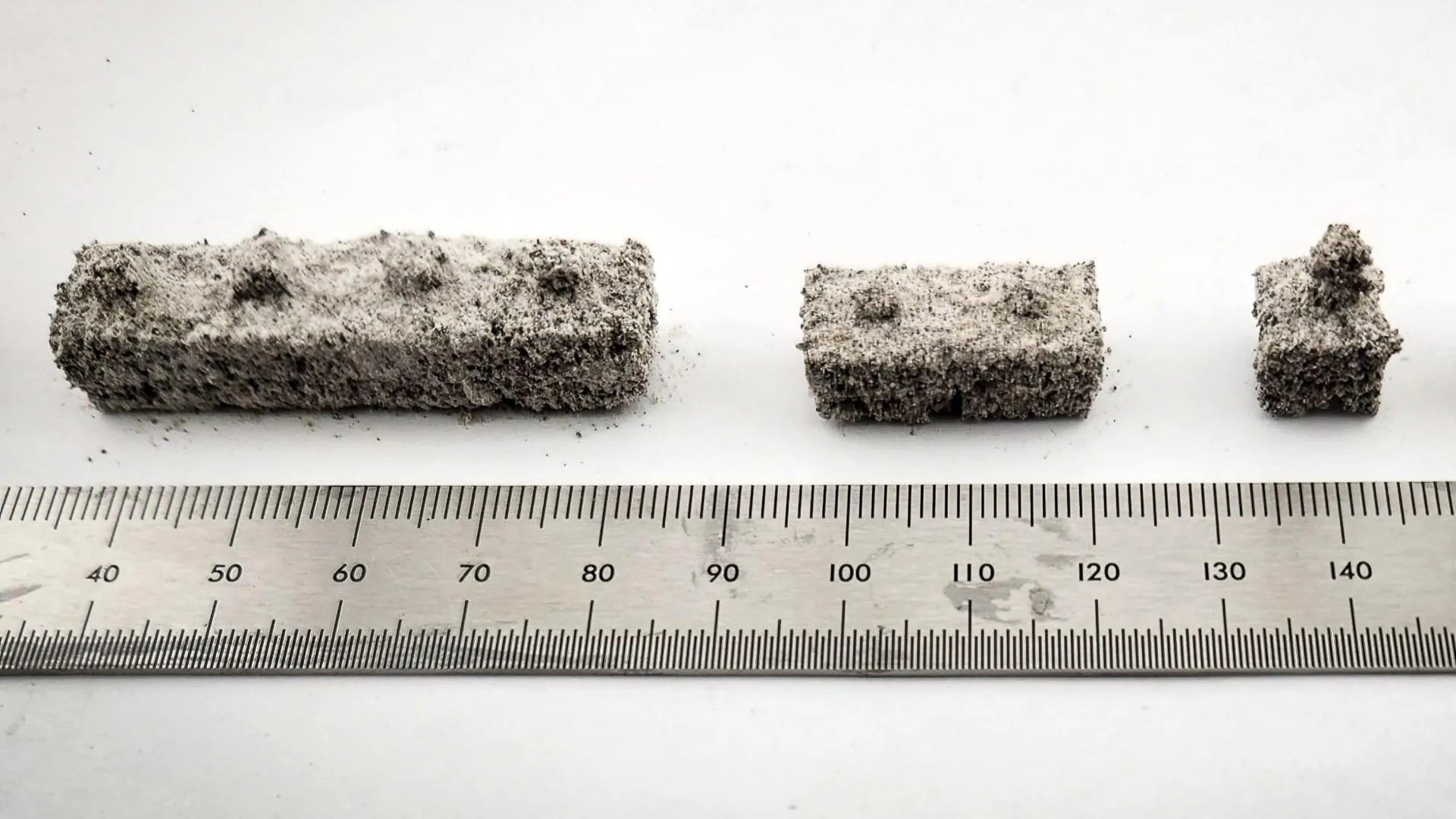
"There’s nothing else it’s binding to. The regolith powder is binding to itself," said McCallum. This self-sintering method produced small-scale, interlocking blocks shaped like crosses and the letter H. By mirroring the design philosophy of interlocking plastic building blocks, the team demonstrated that these components could theoretically be used to assemble larger modular structures, such as radiation shields, landing pads, or base foundations.
Challenges and Structural Integrity
Despite the milestone, the researchers are cautious about the current load-bearing capacity of these bricks. Because the sintering process creates internal porosity within the blocks, they currently lack the compressive strength required for major load-bearing architecture.
"These structures we’re making can be self-supported," McCallum noted. "But I would be hesitant to say our process could be used for something that’s supporting other loads at this moment."
Professor Wan Shou emphasized that the move from laboratory demonstration to lunar deployment involves a significant leap in environmental complexity. The current research was conducted under Earth’s gravity and atmospheric pressure. Future development must account for the Moon’s one-sixth gravity and the vacuum of space, both of which will fundamentally alter the heat transfer and powder-spreading mechanics of the printing process. Furthermore, the longevity of these structures against extreme lunar temperature fluctuations—ranging from roughly 127°C during the day to -173°C at night—remains a critical area for future investigation.
Chronology of Lunar Construction Research
The quest to build on the Moon has evolved significantly over the past two decades:
- 2005-2010: NASA and various academic institutions begin preliminary studies on lunar concrete, focusing on sulfur-based binders.
- 2013: The European Space Agency (ESA) collaborates with architects to test 3D-printed regolith structures, using a binding salt to solidify the material.
- 2019: NASA launches the "3D-Printed Habitat Challenge," encouraging private sector and academic innovation in ISRU construction.
- 2023-2024: The University of Arkansas project marks a significant pivot toward binder-less, laser-sintered modular construction, moving beyond simple shell-printing to modular, interlocking components.
Broader Implications for the Artemis Era
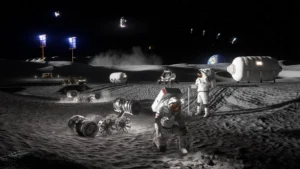
The ability to manufacture components locally aligns with NASA’s broader strategic objective to establish a "sustained presence" on the Moon. As the Artemis program transitions from brief crewed sorties to long-term exploration, the dependence on Earth-based logistics must decrease.
Data from the Lunar Reconnaissance Orbiter (LRO) indicates that there is an abundance of regolith across the lunar surface, meaning that if a sustainable 3D printing process is perfected, the raw materials for a small city are already in place. This would theoretically lower the "cost per cubic meter" of lunar infrastructure by orders of magnitude.
If this technology can be scaled, it will likely be deployed alongside automated robotic scouts. These machines would land on the Moon, survey the site for geological stability, and begin the printing process months or years before the first humans arrive to assemble the modular blocks.
The Human Element: Undergraduate Contribution
The project highlights the role of higher education in solving the most pressing challenges of modern aerospace. Cole McCallum’s journey from an undergraduate in Little Rock to an aerospace student in Toulouse serves as a case study for the value of hands-on research.
McCallum, now a Lafayette Fellow studying at ISAE-SUPAERO in France—one of the premier aerospace institutions in the world—credits his time in the University of Arkansas laboratory with providing him the resilience needed for complex scientific research. The iterative nature of his work, which involved countless failed attempts before the first successful brick was produced, provided a realistic look at the rigors of engineering.
"It helps you refine and overcome all the problems you have as a researcher," McCallum said. "There are a lot of mistakes that I made the first time through. It was really nice to have a head start on everyone else and make those mistakes early."
Future Outlook
As space agencies look toward the 2030s and 2040s for Mars missions, the lessons learned from this lunar project will be invaluable. The challenge of building on the Moon is a dress rehearsal for the Martian surface, where the distance from Earth makes supply chains even more precarious.
The success of the University of Arkansas team serves as a technical proof-of-concept that the "in-situ" paradigm is not only possible but increasingly viable. While the bricks produced in the laboratory are only a few centimeters in size, the methodology—the use of concentrated energy to forge structures from the lunar floor—represents a fundamental shift in how humanity plans to leave its mark on the solar system. The next phase of research will likely focus on structural reinforcement additives (such as metallic fibers) and the development of large-scale, solar-powered laser printing systems designed to operate autonomously in the harsh lunar environment.
By proving that the very dust of the Moon can be transformed into the foundations of human civilization, the researchers have brought the dream of long-term lunar habitation one step closer to reality.