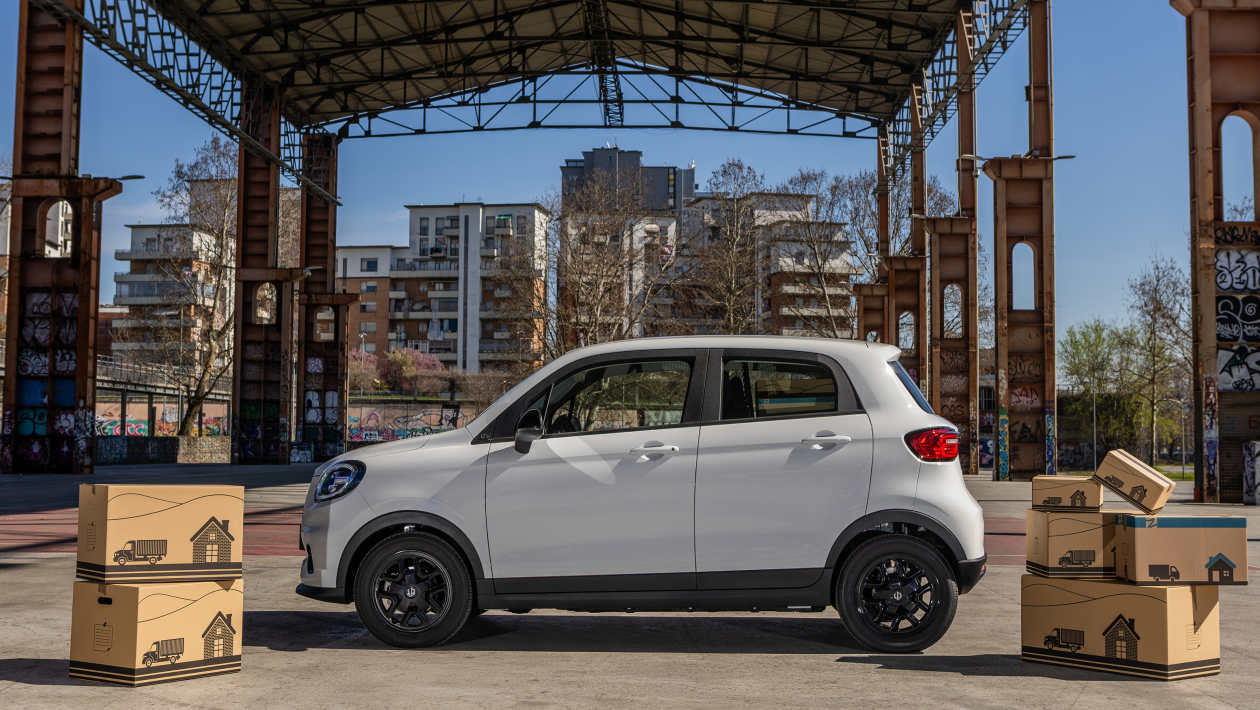
The release of official imagery for the Leapmotor T03 LCV marks a significant milestone in the diversification of the United Kingdom’s commercial vehicle sector, signaling the arrival of what is projected to become the nation’s most affordable new electric van. Developed by the Chinese electric vehicle specialist Leapmotor in collaboration with automotive giant Stellantis, the T03 LCV is a light commercial adaptation of the existing T03 five-door city car. This new derivative is specifically engineered to address the burgeoning demand for compact, zero-emission transport solutions within the "last-mile" delivery sector, where urban maneuverability and low overhead costs are paramount for small businesses and independent contractors alike.
The official photographs reveal a vehicle that retains the compact footprint and "friendly" aesthetic of its passenger-carrying counterpart while introducing critical structural modifications necessary for commercial classification. By removing the rear seating and optimizing the internal dimensions for cargo, Leapmotor has positioned the T03 LCV as a direct competitor to micro-vans and heavy quadricycles, offering a more robust, highway-capable alternative to vehicles like the Citroën Ami Cargo.
Design and Functional Architecture of the T03 LCV
The transition from a passenger hatchback to a light commercial vehicle (LCV) involves more than mere badge engineering. The T03 LCV utilizes a high-strength steel cage construction, which provides a balance between lightweight efficiency and the structural integrity required for carrying payloads through congested urban environments. The exterior design remains largely unchanged from the standard T03, featuring a short wheelbase of 2,400mm and a total length of approximately 3,620mm. This compact stature allows for a turning circle of just 9.6 meters, making it exceptionally well-suited for navigating narrow residential streets and tight delivery bays.
Internally, the most significant changes are found behind the front seats. The rear passenger bench has been entirely discarded to make way for a flat-loading floor, which is finished with a durable, non-slip material designed to withstand the rigors of daily commercial use. To ensure driver safety and cargo security, a full-height bulkhead has been installed, separating the cockpit from the load area. While official volume figures for the UK market are still being finalized, the conversion is expected to offer approximately 800 to 1,000 liters of usable cargo space, sufficient for small parcels, toolkits, or grocery deliveries.
Technical Specifications and Powertrain Performance
The Leapmotor T03 LCV is powered by a front-mounted permanent magnet synchronous motor, which is expected to deliver approximately 94bhp (70kW) and 158Nm of torque. This power output ensures that the van remains capable of keeping pace with urban traffic even when fully laden. The vehicle is equipped with a 37.3kWh lithium-ion battery pack, a capacity that is relatively high for a vehicle of this size, providing a distinct advantage over smaller-battery competitors.

Under the Worldwide Harmonised Light Vehicle Test Procedure (WLTP), the T03 LCV is anticipated to offer a combined range of approximately 165 miles. In purely urban driving cycles, where regenerative braking is more frequently engaged, this range could potentially exceed 200 miles. For last-mile delivery drivers, who typically cover between 60 and 100 miles in a single shift, this range provides a comfortable buffer, reducing "range anxiety" and the need for mid-day charging stops.
Charging capabilities are optimized for modern infrastructure, with the T03 LCV supporting both AC and DC charging. Using a 6.6kW AC home or depot charger, a full charge can be achieved in roughly six hours. For rapid top-ups, the vehicle supports DC fast charging, allowing the battery to go from 30% to 80% in approximately 36 minutes, which is well within the timeframe of a standard lunch break or a loading interval.
Chronology of Leapmotor’s Expansion and the Stellantis Partnership
The introduction of the T03 LCV to the British market is the culmination of a rapid international expansion strategy. Leapmotor was founded in 2015 as a technology-focused EV startup based in Hangzhou, China. Unlike many of its contemporaries, Leapmotor emphasized in-house development, creating its own electric motors, electronic control systems, and battery management software.

- 2020: The original T03 passenger car is launched in China, quickly becoming one of the best-selling compact EVs in the domestic market.
- 2023: Stellantis, the parent company of brands such as Vauxhall, Peugeot, and Fiat, announces a €1.5 billion investment to acquire a 21% stake in Leapmotor. A joint venture, Leapmotor International, is formed with a 51/49 ownership split in favor of Stellantis.
- 2024: Leapmotor International begins shipping vehicles to European markets, utilizing Stellantis’s established distribution networks and aftersales infrastructure.
- 2025: The T03 passenger car arrives in the UK, priced competitively to undercut established European city cars.
- 2026: The T03 LCV is officially unveiled, with pictures released in April, targeting the commercial sector as part of a broader strategy to dominate the entry-level EV market.
This partnership is critical for the T03 LCV’s success in Britain. By leveraging Stellantis’s existing network of dealers and service centers, Leapmotor can offer the logistical support and reliability guarantees that commercial fleet operators require—areas where independent Chinese startups have historically struggled.
Economic Implications and Market Positioning
The most compelling aspect of the Leapmotor T03 LCV is its projected price point. Industry analysts suggest that the van could be priced as low as £14,000 to £16,000 (excluding VAT), potentially making it the cheapest new commercial vehicle available in the UK. This pricing strategy is particularly disruptive at a time when the average price of electric vans remains significantly higher than their internal combustion engine (ICE) counterparts.
The economic argument for the T03 LCV extends beyond the initial purchase price. In the UK, small businesses are increasingly pressured by environmental regulations, such as London’s Ultra Low Emission Zone (ULEZ) and similar Clean Air Zones (CAZ) in cities like Birmingham, Bristol, and Glasgow. The T03 LCV offers a solution that avoids daily congestion and emission charges while qualifying for the UK government’s Plug-in Van Grant (PiVG), which can further reduce the acquisition cost.

Furthermore, the total cost of ownership (TCO) is expected to be significantly lower than that of a diesel-powered van. With fewer moving parts, reduced maintenance requirements, and the lower cost of electricity per mile compared to fossil fuels, the T03 LCV represents a viable financial path for sole traders looking to transition to electric mobility without the prohibitive costs associated with larger electric vans like the Ford E-Transit or the Vauxhall Vivaro Electric.
The Competitive Landscape and Industry Reactions
The T03 LCV enters a niche but rapidly growing segment of the market. Its primary rivals include:
- Citroën Ami Cargo / Fiat Topolino Dolcevita: These vehicles are cheaper but are classified as quadricycles. They have a limited top speed (28mph) and are restricted from motorways, making them unsuitable for certain delivery routes.
- Dacia Spring Cargo: A direct competitor in terms of utility and price. The Spring Cargo offers a similar "car-derived" van experience but faces stiff competition from the T03 LCV’s higher standard technology suite.
- Renault Kangoo E-Tech (Smallest Battery Version): While more capable in terms of volume, the Kangoo sits in a much higher price bracket, often costing twice as much as the projected price of the Leapmotor.
Industry reactions have been largely positive, though cautious regarding the vehicle’s compact size. Logistics experts note that while the T03 LCV cannot replace a 3.5-tonne van for heavy haulage, it is the "missing link" for the final mile of the delivery chain. Fleet managers have expressed interest in the vehicle’s potential to reduce the "carbon footprint per parcel," a metric that is becoming increasingly important for corporate social responsibility (CSR) reporting.

Broader Impact on the UK Automotive Sector
The arrival of the Leapmotor T03 LCV is emblematic of a larger shift in the UK automotive landscape: the influx of Chinese-manufactured EVs supported by European corporate partnerships. This trend is likely to accelerate as the UK’s Zero Emission Vehicle (ZEV) mandate takes full effect, requiring manufacturers to ensure that a growing percentage of their sales are zero-emission vehicles.
The T03 LCV also highlights the evolution of the "car-derived van." Traditionally, this segment was dominated by vehicles like the Ford Fiesta Van or the Vauxhall Corsa-e Van. However, as manufacturers have discontinued small three-door hatchbacks, a vacuum was created in the market. Leapmotor is effectively filling this void with a purpose-built electric solution that prioritizes efficiency over superfluous features.
As the UK moves toward its 2030 goal of ending the sale of new pure-petrol and diesel cars and vans, the availability of affordable, entry-level electric options like the T03 LCV will be crucial for ensuring that small businesses are not left behind in the transition. The official pictures released today represent more than just a new model; they represent the democratization of electric commercial transport, providing a blueprint for how affordable technology can drive the green revolution in the logistics sector.

In conclusion, the Leapmotor T03 LCV is poised to be a pivotal player in the UK’s commercial vehicle market. By combining the agility of a city car with the utility of a van and the backing of the Stellantis group, it offers a pragmatic and cost-effective solution for the modern delivery landscape. As final specifications and official pricing are confirmed later this year, all eyes will be on how this "small but mighty" contender reshapes the expectations of what a budget-friendly electric van can achieve.