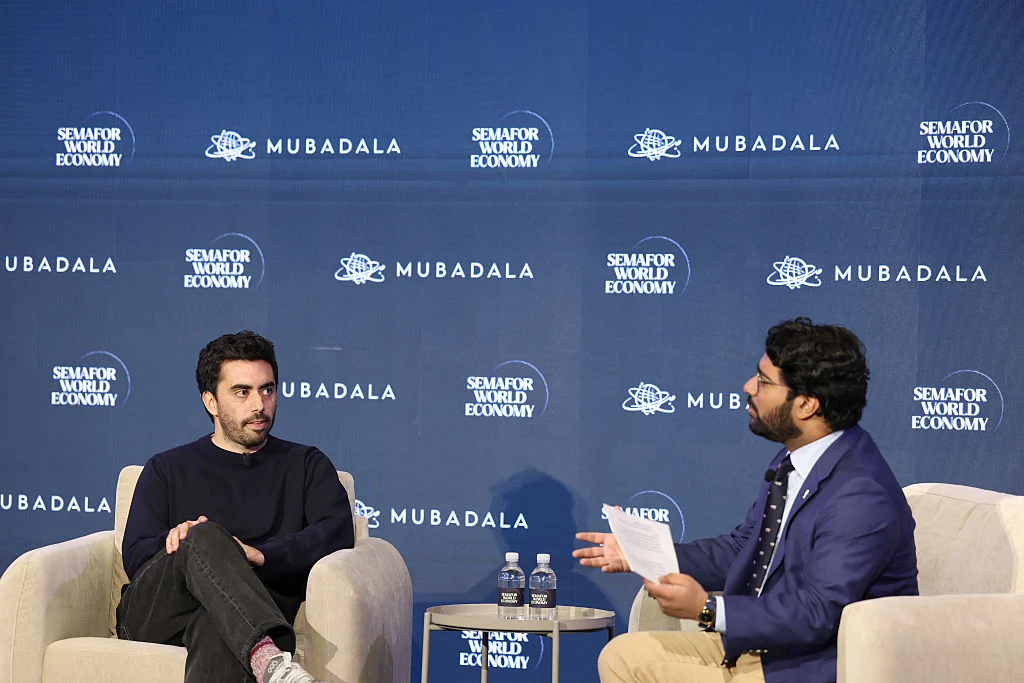
Cristóbal Valenzuela, the co-founder and CEO of AI video-generation startup Runway, now valued at north of $5 billion, has stirred considerable debate within the creative industries, particularly among the anti-AI contingent, with his recent remarks regarding artificial intelligence’s transformative potential in Hollywood. Speaking at Semafor’s World Economy Summit, a prominent gathering designed to convene global leaders for discussions on pressing economic and geopolitical issues, Valenzuela articulated a vision that challenges the foundational economic and artistic paradigms of film production. His proposal suggests a radical reallocation of resources: instead of investing $100 million into a single feature film, studios should leverage AI to produce 50 films of comparable visual quality for the same budget, thereby dramatically increasing output and, in his view, the statistical probability of achieving a commercial or critical hit.
Valenzuela’s provocative assertion, delivered during a panel discussion on the future of creative industries, centered on what he termed a "quantity problem" in filmmaking. "If you’re spending a hundred million dollars on making one feature film, which is 90 minutes, imagine taking a hundred million dollars and spending it on, like, 50 movies," Valenzuela stated, outlining his core argument. "Same quality. Same amount of output, visually. But you make way more content. So you have way better chances of hitting something. It’s a quantity problem." This perspective directly confronts the prevailing ethos in Hollywood, where a film is often considered a significant artistic and financial investment, contingent on the unique vision of a creative team and the meticulous craft of hundreds, if not thousands, of human artists and technicians. Valenzuela’s model, conversely, frames the entire enterprise as a numbers game, where success is primarily a function of volume, made attainable by the efficiencies of AI.
Runway’s Ascent and the AI Video Frontier
Runway, a company at the forefront of AI-powered creative tools, has rapidly ascended in the tech landscape, culminating in a recent funding round that pushed its valuation past the $5 billion mark. The startup is renowned for its AI "world models" like Gen-1 and Gen-2, which enable users to generate video from text, images, or existing video clips, offering capabilities ranging from stylistic transfers to entirely novel scene creation. These tools are designed to streamline various aspects of post-production and visual effects, promising to democratize filmmaking and empower creators with unprecedented speed and flexibility. The company’s significant financial backing underscores investor confidence in the disruptive potential of generative AI within media and entertainment, mirroring similar investments in rivals like OpenAI’s Sora, Google’s Lumiere, and Meta’s Emu Video, all vying for dominance in the nascent AI video space.
Valenzuela acknowledged the considerable controversy surrounding the introduction of AI into creative markets such as film and television production. However, he emphasized that "things are changing fast," suggesting that much of the initial skepticism stemmed from "fear and misunderstanding." He posited that a broader understanding of AI’s capabilities is now emerging, allowing for more productive discussions about its integration. Runway, he claimed, actively collaborates with numerous studios and creators, and its technology is already demonstrably contributing to reduced production costs across the industry.
Tangible Shifts: AI’s Early Impact on Production Costs
The financial implications of AI in film production are already materializing, offering concrete examples that support Valenzuela’s claims of cost reduction. A notable case is the upcoming "Bitcoin: Killing Satoshi," projected to be the first studio-quality AI feature film, with an estimated production cost of $70 million. This figure represents a significant reduction from an initial estimate of $300 million for traditional production methods, as reported by TheWrap, showcasing AI’s potential to dramatically alter budget structures. Beyond independent productions, major industry players are also exploring or implementing AI solutions. Amazon has publicly indicated its interest in leveraging AI to cut production costs for its extensive film and TV slate. Similarly, studios in India, a prolific filmmaking nation, have begun integrating AI into their workflows. Sony Pictures has announced plans to utilize the technology, and even acclaimed director James Cameron, known for his epic, effects-heavy blockbusters, has voiced support for AI as a means to sustain high-budget productions without resorting to layoffs, suggesting a pragmatic acceptance of the technology’s economic advantages.
Valenzuela elaborated on the pervasive influence of AI across the production pipeline. When asked which specific areas are experiencing cost declines, he asserted, "It’s everywhere. It’s in the pre-production side, it’s in scripting, it’s in planning, it’s in execution, visual effects – this is already beginning to be deployed at scale." This comprehensive integration suggests that AI is not merely a niche tool for specific effects but a fundamental shift in how films are conceived, developed, and brought to fruition. From assisting with script analysis and character development in pre-production to generating intricate visual effects and even aiding in virtual set design, AI’s footprint is expanding, promising efficiencies at every stage.
The Clash of Philosophies: Art vs. Algorithm
While proponents like Valenzuela champion AI’s capacity to streamline production and foster an era of unprecedented content volume, critics within the creative community raise fundamental questions about the nature of art and the implications of algorithmic creativity. The notion that scaling creativity with AI will automatically lead to "more great art" is fiercely disputed. For many traditional filmmakers, artists, and industry veterans, a film is not merely a product to be manufactured at scale but a unique, often deeply personal, artistic expression. It embodies the collaborative genius of writers, directors, cinematographers, actors, editors, and countless other craftspeople, whose human intuition, emotional depth, and lived experiences are irreplaceable.
The traditional filmmaking model emphasizes quality over sheer quantity, with studios investing heavily in a select number of projects deemed to have strong artistic merit and commercial appeal. Success is often attributed to backing the "right creative team" and fostering an environment where artistic vision can flourish. Valenzuela’s proposition, to many, risks reducing this complex, human-centric process to a utilitarian output mechanism, where the "art" becomes a byproduct of a statistical game rather than an intentional creation. This philosophical divergence lies at the heart of the ongoing tension between Silicon Valley’s tech-driven optimization strategies and Hollywood’s historical reverence for human artistry.
The "Crisis of Creativity" and the Flood of Content
Valenzuela, however, sees the current industry landscape as facing a "crisis of creativity" exacerbated by existing economic incentives. He argues that the high cost and inherent risks of traditional filmmaking restrict access and stifle innovation. To illustrate his point, he drew a comparison to the publishing industry, where he claimed some 25 million books are produced yearly, far exceeding anyone’s capacity to read. While acknowledging the vastness of this output, he maintained, "Of course, I don’t read 25 million books… but the world is in a much better place because there’s more people who manage to tell a story or say something [to] the world."
It is worth noting that Valenzuela’s specific figure for annual book publications appears to be significantly higher than conventional estimates. Data from UNESCO typically indicates around 2.2 million new titles published globally each year. However, his point likely encompasses the broader ecosystem of self-published e-books, online serials, and user-generated content platforms like Wattpad, many of which are indeed seeing an influx of AI-assisted creation and often fall outside traditional publishing metrics. Regardless of the precise number, his underlying argument is clear: increased accessibility to creation tools, even at the cost of overwhelming volume, ultimately enriches the cultural landscape by empowering more voices. He hopes the movie industry will follow this trajectory, using AI to "flood the market with content," betting that among the deluge, more hits will emerge.
This vision aligns with Runway’s internal mantra: "The best movies are yet to be made because we haven’t heard from probably, like, the billions of people who haven’t had access to this… technology." This statement encapsulates the democratizing aspiration of AI advocates, who believe that by lowering the technical and financial barriers to entry, a new generation of filmmakers from diverse backgrounds will unleash an unprecedented wave of cinematic innovation.
Broader Implications: Jobs, Copyright, and Audience Experience
The implications of Valenzuela’s vision extend far beyond mere production budgets. The potential for widespread job displacement is a significant concern for creative guilds and unions, which have already seen AI emerge as a central issue in recent labor disputes, such as the 2023 WGA and SAG-AFTRA strikes. Roles in visual effects, animation, concept art, editing, and even certain aspects of writing and directing could face automation or significant restructuring, raising anxieties about livelihoods and the future of creative labor. While proponents argue AI tools augment human capabilities, critics fear they will ultimately replace them, leading to a de-skilling of the industry.
Furthermore, the legal and ethical complexities surrounding AI-generated content remain largely unresolved. Questions of copyright ownership—who owns the content created by an AI, or who is liable for potential infringements if AI models are trained on copyrighted material—are hotly debated. The ethical considerations of synthetic media, including deepfakes and the potential for misuse, also weigh heavily on the industry.
From an audience perspective, the idea of a content deluge presents its own challenges. While more choice might seem beneficial, the phenomenon of "content fatigue" is already prevalent, with streaming platforms struggling to maintain subscriber engagement amidst an overwhelming array of options. The critical question remains whether a massive increase in AI-generated films, even if visually "same quality," will genuinely resonate with audiences or merely contribute to a vast ocean of mediocrity, further devaluing the cinematic experience. The human element—the spark of genius, the nuanced performance, the deeply personal narrative—is often what distinguishes truly great art from mere content.
Conclusion: Navigating Hollywood’s AI Horizon
Cristóbal Valenzuela’s bold assertions at the Semafor World Economy Summit serve as a potent flashpoint in the ongoing debate over AI’s role in Hollywood. His vision of a high-volume, AI-driven film industry, focused on maximizing output and statistical success, offers a compelling economic argument for a sector perpetually grappling with spiraling costs and unpredictable returns. The early successes in cost reduction and the growing adoption by major studios like Amazon and Sony, alongside the support of influential figures like James Cameron, underscore the inevitability of AI’s increasing integration.
However, Valenzuela’s technologically deterministic perspective clashes profoundly with the deeply ingrained artistic values and human-centric traditions of filmmaking. The industry faces a critical juncture, balancing the promise of innovation and democratization with the imperative to protect human creativity, ensure fair labor practices, and uphold the integrity of art. The future of Hollywood will likely involve a complex negotiation between these forces, as creators, technologists, and policymakers collectively chart a course through an AI-powered landscape that is rapidly transforming the very definition of cinematic storytelling. The "best movies" may indeed be yet to be made, but whether they emerge from a flood of algorithmic output or continue to be forged in the crucible of human collaboration remains the central question.