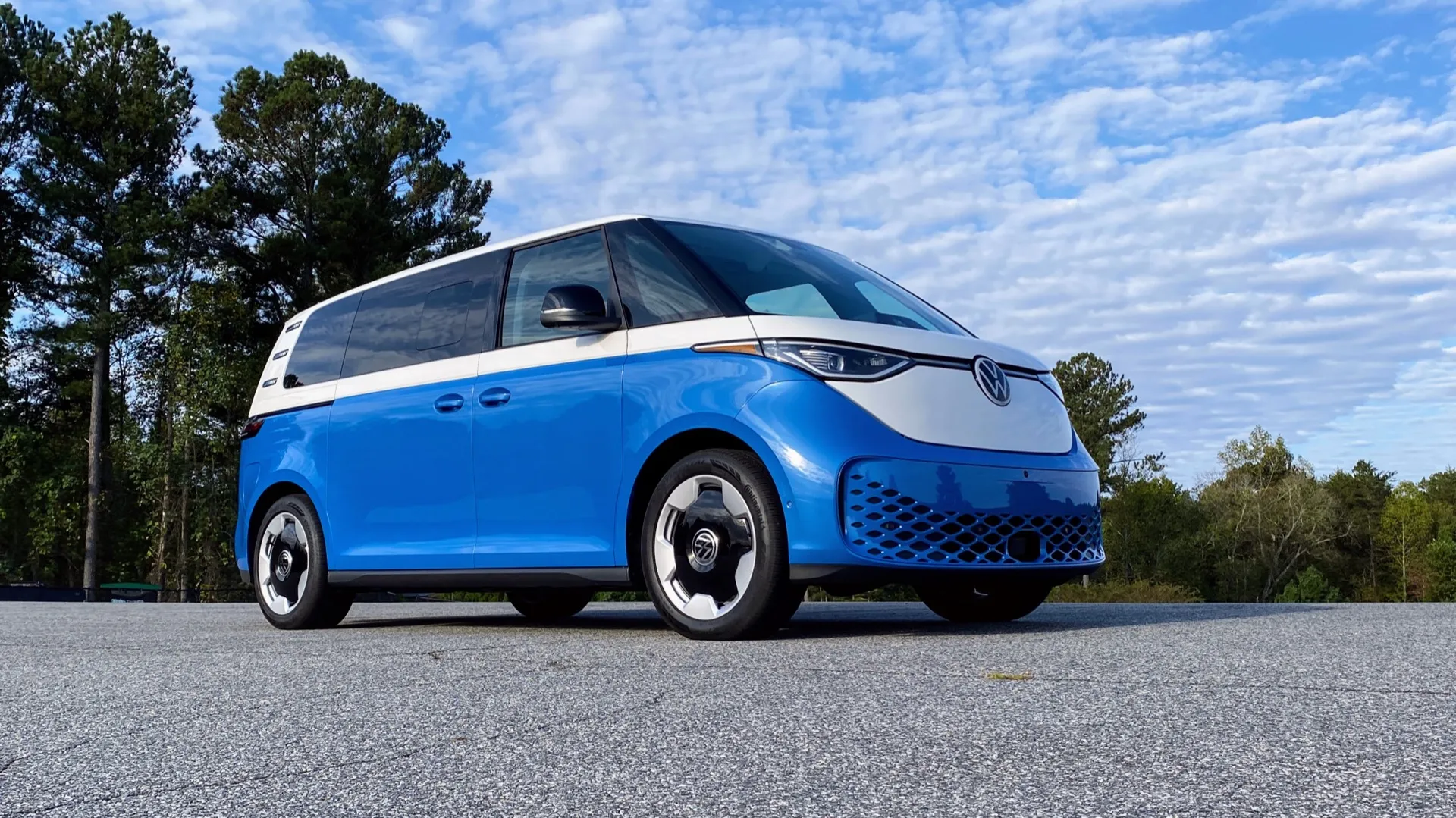
The long-anticipated arrival of the 2025 Volkswagen ID. Buzz in the United States marks a pivotal moment for the German automaker as it attempts to blend its storied heritage with an ambitious electric future. Decades after the original Type 2 Microbus became a global symbol of counterculture and freedom, its spiritual successor has finally reached American shores in a specifically tailored, long-wheelbase format. While the vehicle has been met with significant consumer enthusiasm across diverse demographics, its market positioning as a premium, niche offering at a time of fluctuating electric vehicle (EV) demand presents a complex challenge for Volkswagen of America.

A Chronology of Anticipation: From Concept to Production
The journey of the ID. Buzz to the U.S. market has been characterized by a series of conceptual teases and significant delays. The lineage of the modern electric bus can be traced back to the 2001 Microbus Concept, which generated immense excitement but never reached production. This was followed by the Bulli concept in 2011 and the BUDD-e in 2016. However, it was the 2017 North American International Auto Show in Detroit where the ID. Buzz concept finally debuted on the Modular Electric Drive Matrix (MEB) platform, promising a production reality.
While a short-wheelbase version of the ID. Buzz has been on sale in Europe since 2022, Volkswagen executives made the strategic decision to delay the U.S. launch to ensure the vehicle met American requirements for space and power. This resulted in a two-year waiting period during which the vehicle was stretched by nearly 10 inches to accommodate a three-row seating configuration and a larger battery pack. This localized development included the integration of a new infotainment system, improved software, and the more powerful AP550 rear electric motor.
Technical Specifications and Powertrain Dynamics
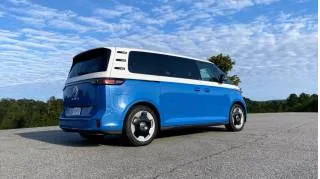
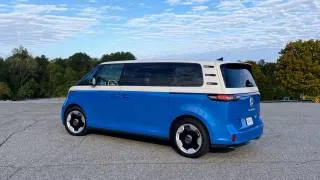
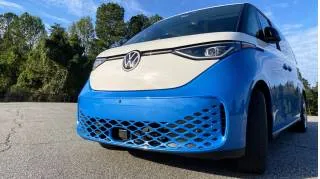
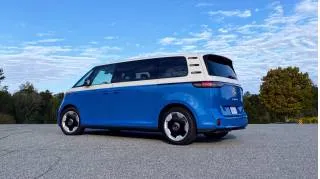
The U.S.-spec ID. Buzz is built exclusively on a 127.5-inch wheelbase, with an overall length of 195.4 inches. Standing 76.2 inches tall, it is significantly larger than the ID.4 crossover, providing the cavernous interior space expected of a van. Despite its retro silhouette, the vehicle achieves a respectable coefficient of drag of 0.29, aided by a streamlined front end and flush-mounted windows.

Under the floor lies a 91-kWh lithium-ion battery pack, an upgrade from the 82-kWh pack found in European models. The rear-wheel-drive (RWD) variants utilize Volkswagen’s latest electric drive unit, producing 282 horsepower and 413 lb-ft of torque. For those requiring more traction and power, the 4Motion all-wheel-drive (AWD) version adds an inductive motor to the front axle, bringing total system output to 335 horsepower.
Performance metrics are competitive for the segment. The RWD ID. Buzz reaches 60 mph in approximately 7.5 seconds, while the AWD version slashes that time to 6.0 seconds. Towing capacity is rated at 2,600 pounds for braked trailers. However, the vehicle’s substantial curb weight is a defining characteristic of its driving dynamics; the RWD model weighs nearly 6,000 pounds, while the AWD version exceeds 6,100 pounds. This mass results in a "heavy" driving feel, though the low center of gravity provided by the battery placement and precise steering ensures the van remains stable and predictable on the road.
Efficiency, Range, and Charging Infrastructure
The Environmental Protection Agency (EPA) has rated the RWD ID. Buzz at an estimated range of 234 miles per charge, while the AWD version is rated slightly lower at 231 miles. In real-world testing across varied terrains—including mountain passes and highways—the vehicle has demonstrated efficiency ratings between 2.4 and 2.6 miles per kWh. While these figures are sufficient for daily commuting and moderate trips, they trail some of the leading electric three-row SUVs currently on the market.
Charging capabilities are a highlight of the ID. Buzz’s technical suite. The vehicle supports DC fast charging at rates of up to 200 kW, allowing the battery to replenish from 10% to 80% in approximately 26 minutes. For home or destination charging, the 11-kW onboard charger provides a full recharge on a Level 2 station in about nine hours. To optimize charging speeds during transit, the native navigation system includes an automated battery preconditioning feature that warms or cools the pack as the vehicle approaches a designated charging station.

Interior Versatility and the Retro-Modern Aesthetic
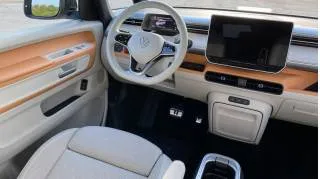
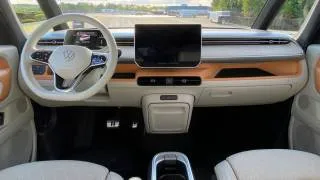
The ID. Buzz’s interior design is a departure from the minimalist, often stark interiors of many modern EVs. It prioritizes "retro-fun" without sacrificing utility. The three-row cabin can be configured to seat six or seven passengers, with the AWD version coming standard with second-row captain’s chairs. The interior is characterized by an airy feel, aided by an optional 67-inch long electrochromic panoramic sunroof—the largest in the Volkswagen Group—which can transition from transparent to opaque at the touch of a button.
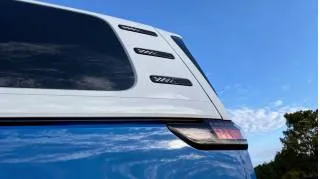
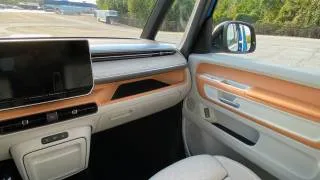
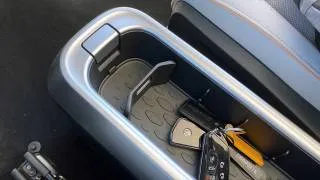
Storage solutions are abundant and modular. The "Buzz Box" center console is completely removable and features multiple drawers and compartments. The dashboard includes a dedicated tray for small items and a wireless charging shelf designed to keep smartphones secure during transit. Tech-wise, the van is equipped with eight USB-C ports distributed across all three rows, ensuring all passengers remain connected.
The cargo area features a sturdy, hinged "Flexboard" that creates a flat loading floor when the rear seats are folded. While the third-row seats are removable to maximize cargo volume, they are notably heavy, reflecting the vehicle’s robust build quality. Volkswagen claims the ID. Buzz offers more interior volume than its Atlas SUV despite having a smaller exterior footprint, positioning it as a highly efficient use of space for families.
Pricing Strategy and Market Positioning
Perhaps the most controversial aspect of the ID. Buzz’s U.S. launch is its pricing. The vehicle starts at $61,545 (including destination fees) for the base Pro S trim. The Pro S Plus trim begins at $65,045, and the limited 1st Edition models can reach upwards of $71,545.
To put this in historical context, the 1965 Volkswagen Microbus sold for approximately $2,550. When adjusted for inflation using the Consumer Price Index, that figure equates to roughly $25,400 in 2024 dollars. With a starting price more than double the inflation-adjusted cost of its ancestor, the ID. Buzz is clearly positioned as a premium lifestyle vehicle rather than a utilitarian "people’s car."
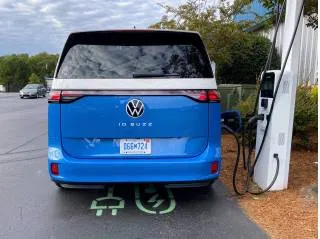
Further complicating the value proposition is the vehicle’s manufacturing origin. Because the ID. Buzz is currently produced in Hannover, Germany, it does not qualify for the $7,500 federal EV tax credit for outright purchases under the Inflation Reduction Act. However, consumers may be able to access these savings through lease incentives, as the "lease loophole" allows commercial entities (including captive finance arms) to claim the credit on imported vehicles and pass the savings to the lessee.

Broader Impact and Competitive Landscape
The ID. Buzz enters an increasingly crowded market for large electric family vehicles. Its primary competitors include the Kia EV9, which offers more range and a lower starting price, and the Rivian R1S, which provides superior off-road capability and performance. However, neither of these competitors possesses the cultural equity or the "smile factor" inherent in the Volkswagen brand.

Market analysts suggest that the ID. Buzz will serve as a "halo car" for Volkswagen, drawing foot traffic into dealerships and revitalizing interest in the brand’s ID. lineup. However, there is concern regarding the "niche" classification. By not producing the vehicle in the U.S. and maintaining a high price point, Volkswagen may be limiting the vehicle’s potential to achieve mass-market volume.
The success of the ID. Buzz will likely depend on whether the nostalgia it evokes can outweigh the pragmatic concerns of range and price for American buyers. In regions ranging from the suburbs of north Georgia to the coastal hubs of California, early reactions indicate that the demand is high, with the vehicle garnering attention from owners of everything from tattered pickups to high-end Teslas.

Conclusion: A High-Stakes Gamble on Nostalgia
The 2025 Volkswagen ID. Buzz is a testament to the power of design and brand heritage. It successfully translates the spirit of the 1960s into a functional, technologically advanced package for the 21st century. While it may not be the affordable "hippie bus" of the past, it remains a unique offering in a sea of homogenized SUVs. As Volkswagen navigates the complexities of the U.S. EV market, the ID. Buzz stands as a bold, if expensive, reminder of the company’s ability to capture the public imagination. Whether it remains a boutique novelty or evolves into a core pillar of VW’s American strategy will be determined by how many consumers are willing to pay a premium for a piece of modernized history.