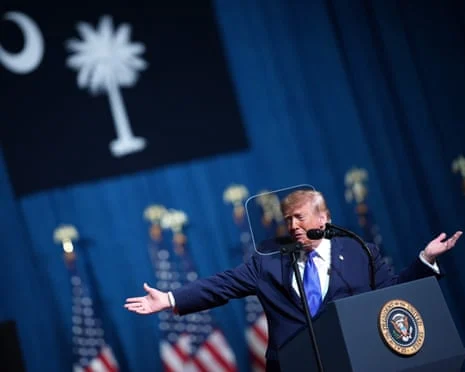
As the final stretch of the 2026 United States midterm elections intensifies, President Donald Trump has escalated his attacks on Democratic figures across the country. Speaking before an enthusiastic campaign audience in Rock Hill, South Carolina, the president reiterated his fiery demand that Democratic Senatorial candidate Mary Peltola face criminal prosecution and disqualification from the crucial Alaska Senate contest. The remarks underscore a turbulent political climate marked by aggressive rhetoric, high-stakes legal battles, and a deeply polarized electorate just days before voters head to the polls to decide the balance of power in Washington.
The core of Trump’s grievance centers on allegations of a deliberate "ballot-stacking" scheme orchestrated by Peltola’s campaign. According to recent reporting, Peltola’s team—alongside the Democratic Senatorial Campaign Committee (DSCC)—reportedly engaged in recruiting a retiree sharing the exact name of her Republican opponent, incumbent Senator Dan Sullivan, to run in the race. The inclusion of the secondary candidate, Dan J. Sullivan, was allegedly designed to siphon votes and confuse the electorate in Alaska’s ranked-choice voting environment.

"This is voter fraud at the highest level," Trump declared to the South Carolina crowd, pulling no punches. He asserted that Peltola and her associates "should be removed from the ballot and prosecuted, and so should the fake Dan Sullivan." Emphasizing the gravity of his accusations, the president added, "I think it’s a criminal act, what they did."
Chronology of the Alaska Senate Controversy and Legal Escalations
The controversy surrounding the Alaska Senate race has steadily intensified over several months, shifting from partisan bickering into tangible legal and executive inquiries.
- Summer 2026: Rumors and initial allegations surfaced accusing Democrats of attempting to manipulate the ballot by recruiting independent or minor candidates with identical names to incumbent Republicans.
- Late October 2026: Investigative reporting from outlets like The New York Times brought forth documentary evidence, text messages, and accounts from former campaign staffers indicating that Peltola’s team and national Democratic committees were indeed involved in encouraging the secondary Dan Sullivan to enter the race.
- October 28–29, 2026: Following the public disclosures, Alaska’s Republican Governor, Mike Dunleavy, formally ordered a state investigation into whether the Peltola campaign’s actions crossed legal boundaries regarding election integrity. Simultaneously, high-ranking Republicans, including Vice President JD Vance and senior Senator Lisa Murkowski, weighed in, though with varying degrees of severity regarding potential legal consequences.
Governor Dunleavy defended the state inquiry in a public statement on social media, writing, "Deliberately tricking voters into casting their ballots for someone else strikes at the integrity of our elections. Anyone or any organization found to have broken the law must be held accountable."

While Governor Dunleavy and President Trump have pushed for severe legal repercussions, other members of the GOP have adopted a more measured stance. Senator Lisa Murkowski, a moderate Republican from Alaska known for occasionally breaking with party leadership, condemned the tactic as "simply wrong" and stated that candidates should win based on their merits, policy ideas, and accomplishments. However, Murkowski stopped short of endorsing Trump’s calls for immediate disqualification or criminal indictments.
Similarly, Vice President JD Vance, speaking to reporters on the tarmac while en route to a campaign event in Texas, supported the call for a thorough investigation into potential election fraud. "She is trying to steal a Senate seat from the voters of Alaska, and it’s disgraceful," Vance remarked, echoing the sentiment that the maneuver represents a profound moral failing, even if the precise legality of candidate recruitment tactics remains a gray area under federal election law.
A Backdrop of Nationwide Midterm Tensions
The fiery rhetoric in South Carolina did not occur in a vacuum. The 2026 midterm elections have brought forth a cascade of unprecedented legal confrontations and administrative maneuvers between the White House and state-level election officials.
Earlier in the week, a federal judge in California rebuffed a request from the Trump administration’s Department of Justice to force local election officials to set aside and segregate roughly 20,000 ballots belonging to individuals the administration claimed were non-citizens. U.S. District Judge David Carter strongly criticized the Justice Department’s pre-election intervention, writing that "never before in American history has the federal government, on the eve of an election, sought to coerce a state and local government to abandon their own Constitutional elections procedures." Despite the ruling, reports surfaced that the administration has continued issuing grand jury subpoenas to local California election officials as part of a broader strategy to challenge the legitimacy of outcomes in Democratic-led states.
Meanwhile, the national polling landscape paints a volatile picture. Recent CNN polling data indicates that Democrats maintain significant leads in major Senate races in Texas and Michigan, threatening traditional Republican strongholds. Conversely, traditionally safe red states like Kansas have evolved into fiercely competitive battlegrounds, prompting shifts in campaign schedules. President Trump notably canceled an in-person appearance at a rally in Salina, Kansas, opting instead to deliver a remote tele-rally for embattled incumbent Senator Roger Marshall, while shifting his physical presence to states like South Carolina and Florida.
Broader Implications for Election Integrity and Future Governance
The fierce dispute over candidate recruitment in Alaska and the escalating rhetoric surrounding electoral legitimacy highlight a growing vulnerability in American election administration. While strategic candidate recruitment—often colloquially termed "spoiler candidates" or ballot-stacking—has historical precedents across the American political spectrum, the modern application within hyper-polarized, closely contested legislative races has drawn intense scrutiny.

Legal experts note that while underhanded or deceptive political tactics are widely criticized from an ethical standpoint, prosecuting candidates for encouraging eligible citizens to exercise their legal right to run for public office presents steep constitutional hurdles under the First Amendment. Nevertheless, the willingness of executive branch officials, state governors, and national party leaders to leverage the machinery of the justice system and state investigative bodies signals a profound transformation in how electoral disputes are handled.
As the nation counts down the final days before the 2026 congressional midterms, the battles in Alaska, California, Texas, and beyond will not only determine control of the House and Senate for the remainder of the presidential term, but will also establish formidable precedents for the future of democratic norms, campaign ethics, and election oversight in the United States.